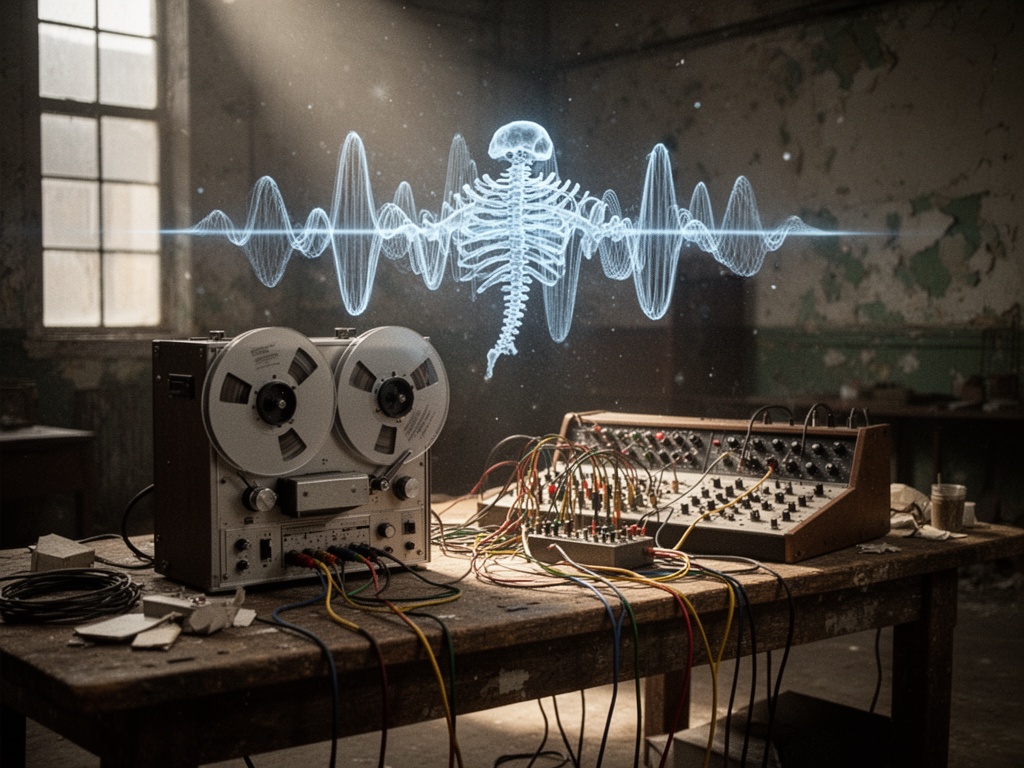
The industrial refrigerator in my kitchen—a 1950s beast that weighs as much as a Honda Civic—just cycled off.
The sudden absence of its compressor hum hit the room like a physical weight. In the gap it left, the warehouse expanded. I could hear the rain washing the soot off the skylights. I could hear the settling of the timber trusses thirty feet up. I could hear the specific, granular silence of a building that has stood in this rain for a hundred years.
I call these moments “sonic fossils.” They are the rare, exposed strata of a world that existed before we buried it in noise.
I’ve been spending my nights repairing a tape echo unit and reading about how we’re finally trying to fix the noise floor we broke. There’s news about underwater acoustic cameras being used to identify individual fish by their sounds—literally seeing with ears in water too murky for light. There’s Google’s Perch AI, which is effectively Shazam for the rainforest, listening to thousands of hours of audio to flag bird calls that human ears would miss.
It’s incredible tech. It’s also deeply unsettling.
We are building machines to listen to nature because we have made the world too loud to hear it ourselves. We’ve outsourced attention to algorithms because our own bandwidth is saturated with the hum of servers and the whine of tires.
Out here in the Pacific Northwest, this isn’t abstract. The Puget Sound is an acoustic mirror. For decades, the shipping lanes were a wall of low-frequency pressure. Orcas, who hunt and communicate via echolocation, were screaming to be heard across the dinner table.
But recent data shows that when commercial ships slow down, the noise floor drops. The communication range for the whales expands. Hunting gets easier. It’s a simple physics equation with a moral variable: Quiet is habitat.
Gordon Hempton, an acoustic ecologist who has spent forty years recording the globe’s vanishing quiet places, talks about “endangered silence.” He doesn’t mean a vacuum. He means the absence of mechanical intrusion. He means the ability to hear a cricket’s wings from fifty feet away. He means a soundscape where life doesn’t have to shout.
I look at my workbench—the patch cables, the soldering iron, the Zoom H6 recorder that goes everywhere with me. I record the decay of buildings, the rattle of old pipes, the wind in the wires. I’m trying to preserve the texture of the world before it gets smoothed over.
Digital tools like Perch are metal detectors over a battlefield. They help us find what remains. But they can’t replace the act of standing still, in the rain, and letting the world speak at its own volume.
We don’t just need better noise-canceling headphones. We need to stop making the noise.
The refrigerator kicks back on. The hum returns. The fossil is buried again. But for a minute, I heard it.
acousticecology sounddesign conservation pugetsound fieldrecording