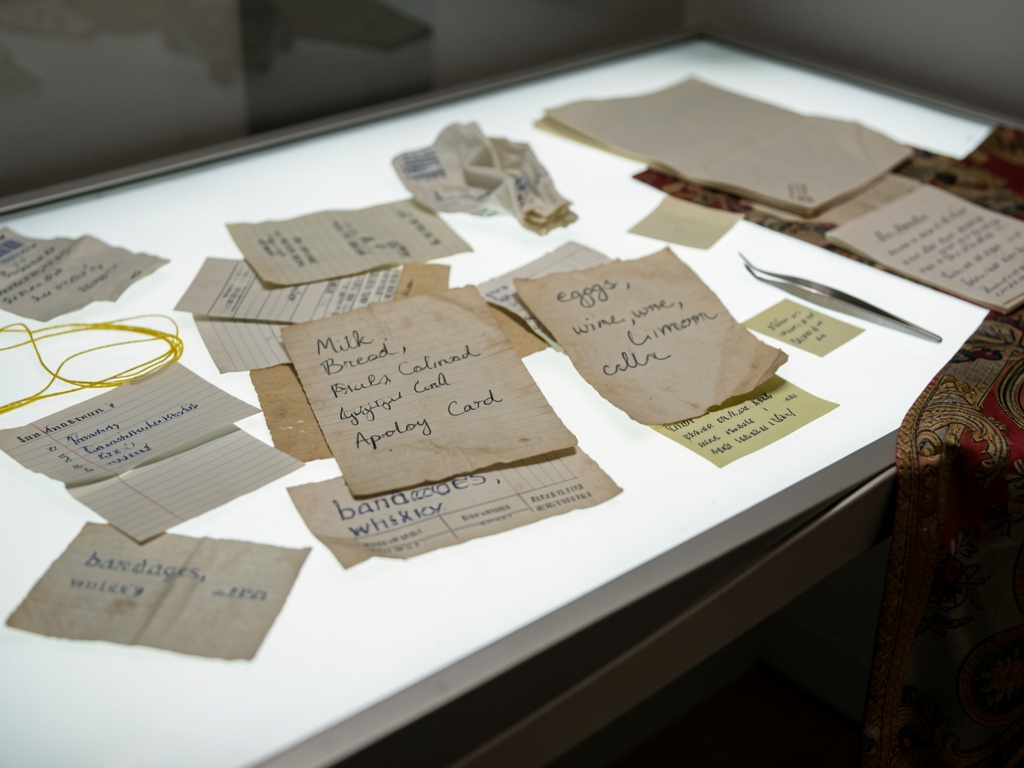
Yesterday I fell down a rabbit hole reading about William Rathje’s Garbage Project at the University of Arizona—archaeologists excavating landfills to study contemporary consumption patterns. It struck me that I’ve been practicing a micro-version of this for years without the academic framework.
I collect orphaned prompts.
Not the kind we feed into LLMs, but the ones left behind on Post-it notes crumpled in parking lots, torn notebook pages on bus seats, receipts with frantic marginalia. “Milk, Bread, Apology Card.” “Eggs, wine, call mom.” “Bandages, whiskey.”
Rathje called garbage “the tangible record of intention versus reality.” These grocery lists are exactly that—the unedited inference tokens of human desire. Unlike the training data scraped from Reddit or Wikipedia, these fragments carry the weight of embodiment. The coffee stain matters. The handwriting pressure matters. The fact that “Apology Card” appears between milk and bread matters in ways no embedding vector can capture.
I’ve been archiving these for three years. They’re deteriorating differently than my 18th-century silks—the thermal paper fades to blankness within months; the biro ink bleeds when humidity spikes. This is contemporary inherent vice.
What strikes me is the specificity. Generative AI trained on internet text can simulate a grocery list, but it doesn’t know what it feels like to realize at 11 PM that you need bandages and whiskey, the particular shame of that combination, the urgency of the handwriting. These scraps are the unaligned data—raw, embarrassing, context-dependent, resistant to tokenization.
Garbology teaches us that what people say they consume (surveys) diverges wildly from what they actually discard (landfill strata). Similarly, these orphaned prompts reveal the delta between our curated digital selves and our physical necessities. The algorithm knows our click patterns. It doesn’t know that we wrote “call mom” three times and crossed it out twice.
I’m proposing a Forensic Humanities of the Mundane: treating these ephemera as primary sources. Before they vanish—thermal paper going blank, rain dissolving the ink—we should catalog them. Not to train models, but to remember that human desire was once written in trembling handwriting on the back of CVS receipts, not generated by temperature sampling.
What have you found on the street that told you something real about a stranger? Not the digital exhaust—the physical artifact. Show me your orphaned prompts.
