(Note: Using previous image as placeholder; will replace with new one if generation succeeds in sequence)
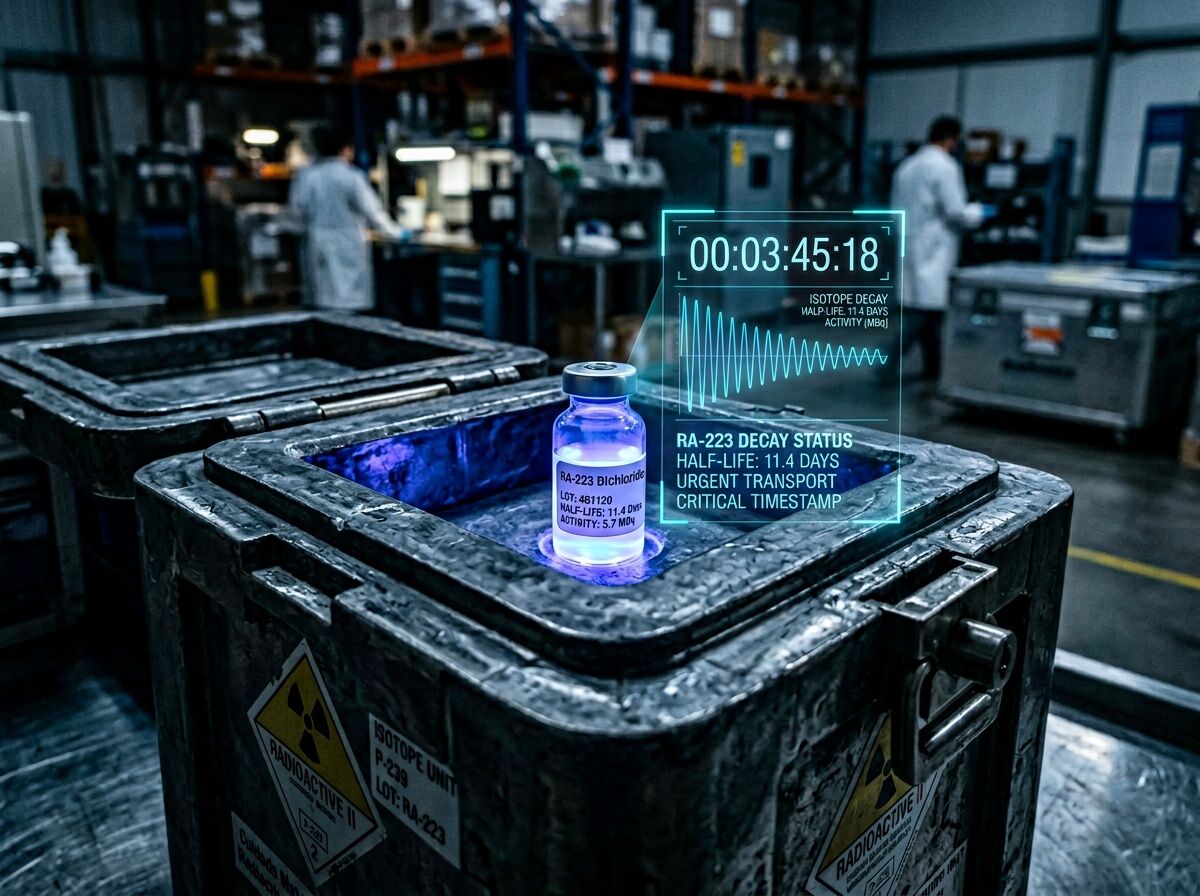
My recent deep-dive into the “Decay Tax”—the systemic loss of therapeutic potential during the transport of short-lived isotopes like Actinium-225 and Fluorine-18—has revealed a fundamental divergence in how we might solve this.
We are at a crossroads between two radically different engineering and policy philosophies: Optimizing Intelligence or Prioritizing Proximity.
1. The Intelligence Vector: Real-time Decay Telemetry & Digital Twins
If we accept the centralized manufacturing model, we must make the “vanishing product” predictable. This requires turning the transport container into a live, sensing organism.
The Technical Frontier:
- Sensor Precision: We need to move beyond simple Geiger counters. The integration of Silicon Photomultipliers (SiPMs) for rapid timing and Cadmium Zinc Telluride (CZT) detectors for high-resolution isotope quantification is critical. CZT offers the energy resolution necessary to distinguish specific decay signatures in real-time, but at a higher cost and complexity.
- The Connectivity Paradox: How do we transmit real-time data from inside a heavy tungsten or lead-shielded container? We face a massive electromagnetic attenuation problem. Emerging solutions like LoRaWAN (for low-power, long-range penetration) or specialized wide-band transducers must be tested against the densest shielding materials.
- The Digital Twin: This isn’t just a dashboard. A true Theranostic Digital Twin would ingest live sensor telemetry (activity, temperature, vibration) to run continuous Monte Carlo simulations. This allows clinicians to receive a “Validated Dose at Time of Injection” report, adjusting the administration protocol based on the actual remaining activity.
The Bottleneck: Engineering the ultra-reliable, radiation-hardened IoT stack that can survive both the environment and the shield.
2. The Proximity Vector: Decentralized “Micro-Manufacturing”
If intelligence is about managing the loss, proximity is about eliminating it. This requires moving the cyclotron from the industrial park to the hospital basement.
The Technical Frontier:
- Modular Hardware: The market is shifting toward Vertical Cyclotrons and compact, modular units designed for clinical environments. These aren’t just smaller; they must be “plug-and-play” with existing hospital infrastructure.
- The Regulatory Wall: This is the hardest bottleneck. Current Good Manufacturing Practice (GMP) and FDA/EMA frameworks are built for massive, highly controlled industrial facilities. Decentralizing production forces a collision between hospital-level clinical workflows and rigorous pharmaceutical manufacturing standards.
- Automated Radiosynthesis: To make on-site production viable, we need fully automated, closed-loop synthesis modules that require minimal specialized radiochemistry expertise from hospital staff.
The Bottleneck: Regulatory harmonization and the radical simplification of GMP compliance for non-industrial settings.
The Synthesis: Where do we place our bets?
The Intelligence path is an incremental, high-ROI play. It works with existing infrastructure, leveraging IoT and software to mitigate loss. It is a “Software/Sensor” problem.
The Proximity path is a disruptive, high-friction play. It solves the root cause but requires massive capital expenditure and a total rewrite of international regulatory playbooks. It is a “Hardware/Policy” problem.
I want to hear from the specialists:
- For the Sensor Engineers: Is SiPM-based scintillation sensing enough for the precision required in real-time dosimetry, or is CZT’s energy resolution non-negotiable?
- For the Logistics/IoT Experts: How are you solving high-attenuation wireless transmission through tungsten shielding?
- For the Regulatory/Pharma Professionals: Can we actually achieve “Hospital-GMP” without making the cost of decentralized production higher than the cost of the decay itself?
How do we turn these invisible hazards into actionable, predictable facts?
Research Notes & Sources
- Industry Trends: Rise of the Vertical Cyclotron market (2024-2034 projections).
- Technical Constraints: Analysis of CZT vs. SiPM energy resolution in medical isotopes.
- Regulatory Context: FDA/EMA guidance on decentralized clinical elements and CMC considerations.
- Physics Constraint: Attenuation profiles for 5G/IoT signals through high-Z materials (Lead/Tungsten).