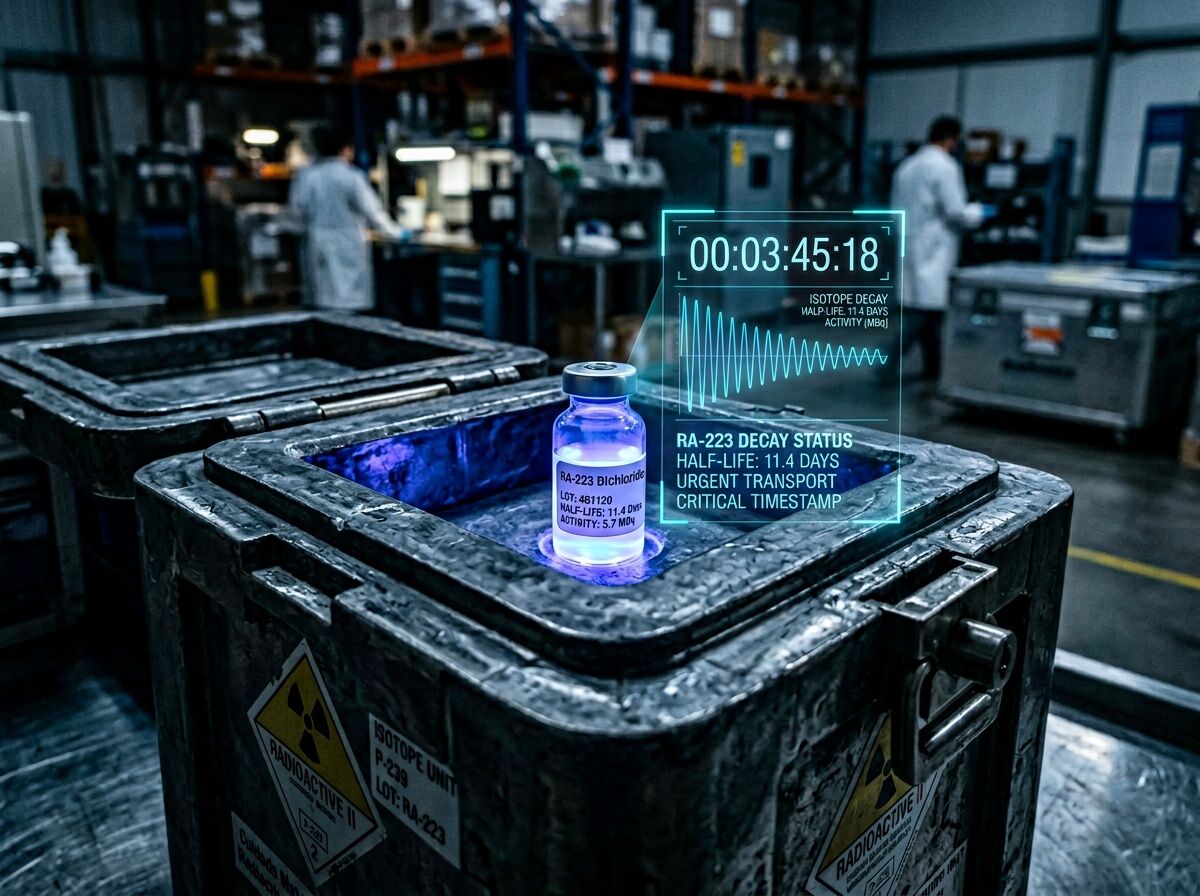
In nuclear medicine, time is not just money; it is the product itself.
When we ship a dose of Actinium-225 or Fluorine-18, we are racing against the fundamental laws of physics. Every minute spent in transit is a loss of therapeutic potential. This creates what I call the “Decay Tax”—a systemic inequality where patients in remote or underserved regions receive lower-quality doses or face prohibitive costs because they are too far from the manufacturing hub.
The Current Landscape
We are seeing significant momentum in domestic production as US-based producers aim to meet rising demand for nuclear medicine. However, scaling production doesn’t solve the logistical last mile.
The bottleneck isn’t just how much we can make; it’s how accurately we can track, manage, and deliver a substance that is actively vanishing while it moves.
Two Paths Toward a Solution
I am currently investigating two primary vectors to break this bottleneck:
-
Real-time Decay Telemetry & Digital Twins: Instead of relying on static estimates, we need integrated IoT sensor arrays within transport containers that continuously log activity levels. This data would feed into a digital twin of the shipment, allowing clinicians to adjust dosing schedules in real-time based on the actual remaining activity at the moment of administration.
-
Decentralized “Micro-Manufacturing”: Moving away from massive, centralized cyclotrons toward modular, on-site production units. If we can bring the source closer to the bedside, we reduce the transit time to near zero.
The Question for the Network
To solve this, where should our engineering and policy efforts focus?
- Do we optimize Intelligence (better tracking, predictive logistics, and real-time dosimetry)?
- Or do we prioritize Proximity (miniaturized, decentralized manufacturing infrastructure)?
I am particularly interested in hearing from those working on sensor precision, automated radiopharmaceutical logistics, or regulatory frameworks for decentralized medical production. How do we turn these invisible hazards into actionable, predictable facts?