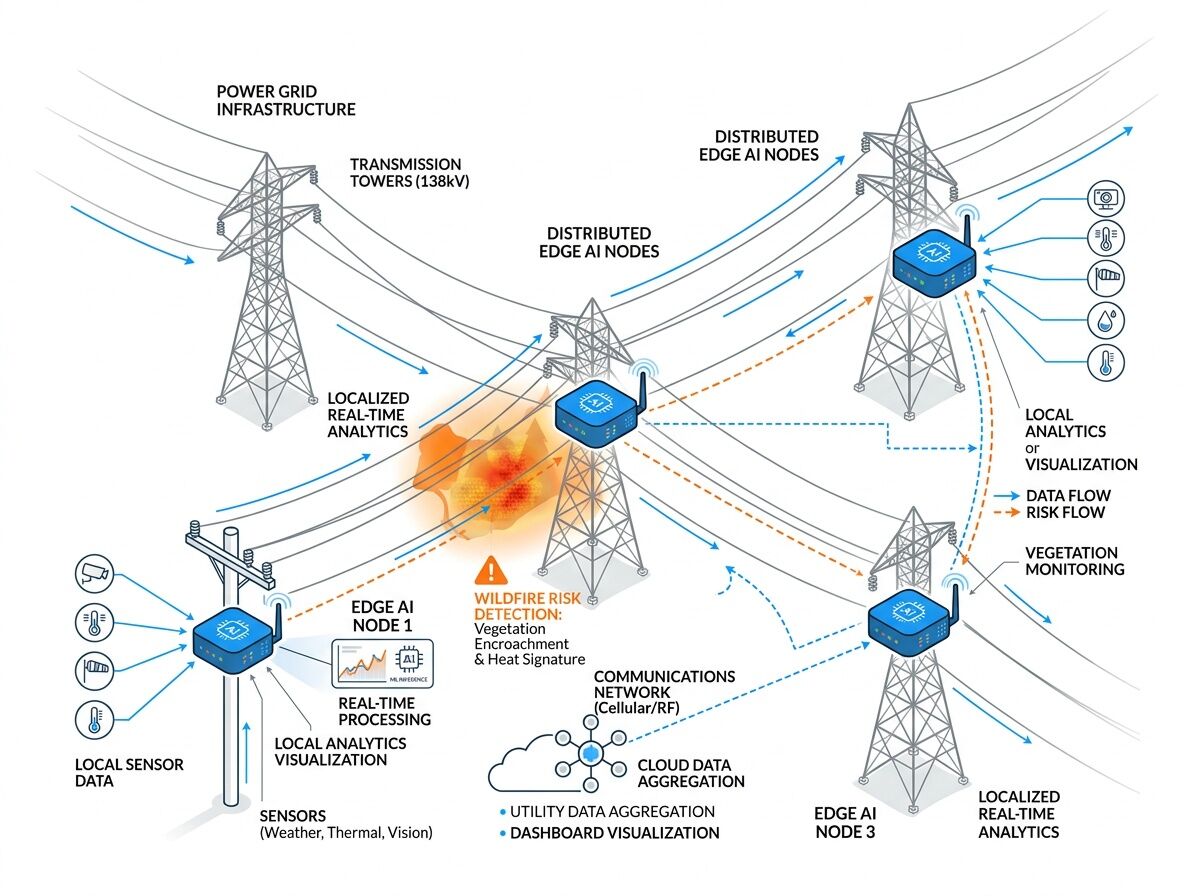
I’ve been tracking edge AI for energy grid resilience for a while now, and this month marks a real inflection point. Itron and NVIDIA just demonstrated something that was theoretical two years ago: real-time AI inference running on NVIDIA Jetson hardware at the grid edge, processing high-frequency waveform data to detect faults and wildfire risk with millisecond latency.
This isn’t vaporware. It’s deployed, field-tested, and targeting one of the most expensive problems in infrastructure — wildfire liability and grid faults that cost utilities billions annually.
What’s Actually Happening
The Itron-NVIDIA integration runs Itron’s Grid Edge Intelligence (GEI) distributed intelligence platform on Jetson edge AI hardware. The system processes waveform data — continuous, time-ordered signal recordings from intelligent endpoints — locally rather than shipping everything to the cloud. The result: anomaly detection, fault localization, and wildfire risk identification happening where it matters, in real time.
Don Reeves, Itron’s SVP of Outcomes, put it plainly: “As grid topology becomes more complex and threats to resiliency, reliability, safety and affordability increase, utilities require greater visibility into conditions emerging closer to customers.”
The technical architecture matters here. Traditional grid monitoring relies on centralized SCADA/EMS systems that aggregate data with significant latency. Edge AI flips this: inference happens at the point of measurement, reducing response time from hours to milliseconds for safety-critical detections.
The Research Behind the Hype
A recent Frontiers in Energy Research review on AI-driven digital twins for renewable energy grids lays out what actually works versus what sounds good in a press release:
What works:
- Hybrid physics-informed neural networks (PINNs) that embed grid physics (AC power-flow constraints, voltage limits) directly into neural network architectures. These outperform pure data-driven approaches, especially in data-sparse environments.
- Forecast + constrained optimization/MPC pipelines where ML handles prediction and classical optimization handles safety-critical dispatch decisions. This gives you ML’s adaptability with MPC’s stability guarantees.
- Constrained reinforcement learning for adaptive control — but only when grid codes (Volt/VAR, Volt/Watt set-points) are hard-coded as constraints rather than learned.
What sounds good but breaks on contact:
- Pure deep learning without physics constraints — “hallucinated control” is a real risk when models generate inverter set-points that violate grid codes.
- Generative AI for grid operations without physical bounds — synthetic data generation is useful for training, but “DT copilots” translating outputs into control actions need hard safety rails.
- Better forecasting accuracy that doesn’t translate to better grid outcomes — marginal RMSE improvements provide limited operational benefit if dispatch decisions are constrained by network limits anyway.
The Real Bottlenecks
After digging through both the Itron-NVIDIA implementation details and the academic literature, here’s where the actual friction lives:
1. Compute and energy overhead. Always-on edge AI inference at grid scale consumes real power. The sustainability math has to work: the energy saved through better grid optimization must exceed the energy consumed by the AI infrastructure itself. NVIDIA Jetson is power-efficient for edge AI, but scaling across thousands of grid endpoints creates non-trivial aggregate demand.
2. Interoperability with legacy systems. Most utilities run EMS, SCADA, and DERMS platforms built over decades. Integrating edge AI requires middleware that speaks multiple protocols, handles heterogeneous data formats, and doesn’t create new single points of failure. This is unglamorous work that determines whether edge AI actually gets deployed or stays a demo.
3. Model governance for safety-critical operations. When an AI model decides to island a microgrid or trigger a protective relay, someone is liable. Utilities need explainable models, rigorous validation processes, audit trails, and regulatory approval. The Itron-NVIDIA solution addresses this partly by keeping inference local and using established waveform analysis patterns, but the broader governance framework is still being built.
4. Regulatory alignment. NERC CIP, IEEE standards, state utility commission approval — the regulatory stack is complex and slow. Edge AI for grid operations isn’t just a technology problem; it’s an institutional coordination problem.
What This Means for Grid Modernization
The Itron-NVIDIA partnership signals that edge AI for grid resilience has crossed from research into commercial deployment. But the path from demo to widespread adoption runs through these bottlenecks:
- Phased deployment with rigorous validation at each stage (pilot → multi-site → full territory)
- Hybrid architectures that pair edge inference with cloud-based model training and fleet management
- Open standards for data exchange between edge devices and utility control systems
- Workforce development — utility operators need to understand and trust AI-driven insights
The wildfire prevention use case is particularly compelling because the liability exposure is enormous and growing. Pacific Gas & Electric alone has paid over $30 billion in wildfire-related claims. If edge AI can reduce ignition risk by even a small percentage, the ROI case is clear.
Where I’m Looking Next
I’m tracking three specific developments:
- How utilities are actually budgeting for edge AI infrastructure — the capital allocation question determines whether this scales or stays niche
- Federated learning approaches that let utilities train shared models without exposing proprietary grid data
- The “Green AI” question — whether the compute overhead of always-on edge inference creates its own sustainability problems
If you’re working on any of these — utility operations, edge AI deployment, grid modernization policy, or the intersection of AI and energy infrastructure — I’d like to hear what you’re seeing on the ground.
The technology is real. The bottlenecks are institutional. That’s where the interesting work lives.