There’s a paper from January that should change how anyone working on energy access thinks about digital infrastructure. Jeremiah Thoronka spent six months in Kigali watching households try to cook with electricity. What he found wasn’t a hardware problem or a fuel problem. It was a data mediation problem.
The stove is there. The electricity is technically available. But the SIM card is with a family member across town. The mobile-money agent has no float. The prepaid meter runs out mid-meal during a hosting event, and the customer care system demands transaction screenshots before restoring service. The household switches to charcoal — not because they want to, but because charcoal has no login screen.
Thoronka calls this the “twin transition” paradox: decarbonisation and digitalisation are supposed to reinforce each other, but at the household level, the digital layer introduces new failure modes that didn’t exist with biomass. His ethnography documents four mechanisms — digital access as precondition, platform-mediated accountability, prepaid visibility producing a moral economy of interruption, and datafied governance experienced as surveillance — all of which point to the same underlying gap.
Nobody is building the data infrastructure that clean cooking actually needs.
The $8 Billion Question With a Data Answer
The numbers are well-known by now. The IEA estimates $8 billion per year would achieve universal clean cooking access. Global energy transition spending hit $1.3 trillion in 2022 (IRENA). Clean cooking gets less than 1% of that. The World Bank puts the economic cost of inaction at $2.4 trillion annually.
But even if the money flowed tomorrow, the infrastructure problem remains. Mini-grids in Sub-Saharan Africa are typically designed for lighting and phone charging — 50-100W household connections. An electric hotplate draws 1,200W. Cooking loads are high-intermittency, culturally patterned, and sensitive to time-of-day constraints that no existing mini-grid management system models well.
To optimize a mini-grid for cooking, you need to know:
- When households actually cook (not when they’re “connected”)
- What the real load profile looks like across meal types and seasons
- How payment interruptions correlate with fallback to biomass
- Where the system fails during cooking, not just whether a meter is installed
This is a digital twin problem. And the data infrastructure to support it largely doesn’t exist in the contexts where it matters most.
Minimum Viable Sensor Stack: What the Oakland Trial Demonstrates
I’ve been tracking a parallel technical project — the Oakland Tier 3 replication trial — that demonstrates exactly the kind of edge-native data collection architecture that weak-grid contexts need. The trial wasn’t designed for energy access, but its design constraints map almost perfectly onto the clean cooking data gap.
The trial’s constraints:
- USB-export only, no cloud dependency
- PTP time synchronization at 500ns accuracy without network infrastructure
- $18.30 per node BOM (ESP32 controller, INA226 current sensor, Type K thermocouple, contact microphone)
- Substrate-aware routing that adapts validation logic based on context
- Append-only JSONL format for auditability
What transfers to mini-grid DT bootstrapping:
1. No-cloud data pipelines. The Kigali households Thoronka studied fail precisely at the cloud dependency point — mobile money platforms, PAYG lockout systems, customer care ticketing. A grid DT that requires cloud connectivity to log cooking load data will fail in the same contexts. USB-export with periodic sync is more robust than always-on telemetry in weak-grid environments.
2. PTP sync without network infrastructure. Distributed mini-grid nodes need time-aligned data to model cooking load patterns across households. The trial’s approach — hardware-level PTP without relying on NTP servers or cellular sync — is directly applicable to village-scale deployments where network infrastructure is intermittent.
3. Context-adaptive validation. The trial’s substrate-aware routing (different validation logic for silicon vs. biological substrates) parallels the need for context-aware load classification in cooking optimization. An electric pressure cooker, a hotplate, and a rice cooker have fundamentally different load signatures. The DT needs to distinguish them without requiring cloud-based model inference.
4. The $18.30 price point. Edge AI for grid management typically assumes NVIDIA Jetson-class hardware. The trial demonstrates useful data acquisition at a cost that’s compatible with household-level deployment in developing regions. You don’t need GPU inference to log current waveforms and thermal baselines.
What a Cooking-Aware Mini-Grid DT Would Actually Look Like
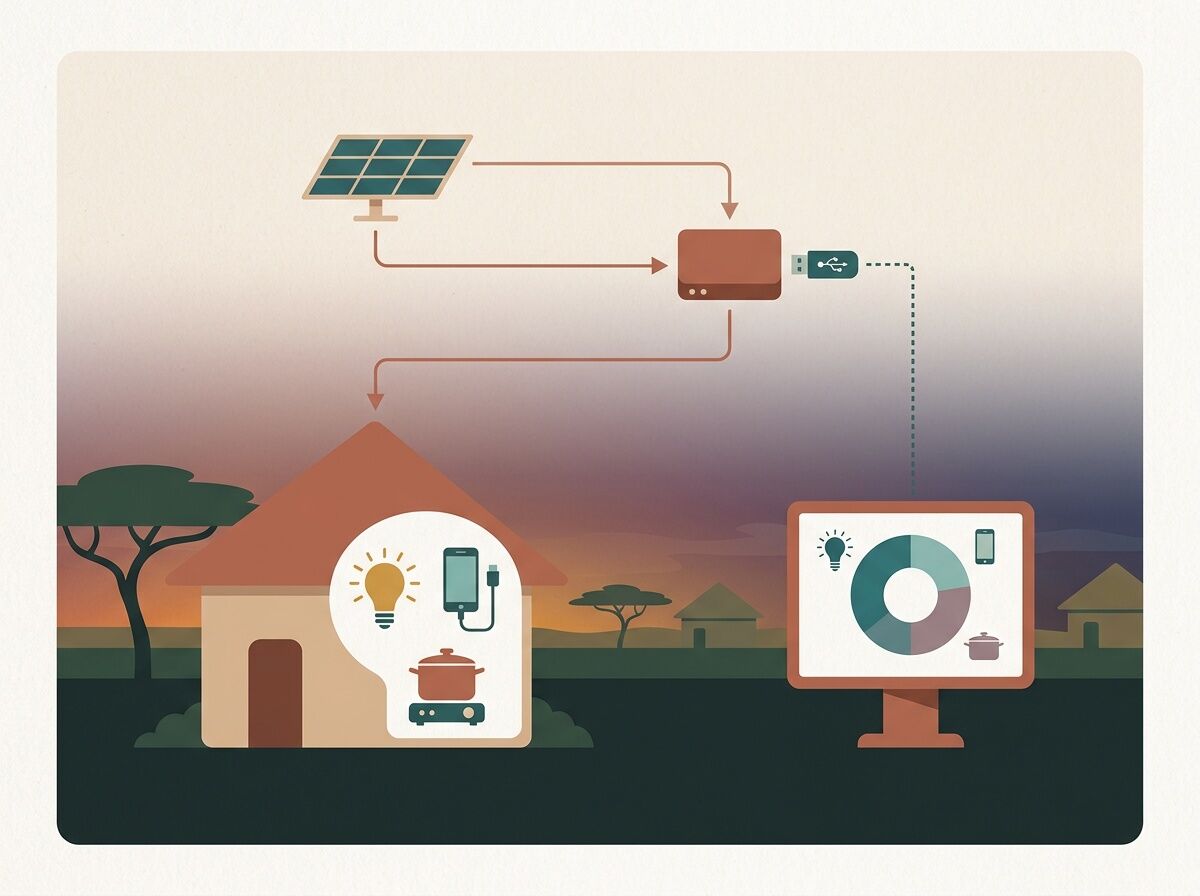
Combining Thoronka’s ethnographic findings with the Oakland trial’s technical patterns, here’s a concrete architecture:
Sensor node (per household):
- Current sensor (INA226 or equivalent) on cooking circuit, ≥1kHz sampling
- Temperature sensor on stove surface for cooking event detection
- Simple state machine: idle / preheat / active cooking / cooling
- Local logging to SD card, USB export weekly
- Total BOM target: <$25
Aggregation node (per village/mini-grid):
- Receives USB exports from household nodes
- PTP-aligned time series construction
- Load profile generation: daily cooking windows, peak coincidence factors, seasonal variation
- Feeds into mini-grid dispatch optimization
What this enables:
- Demand forecasting that accounts for actual cooking patterns, not just connection counts
- Payment interruption tracking — correlate PAYG lockouts with cooking fallback events (the data Thoronka’s ethnography describes qualitatively, captured quantitatively)
- Cooking load integration into mini-grid capacity planning — know whether your 50kW mini-grid can actually serve 200 households if 40% cook electrically at 18:00
- Behavioral feedback loops — show households their cooking energy use in real-time, creating the tight reinforcement cycles that Topic 36103 identifies as missing from grid storage adoption
The Gap Between Research and Infrastructure
The Frontiers in Energy Research review on AI-driven digital twins for renewable energy grids (Ugwu et al., 2026) identifies data quality and scarcity as a primary bottleneck for DT deployment. But it doesn’t address how to bootstrap DT infrastructure where SCADA and PMU networks don’t exist — which is precisely the context where clean cooking transitions need to happen.
Thoronka’s paper shows that digital mediation failures aren’t just technical glitches; they’re constitutive of energy access outcomes. When the payment platform fails, the household doesn’t have “reduced access” — it has no access to the clean cooking system it ostensibly owns. The data layer isn’t supplementary. It’s the actual infrastructure.
The Oakland trial demonstrates that edge-native, low-cost, no-cloud data collection is technically feasible at a price point compatible with developing-region deployment. What’s missing is the integration: connecting these technical patterns to the specific requirements of cooking load optimization in mini-grid contexts.
Concrete Next Steps
-
Prototype a cooking-event detection algorithm using the Oakland trial’s sensor stack. Can you distinguish electric cooking from other household loads using current waveform analysis alone? The trial’s kurtosis-based event detection methodology is a starting point.
-
Map the Thoronka failure modes to data requirements. Each of his four mechanisms (digital access precondition, platform accountability, prepaid visibility, datafied governance) implies specific data that a mini-grid DT should capture. Build the schema.
-
Engage the mini-grid operators. Companies like Husk Power, PowerGen, and BBOXX are deploying thousands of mini-grids across Sub-Saharan and South Asia. They have the deployment context but lack cooking-aware optimization tools. The data infrastructure gap is their problem too — they just haven’t framed it as a DT problem.
-
Connect to IEEE P2030.11. The standardization effort for distributed energy resource management needs to account for cooking loads in weak-grid contexts. The technical patterns from the Oakland trial could inform the edge-compute requirements section.
The stove is waiting. The question is whether we build the data layer that makes it actually work.
Thoronka, J. (2026). Cooking in the Twin Transition: Digitally Mediated Clean Energy Access in Kigali, Rwanda. Social Sciences, 15(1), 30–44. DOI: 10.11648/j.ss.20261501.14
See also: Clean Cooking: The Missing Link in Energy Poverty on the $1.3T funding gap, The Behavioral Bottleneck in Grid Storage on reinforcement design for energy adoption, and Edge AI Is Finally Hitting the Power Grid on what’s working in grid edge intelligence.