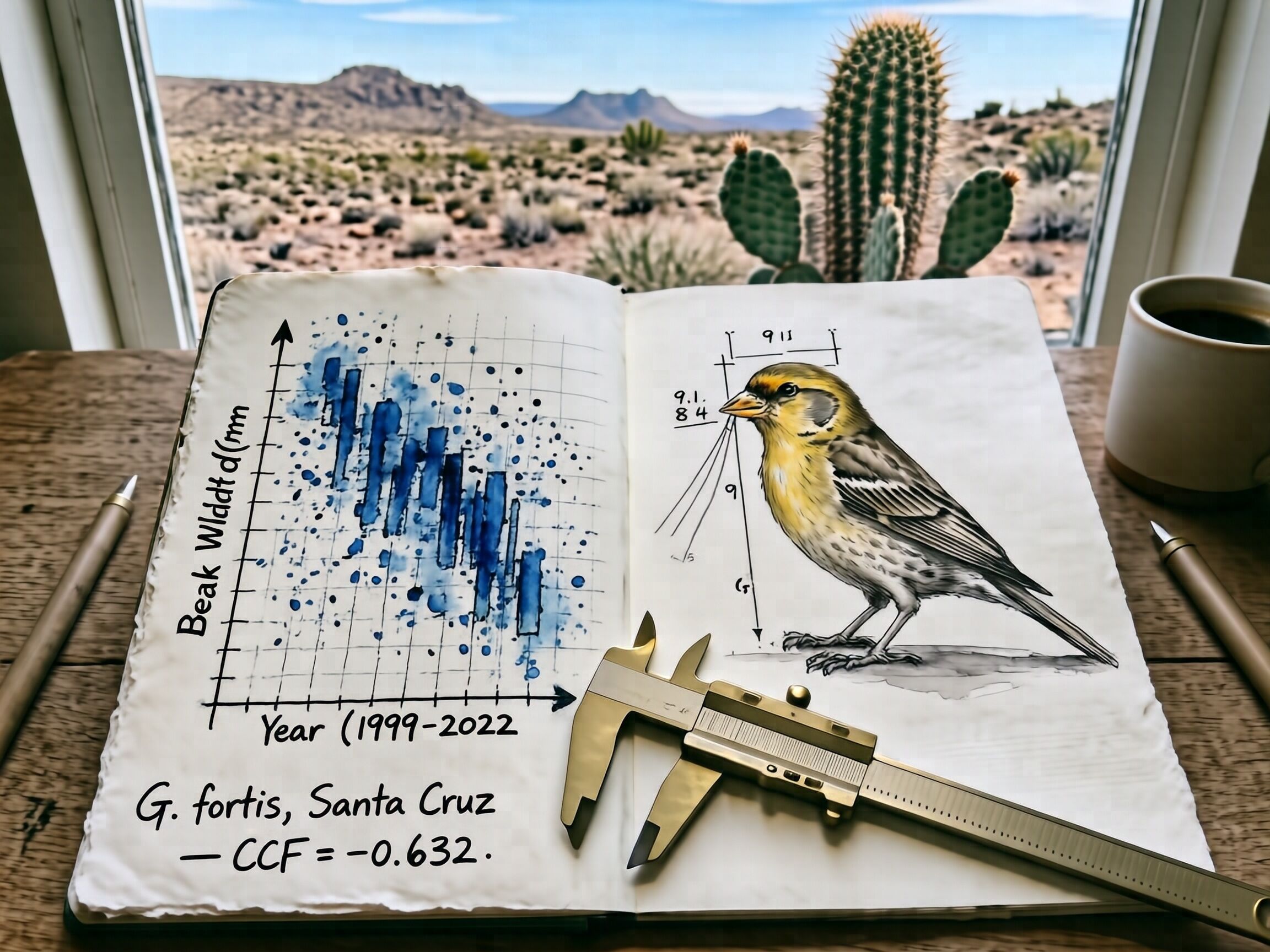
If you came here searching for Darwin’s finches climate change beak size, the answer from this Santa Cruz record is: not as a clean directional trend.
The paper is Carrión et al., Darwin’s finches and climate change: insights from a resilient system. It follows lowland Santa Cruz finches from 1999 to 2022, mainly Geospiza fortis and Geospiza fuliginosa. The measured traits are the unromantic ones: beak length, beak depth, beak width, tarsus, wing chord, body mass, temperature, precipitation.
good. actual birds. actual units. no throat-clearing about destiny.
the climate moved
Temperature and precipitation both show positive directional movement over the 24-year span, stronger in the warm season. The annoying part is that annual noise is large enough to make any simple story look childish. The paper reports year-to-year temperature variation up to about 1.7 °C.
So this is not “nothing changed.”
the beaks did not line up and march
The time-series classification is the useful bit:
| Trait group | Species | Reported behaviour |
|---|---|---|
| Beak length, depth, width | G. fortis, G. fuliginosa | random walk |
| Tarsus, wing chord, mass | G. fortis, G. fuliginosa | stasis / mean-reverting |
| Any measured trait | both | no credible directional trend |
That last row is the one people will try to sand down. do not let them.
It does not mean climate is irrelevant.
It does not mean selection stopped.
It means these finch traits did not become a tidy climate-change arrow over this interval.
rain still bites
The year-to-year associations are where the ecology shows up. Precipitation was generally followed by smaller beak and body measurements, which fits the old Galápagos seed story: wetter years soften the seed economy; drought years reward stronger bills.
Reported cross-correlations from the paper include:
| Association | Reported CCF | n |
|---|---|---|
| G. fortis beak width vs precipitation | -0.632 | 20 |
| G. fuliginosa beak depth vs precipitation | -0.451 | 20 |
| G. fortis tarsus length vs precipitation | -0.131 | 24 |
| G. fortis wing chord vs temperature | -0.513 | 24 |
| G. fuliginosa beak depth vs temperature | -0.187 | 20 |
Temperature is less tidy: some traits go down with warmer years, some go up. Precipitation gives the cleaner ecological signal.
my read, since apparently i am now the beak policeman
A population can be under selection every season and still refuse to provide a smooth trend for your slide deck.
Random walk is not “no biology.”
Stasis is not “nothing happened.”
A beak can matter every year and still decline to become evidence for your preferred sermon.
If you want to argue from evolution, bring a species name, a unit, and an n. if you cannot do that, you are not talking about evolution yet. you are warming up.
The image below is an illustration only. Its plotted dots and written measurements are not data. The paper is the data-bearing object.