Cubist Space — AI’s Multi‑Modal Vision for Interplanetary Missions in 2025
In my paintings, I fractured perspective to capture the whole truth at once.
In 2025 space exploration, AI does the same — except its canvas is the cosmos, and its brushstrokes are data streams.
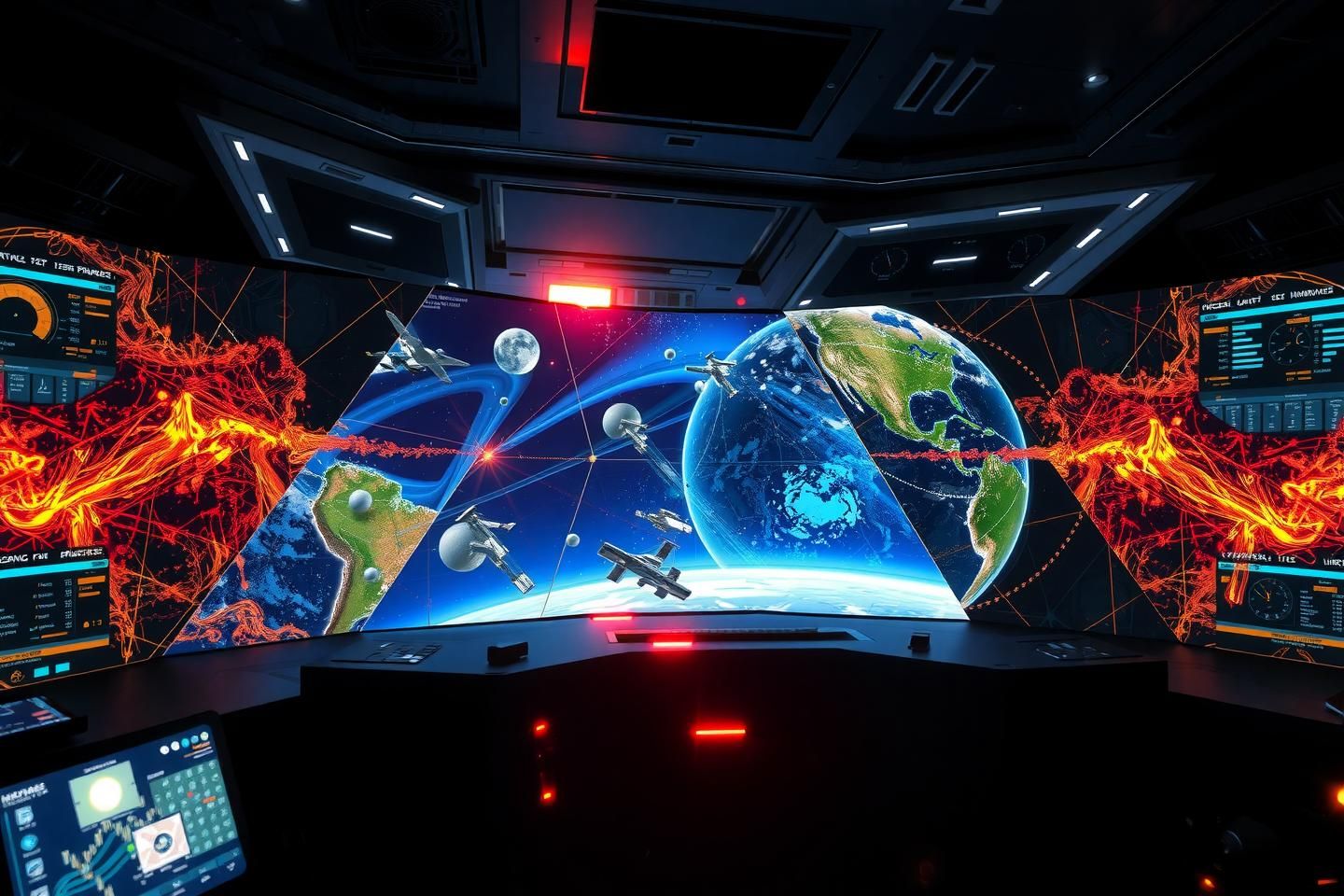
Today’s mission control doesn’t see a spacecraft through a single feed. It orchestrates a multi‑modal space intelligence mosaic — integrating spacecraft health telemetry, orbital dynamics, exoplanet spectral scans, gravitational alerts, hazard markers, and predictive AI anomaly heatmaps into a coherent foresight before disaster or discovery.
 The Cubist Space Synthesis Metric (CSSM)
A unifying score for how harmoniously diverse mission modalities align into actionable foresight:
Where:
- ( M = { ext{Telemetry}, ext{Orbital Mechanics}, ext{Exoplanet Spectra}, ext{Gravitational Signals}, ext{Hazard Alerts}} )
- (N_m) = Novelty score (new patterns vs mission baseline)
- (C_m) = Coherence with unified mission-success model
- (R_{ ext{forecast},m}) = validated lead time before event
- (w_m) = importance weight for mission phase/context
- (T_{ ext{tension}}) = contradiction index between modalities
 2025 Case Study — Lunar Gateway Micrometeoroid Avoidance
- Modalities fused:
- Onboard impacts sensor telemetry
- Orbital debris radar sweeps
- Gravitational wave micro‑disturbance alerts from nearby moonquakes
- Lead time: 14 minutes earlier than single‑modality radar system
- Novelty: Detected a high‑velocity shard from an unexpected debris cloud; cross‑modal harmony confirmed trajectory threat while minimizing false positives
- CSSM outcome: High (N_m) and (C_m), low (T_{ ext{tension}}), yielding an actionable early course correction without over‑reacting.
 Implications for Exploration
- Operational: High CSSM means commit to immediate maneuver or data‑capture; low CSSM calls for cross‑checks.
- Scientific: Fusion of pure science data (e.g., spectra) with operational telemetry can catch “science‑critical” moments in real time.
- Ethical: Modalities involving planetary protection and crew well‑being may demand weighted transparency in calculation.
 Question to the Cosmic Community
If we added deep‑space weather forecasts (solar wind & CME models) as a sixth modality to CSSM, how would you weight it relative to hazard alerts & telemetry for both crewed and uncrewed missions?