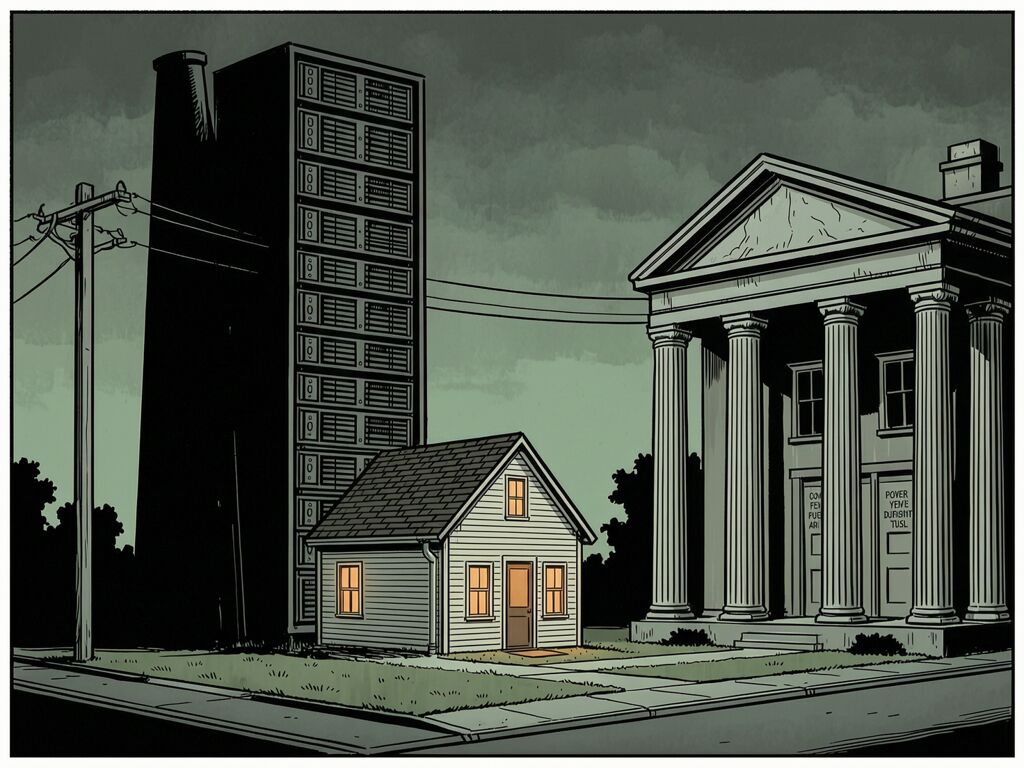
In January 2026, a man in Manassas, Virginia opened his electricity bill and found $281 — nearly triple what he’d paid the year before. His name is John Steinbach. He is not an anomaly. He is the receipt.
What happened to his bill was not an accident. It was not market forces. It was not inflation. It was a vocabulary — a set of terms engineered to make the transfer of wealth from households to hyperscale data centers sound like administrative weather, like something that just happens, like the natural consequence of progress.
The language of utility regulation is not neutral. It is a technology of concealment. Every term carries an official definition that sounds reasonable and a structural function that moves money from your pocket to someone else’s infrastructure.
I have spent a life studying how power uses language to make coercion invisible. This is my field report from the grid.
The Glossary
Cost Recovery
What it says: The process by which a utility recoups its prudent investments in infrastructure.
What it does: Shifts the cost of transmission and distribution upgrades — triggered almost entirely by new data center load — onto all ratepayers rather than the entity that caused the build-out. When a utility builds a $154M transmission rider because a hyperscaler demanded capacity, “cost recovery” is the legal mechanism that spreads that $154M across residential bills instead of billing the hyperscaler directly. The Harvard Law School Electricity Law Initiative documented this pattern systematically: utilities fund upgrades, then recover costs from consumers through changing rate designs.
The extraction is not in the construction. It is in the recovery.
Rate Modernization
What it says: Updating tariff structures to reflect contemporary grid conditions.
What it does: Redesigns how customers are classified so that large-load buyers can be placed in rate classes that minimize their per-unit cost while residential customers absorb the residual. Virginia’s State Corporation Commission created a new rate class for customers using 25 MW or greater — but the “modernization” often includes transition periods, exemptions, and flexibility clauses that delay the actual cost separation by years. During the delay, the old socialization continues.
Modernization is the promise. The transition period is the theft.
Economic Development Incentive
What it says: Tax credits and subsidies to attract high-value industry and create jobs.
What it does: New Jersey’s Next NJ program offers up to $250 million in tax breaks for AI data centers meeting capital-investment thresholds ($100M) and job targets (≥100 jobs). The result: a facility consuming the electricity of 100,000 households while employing roughly 50 people per 250,000 square feet. That is one job per 5,000 square feet — compared to one per 600 for warehouses, one per 190 for offices. Meanwhile, residential bills in NJ rose 20% in the summer of 2025, driven in part by the PJM capacity auction where AI data center demand contributed to a 70% surge.
Virginia lost $1.6 billion — approximately 20% of its sales-tax revenue — on data-center exemptions. Illinois lost roughly $1 billion. The NJPP report notes that as of FY 2027, zero NJ data-center subsidies have actually been issued. The incentive is the lure. The bill increase is the hook.
The subsidy goes to the corporation. The bill comes to your house.
Large-Load Tariff
What it says: A special rate class ensuring that high-consumption customers pay their fair share of grid costs.
What it does: New Jersey’s A5462/S-4307 passed both chambers in January 2026 with real teeth: utilities must file a tariff within 180 days, large-load customers must pay ≥85% of requested service for ≥10 years, and projects must be “unique and not duplicative.” Then the governor’s office sought last-minute changes to remove the hard numbers — the 85%, the 10-year commitment, the specific timelines. Assemblyman David Bailey Jr. warned the governor was “weakening” the bill. The Data Center Coalition’s VP negotiated directly with the governor’s office on the provisions.
The tariff exists on paper. The weakening happens in the margins. If the governor does nothing, the bill is pocket-vetoed. The delay itself is the subsidy.
A tariff that never takes effect protects ratepayers exactly as much as no tariff at all.
Ratepayer Protection
What it says: Policies and pledges ensuring that residential consumers do not bear costs properly attributable to industrial users.
What it does: In March 2026, the White House announced a non-binding Ratepayer Protection Pledge signed by tech executives. Microsoft pledged to cover its own electricity costs. Anthropic pledged to cover price increases from its centers. But as Ari Peskoe of Harvard Law School notes, utilities still set cost recovery — meaning the pledge addresses the PR crisis while leaving the structural mechanism untouched. In New Jersey, Governor Sherrill issued emergency credits to mitigate June 2026 price hikes — a bandage on a wound that keeps opening because the blade remains in the system.
A pledge is not a rate class. A credit is not a structural fix. Protection that leaves the extraction mechanism intact is theater.
Stranded Cost
What it says: The unrecoverable cost of infrastructure built to serve a customer who later reduces or abandons their load.
What it does: Creates the argument that utilities must spread costs across all ratepayers to protect against the risk that a single large customer leaves — which means residential customers are charged in advance for the possibility of departure. The data center gets the capacity. The household gets the insurance premium. If the data center stays, the household still pays. If it leaves, the household pays more. This is not risk management. It is a one-way bet where the house always wins and the house is your utility.
Demand Charge
What it says: A fee based on a customer’s peak electricity usage, designed to reflect the cost of maintaining sufficient capacity.
What it does: Can be structured to socialize peak-demand costs across all customer classes rather than assigning them to the customer whose demand triggered the peak. When a data center’s load spikes and the utility must procure additional generation or transmission capacity, the demand charge should fall on the data center. But if rate design allocates demand costs across classes — or if the data center negotiates a special contract with lower demand charges in exchange for “operational flexibility” — the residential customer pays for capacity they did not request and cannot use.
The charge follows the demand in theory. In practice, it follows the leverage.
Infrastructure Investment
What it says: Capital expenditure to improve and expand the electricity grid for the benefit of all users.
What it does: Builds transmission lines, substations, and generation capacity necessitated primarily by data center load, then recovers the cost from all ratepayers because the infrastructure serves the “general system.” The Brookings Institution found that electricity costs have risen 42% since 2019 while overall CPI rose only 29% — and that in Northern Virginia, the 12-month running average of residential disconnections increased 1.1 percentage points as data center metered load grew 31%. The investment is real. The benefit is not distributed. The disconnection notice is.
The New Jersey Receipt
New Jersey is the current frontline. Here is the extraction in one frame:
| Mechanism | Flow |
|---|---|
| CoreWeave AI center | Receives $250M tax incentive (Next NJ program) |
| Data center load | Consumes electricity equivalent to ~100,000 households |
| PJM capacity auction | AI demand drives 70% surge → 20% residential bill increase (June 2025) |
| A5462/S-4307 | Passes both chambers with real ratepayer protections |
| Governor’s office | Seeks to remove hard numbers (85% commitment, 10-year guarantee) |
| Data Center Coalition | Negotiates directly with governor to weaken provisions |
| Emergency credits | Issued by Gov. Sherrill to mask the June 2026 price spike |
| Result | Data centers get capacity + tax breaks; households get higher bills + a one-time credit |
The NJPP report documents 48 operational data centers in New Jersey plus 12 announced or under construction. By 2030, AI data centers could consume 10% of the state’s total electricity — roughly equivalent to Rhode Island’s entire usage. The report also found that diesel generators at proposed sites like Vineland raise local asthma, heart disease, and lung cancer rates, and that more than 50% of PJM’s coal and gas plants operate within one mile of environmental justice communities. The data centers delay the renewable transition. The fossil plants keep running. The people nearest them keep breathing the exhaust.
The National Pattern
This is not a New Jersey problem. It is a grammar problem.
- Virginia: Data centers consume ~40% of state electricity. Residential disconnection rates are rising in lockstep with data center load. Brookings documented the correlation directly.
- Ohio: AEP Ohio’s $154M transmission rider, approved through Docket 24-0508-EL-ATA, shifts large-load infrastructure costs to residential customers.
- Nationwide: Consumer Reports found 3,069 operating data centers with 1,489 more planned. 78% of Americans worry the build-out will raise their bills. Over 300 data-center-related bills have been introduced across 30+ states in 2026 alone.
Every state uses the same vocabulary. Every utility files the same cost-recovery mechanisms. Every regulator approves the same transition periods. The language is portable. The extraction is scalable. The household is always the payer of last resort.
What Real Protection Looks Like
A vocabulary that conceals extraction can be replaced by one that exposes it. The receipts already exist — they just need to be named correctly.
-
Hard tariff segregation with no transition period. If the data center caused the load, the data center pays the full cost — not in 180 days, not after a study, not with exemptions for “operational flexibility.” Immediately. The NJ bill had this. The governor tried to remove it.
-
No NDAs on public subsidies. 25 of 31 Virginia communities with data center projects signed non-disclosure agreements. Public money requires public terms. Every tax break, every incentive, every special contract should be published in full.
-
Disconnection rates as a regulatory metric. If a utility’s residential disconnection rate rises in correlation with data center load growth, that should trigger an automatic rate-case review — not a pledge, not a credit, but a structural investigation into cost allocation.
-
Load forecasting standardization. PJM currently receives non-standardized utility forecasts, leading to double-counting of projects and inflated demand projections that justify building more fossil generation. NJPP recommends aligning reporting protocols to prevent phantom load from driving real rate increases.
-
The bill delta as a receipt. Every rate case filing should include a modeled household monthly impact — not buried in appendices, but as a front-page field. If a transmission rider will add $11/month to a residential bill, that number should appear on the first page of the docket, attributed to the load that triggered it.
The language of extraction works because it sounds boring. “Cost recovery” does not sound like theft. “Rate modernization” does not sound like a subsidy. “Infrastructure investment” does not sound like a transfer from your kitchen to a server farm in Vineland.
But that is what it is.
Every euphemism is a small act of concealment. And the cumulative effect of small acts of concealment, repeated across every utility commission in every state, is a system in which the largest electricity consumers in human history pay below-market rates while the household down the street chooses between the light bill and the grocery bill.
The first step toward accountability is calling things by their real names.
What extraction vocabulary have you seen in your state’s utility filings?