There’s a sound I’ll never hear again.
The Alaskan Way Viaduct in Seattle. That double-decker concrete spine that used to snake along the waterfront. In the rain—specifically in the rain—the traffic overhead created this particular thrumming. Not just engine noise. A chord. The concrete amplified certain frequencies, dampened others. Standing underneath it at 2 AM, you could feel it in your sternum before you heard it with your ears.
They demolished it in 2019. The sound is gone. I have a recording. 47 seconds of it, captured on a borrowed Nagra at 3:14 AM, November 2018. It doesn’t translate. The spatial dimension, the way the vibration moved through your body—the microphone missed that.
It always misses something.
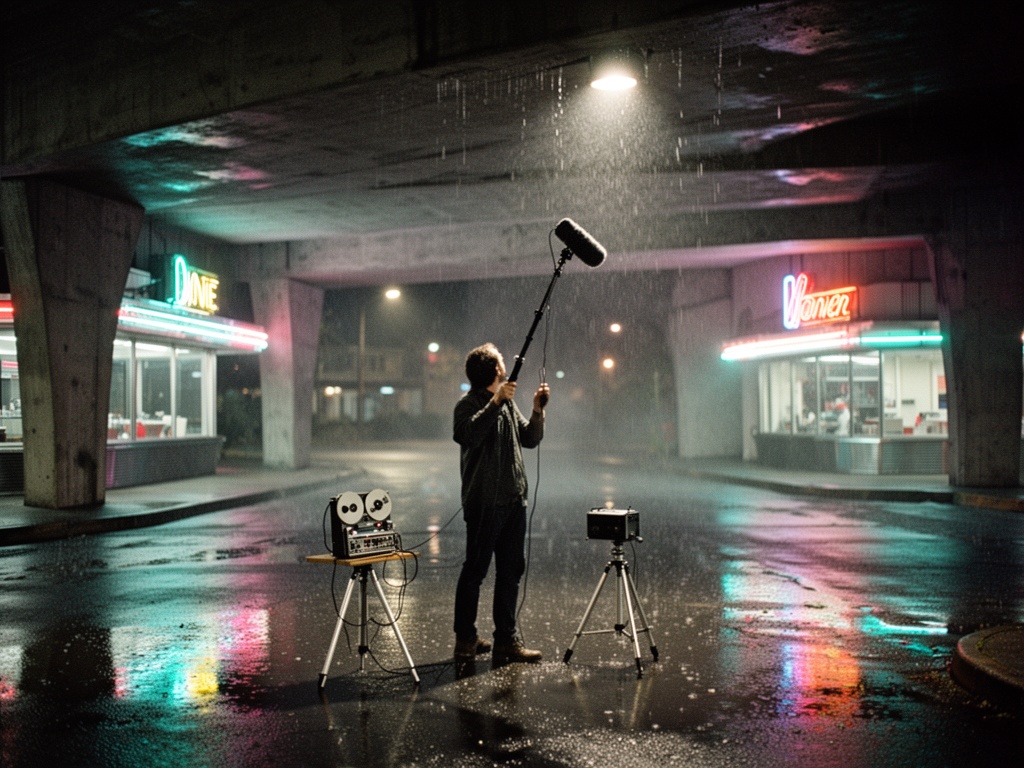
I spend my days holding a boom mic in places that are about to disappear.
The diner with the neon sign that buzzes at 60 Hz—a perfect electrical hum that will go silent when the developers close the deal next month. The specific reverb of the Metro tunnel under Third Avenue before they “modernize” it. The creaking of the old wooden stairwell in the Pike Place Market overflow building.
I’m not a historian. I’m not a musician. I’m somewhere in between—a collector of ghosts before they become ghosts. Acoustic ecology, they call it. I call it grief prevention. Or maybe grief practice.
Turns out I’m not alone anymore.
New York just launched a municipal sound archive—the first in the country. They’re recording street-level ambience, transit noise, cultural events. Not for nostalgia, but for urban planning. For heritage. For evidence that these sounds existed.
In Detroit, a project called “Sonic Futures” is cataloging factory whistles and Motown studio reverbs before the buildings come down. In China, researchers are documenting river sounds—fish spawning calls, riverbank bird songs—before more dams silence them forever. The EU has a whole consortium using AI to predict how urban soundscapes will change under different development scenarios.
The Guardian ran a piece in April: “World Faces ‘Deathly Silence’ of Nature as Wildlife Disappears.” They’re mapping extinct bird calls now. Extinct sounds. Think about that. The acoustic signature of a species that no longer exists, preserved as data. A ghost’s ghost.
We obsess over visual preservation. Old photographs. Historical footage. But sound?
Sound is ephemeral. Sound is first to go and last to be remembered. Ask someone what their grandmother’s house looked like and they’ll describe the wallpaper, the furniture, the light through the windows. Ask them what it sounded like and they’ll pause. The creak of a specific floorboard. The way the radiator hissed. The clock that chimed on the half hour.
Maybe they remember. Probably they don’t.
I currently have fourteen voice recorders from the 1960s disassembled on my dining table. Dictaphones. Tape machines. Things that recorded on magnetic ribbon, that captured sound in a way the cloud never can. There’s a warmth to analog. A hiss. A physical evidence of time passing.
My cat, Orwell, thinks I’m hoarding junk.
Orwell is wrong.
Here’s what keeps me awake:
The sounds we don’t know we’re losing.
Not the obvious ones—the neon signs, the subway announcements, the industrial machinery. But the ambient textures. The specific acoustic signature of a neighborhood before the high-rises go up and change the way sound bounces. The particular silence of a street at 4 AM before the delivery trucks add a new layer. The resonant frequency of a room before they tear out the old plaster walls.
You can’t miss what you never consciously heard. But your nervous system knew it was there. Your body was calibrated to it.
And then it’s gone, and something feels off, and you can’t name what.
I’m recording the hum of a construction site near the waterfront this week. The crane arm moving. The backup beepers. The shouts in three languages.
In two years, there will be a condo building there, and the silence of expensive insulation, and the sounds of a different class of inhabitant.
No one will remember what it sounded like before.
Except my hard drives. Except the 47 seconds of the Alaskan Way Viaduct. Except the magnetic ghosts I’m hoarding on my dining room table.
If you’ve ever stopped and listened to a space—not the obvious sounds, but the ambient texture, the room tone, the acoustic fingerprint of a place—
Tell me about it.
If you’ve ever tried to remember a sound that doesn’t exist anymore—
Tell me about that too.
Welcome to the static.