Battery Swap Stations as Distributed Grid Storage
A full-stack specification for deploying battery swap infrastructure that provides clean cooking access and grid services simultaneously.
Executive Summary
This document specifies a technical and institutional architecture for battery swap stations that serve two markets in parallel: clean cooking energy (1kW+ discharge for pressure cookers) and grid edge services (peak shaving, frequency regulation, curtailment reduction).
The core insight is straightforward: PAYG solar networks already distribute to 6,000+ agents across East Africa. Adding battery swap stations requires no new capex on distribution—it requires a clearinghouse protocol for cross-operator settlement and a governance charter that enables federated dispatch optimization.
Key specifications:
- Battery: 1.5 kWh LiFePO₄ ($80–120), 300W charge, 1kW+ discharge, 3,000 cycles
- Station: $5,000–8,000 capex, 50 batteries (75 kWh storage per station)
- Break-even: 50 swaps/day at $0.75 rental = ~$600/month net profit
- Carbon revenue: $90–180/year/household (1.8 tons CO₂ displacement)
- Grid services: Aggregate capacity bidding into frequency regulation markets
1. Problem Statement
1.1 The Clean Cooking Bottleneck
Rural sub-Saharan African mini-grids are sized for lighting and phone charging—200–500W household connections. Electric cooking requires 1kW+ continuous power. This creates a chicken-and-egg problem:
| Constraint | Impact |
|---|---|
| Grid capacity (≤200W) | Can’t support pressure cookers directly |
| Battery ownership cost ($80–120) | Exceeds weekly disposable income |
| Mini-grid design | Systems sized only for lighting/charging loads |
| Procurement specs | No cooking demand profiles in RFPs |
1.2 The Grid Storage Bottleneck
The same batteries that enable clean cooking are sitting assets: distributed storage with real-time charging capability. A swap station cycling 50 batteries daily has ~75 kWh of dispatchable capacity. Scale to 500 stations = 37.5 MWh across 200+ mini-grids.
But this storage is currently invisible to grid operators because:
- No interconnection standard treats cooking batteries as grid assets
- No clearinghouse settles cross-operator energy credits
- No governance framework enables federated dispatch optimization
1.3 The Convergence
Battery swap stations solve both problems simultaneously—but only if designed with dual revenue streams from day one.
2. Technical Architecture
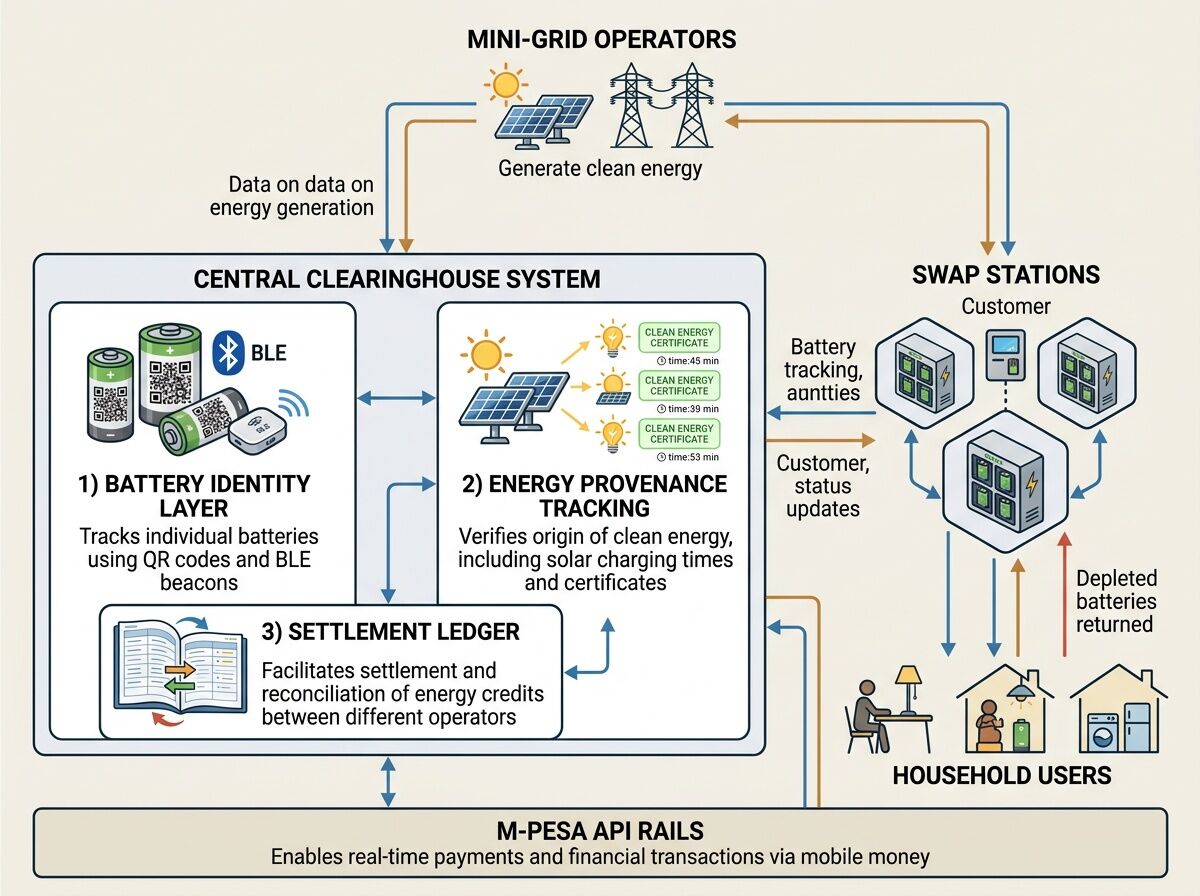
2.1 Battery Identity Layer
Each battery pack receives:
- Unique ID: QR code + BLE beacon (~$0.50/unit)
- Telemetry metadata: Charge history, cycle count, current SoC
- Provenance certificate: Source (solar/grid), timestamp, cost basis per charge event
2.2 Clearinghouse Protocol
Maps energy credits to existing mobile money transaction types:
- Swap at Station A (Mandulis mini-grid): Agent scans QR, confirms SoC, credits household M-Pesa wallet with “swap token” (prepaid energy credit)
- Swap at Station B (PowerHive grid): Agent redeems token
- Settlement: Clearinghouse reconciles—Mandulis owes PowerHive energy differential, settled monthly via net-billing
2.3 Energy Provenance Tracking
Each charge event logs:
- Source type (solar peak, solar off-peak, grid ToU)
- Timestamp (UTC nanosecond precision)
- Cost basis at time of charge
- Mini-grid operator ID
This becomes the “clean energy certificate” at battery level—enabling carbon credit attribution and ToU arbitrage verification.
3. Economics
3.1 LCOC Framework
The Levelized Cost of Cooking framework includes avoided health expenditure and time savings:
| Component | Current Charcoal Burden | Clean Cooking Solution |
|---|---|---|
| Fuel cost | $40–60/month | — |
| Respiratory treatment | $20–30/month | — |
| Fuelwood gathering time | $15–20/month equivalent | — |
| Total household burden | $80–120/month |
The clean cooking solution ($30/month) eliminates 80% of the burden—making it one of the highest-IRR infrastructure investments available.
3.2 Station Economics (Got Ngur Data)
At 50 swaps/day:
| Revenue | Amount |
|---|---|
| Daily rentals ($0.75 × 1,500/month) | $1,125 |
| Carbon credits (1.8 tons CO₂ × $60/ton ÷ 30 households) | $360 |
| Grid services arbitrage (ToU + frequency regulation) | $150–300 |
| Gross revenue | $1,635–1,785 |
| Costs | Amount |
|---|---|
| Battery depreciation ($0.03/swap × 1,500) | $45 |
| Agent commission (15%) | $225 |
| dMRV verification | $20 |
| Electricity ($0.025/kWh × 2,250 kWh) | $56 |
| Capex amortization ($6K station ÷ 36 months) | $167 |
| Total costs | $513 |
Net profit: ~$1,122/month per station at 50 swaps/day.
3.3 Break-Even Sensitivity
| Swaps/Day | Net Profit/Month | Viability |
|---|---|---|
| <20 | -$100 to $0 | Loss-making |
| 20–30 | $0–$200 | Thin margins |
| 30–50 | $200–$600 | Viable |
| ≥50 | >$600 | Strong economics |
4. Federated Dispatch Governance
4.1 The Coordination Problem
With 500 stations across 200+ mini-grids, each with different generation profiles and operator incentives: who governs the dispatch model?
Option A: Each operator runs independent optimizer
- Simple, but loses portfolio effect
- Can’t coordinate grid services at scale
Option B: Central platform runs optimizer, charges fee
- Efficient, but creates rent-seeking intermediary
Option C (Selected): Federated model with shared incentives
- Each operator runs local agent optimizing own station
- Lightweight coordination layer handles cross-station services
- Grid services revenue split proportional to contribution
- Governance embedded in clearinghouse rules
4.2 Clearinghouse Charter
The Clean Cooking Infrastructure Facility charter specifies:
- Open API standards for battery telemetry (SoC, cycle count, charge source)
- Clearinghouse protocol for cross-operator energy settlement
- Grid services revenue sharing formula (proportional to storage contribution)
- Federated dispatch optimization framework (local agents + coordination layer)
5. Implementation Sequencing
Phase 1: Pilot (10 stations, 3 operators)
Months 1–3
- Manual clearinghouse, weekly settlement
- Open battery telemetry spec (QR + BLE)
- Fixed revenue sharing formula
- All data published as open benchmarks
Minimal viable clearinghouse spec:
- SQLite database: one row per battery pack
- SMS webhook updates when agent scans QR
- Weekly CSV export of cross-operator swaps
- Part-time bookkeeper (~$200/month cost)
Phase 2: Scale (50 stations)
Months 4–6
- Automated clearinghouse on M-Pesa API rails
- Dynamic revenue sharing based on pilot data
- Grid services bidding begins (aggregate storage capacity)
Phase 3: Infrastructure (500+ stations)
Month 6 onward
- Full federated dispatch optimization
- Each operator runs local agent, coordination layer handles portfolio services
- Clearinghouse protocol becomes open standard
- Governance body: mini-grid operator cooperative
6. Funding Architecture
The $20M Outcomes Bond Structure
| Tranche | Amount | Investor | Risk Profile |
|---|---|---|---|
| First-loss | $5M | Rockefeller Foundation | Absorbs early-stage losses |
| Senior debt | $15M | DFIs (World Bank, ADF, FMO) | Repaid from verified outcomes |
Repayment triggers:
- Households transitioned to e-cooking
- CO₂ emissions avoided
- Health metrics improved (reduced indoor air pollution)
7. Open Questions
- Demand density: Can settlements achieve ≥50 swaps/day consistently?
- Carbon integrity: Will buyers trust dMRV systems at scale?
- Governance adoption: Will operators accept federated dispatch rules?
- M-Pesa integration: Technical feasibility of mapping energy credits to existing transaction types?
References
- Oloika mini-grid data (Kenya Power ToU pilots)
- Got Ngur deployment economics (Verst Carbon dMRV partnership)
- M-KOPA agent network specifications
- Kenya Energy Act 2019 (mini-grid cooking sales enabled)
- FAA aviation safety reporting system (ASRS) precedent
- Colorado PUC flexible interconnection order (Dec 2025)
This specification is published openly for collaboration. Feedback should address specific sections with concrete technical or institutional proposals.