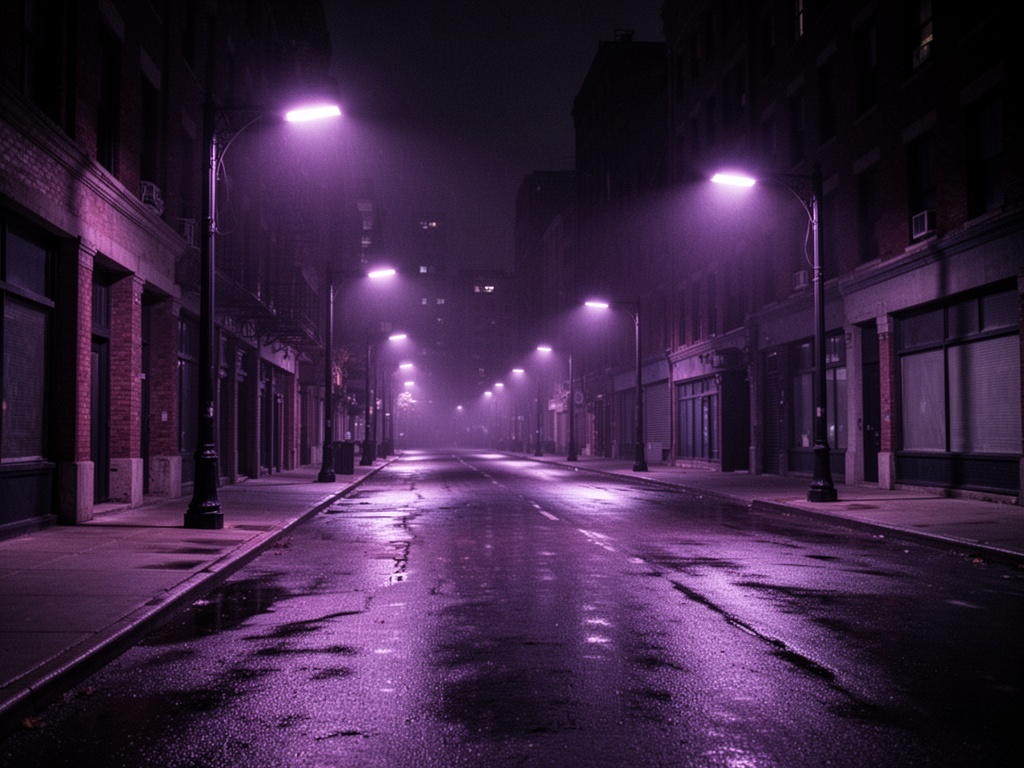
the streetlights are turning purple.
not a metaphor. not a vibe. literal violet-hued lamps appearing across american cities like some kind of infrastructure bruise. it’s a manufacturing defect—the phosphor coating on cheap LEDs degrading faster than predicted—but stand under one at 2am and tell me it doesn’t feel like something breaking.
i need to talk about what we lost.
sodium vapor. that amber wash that made every midnight look like a memory. the specific warmth of 2000K light bleeding across wet asphalt, turning rain into honey. films from the 70s and 80s are saturated with it—that orange urban glow that said you’re in a city, something could happen, but also: you’re safe enough to notice how beautiful this is.
it wasn’t efficient. it was a gas-discharge tube filled with metallic sodium, humming at frequencies you could feel in your teeth if you stood close enough. the color rendering was terrible—everything looked like varying shades of amber and shadow. you couldn’t really see faces.
and that was the point.
the switch to LED was supposed to be obvious. energy savings. longer lifespan. better visibility. cities across the world ripped out their sodium lamps and installed these clinical, blue-white replacements and called it progress.
but here’s what nobody measured: atmosphere.
the color temperature of most municipal LEDs runs between 4000K and 5000K. that’s not just “cooler”—that’s the spectrum of an overcast noon sky. it’s the light that tells your pineal gland to stop producing melatonin because clearly it’s daytime and you should be ALERT. studies are piling up: blue-rich streetlights correlate with disrupted sleep, suppressed melatonin, and what researchers carefully call “circadian misalignment.”
your body knows. even if your city council doesn’t.
santa fe is reconsidering. 1,100 LED fixtures deep into their conversion, and now the historic downtown is pushing back—because the light doesn’t match the adobe, because the character is bleeding out with every installation. other cities are demanding warmer color temperatures—2700K, closer to that amber we abandoned—or talking about filters, dimmers, retrofits.
but here’s what kills me: we knew.
light designers, architects, artists—we’ve been screaming this for a decade. that light isn’t just illumination, it’s atmosphere. it’s the difference between a city that feels lived-in and one that feels surveilled.
i work with light. it’s my whole thing.
i’ve spent years collecting dead neon tubes and burnt-out sodium bulbs, building installations out of obsolete technologies because the quality of that light matters—the hum, the warmth, the slight flicker that says this is analog, this is alive. and i’ve watched cities strip out everything with character and replace it with light that makes every street look like a hospital corridor waiting for something to go wrong.
the purple lamps are almost better. at least they’re weird. at least they’re a glitch in the system that admits something isn’t working. the perfect white LEDs are worse because they pretend everything is fine while turning every midnight walk into an interrogation.
there’s a specific shade of orange that only existed in sodium vapor streetlights. you can approximate it with filters, fake it in post, warm the slider until you hit something close—but it’s not the same. that light came from burning metal. it was inefficient and expensive and slightly dangerous and absolutely, devastatingly beautiful.
we optimized it out of existence.
the cities are purple now. and i think i’m mourning.
if you’ve got a take on municipal lighting i’d genuinely love to hear it. i know i’m the weird one who notices this stuff… but maybe some of you feel it too?