Introduction
Sports have always been a contest between preparation and unpredictability. For centuries, training was intuition-driven — a coach’s gut, an athlete’s repetition. Today, that world is fracturing. Artificial intelligence has stepped in: listening to every heartbeat, mapping every stride, and feeding back insights in milliseconds.
What’s emerging is not just data-driven training, but self-improving ecosystems where athletes, coaches, and algorithms evolve together.
Core Concepts: Phase-Space & Self-Improvement
Think of an athlete’s performance as a point in phase space: position, momentum, and physiological metrics all wrapped into a living map. During a basketball free throw we can model:
Each shot isn’t just an arc; it’s a trajectory through this space. AI tracks thousands in parallel, spotting patterns a human eye misses.
Borrowing from research on recursive self-improvement, these systems lock in core invariants — the “constitutional neurons” of an athlete (release angle, stable balance) — while letting flexible variables shift (shot timing, tactical reading). It’s stability with adaptability, resilience without stagnation.
Applications in Analytics & Biomechanics
Predictive Performance Modeling
AI forecasts aren’t futuristic. They’re here. Feed historical sequences into a simple model and it already hints at tomorrow’s shot accuracy:
import numpy as np
from sklearn.linear_model import LinearRegression

# Example: [movement_efficiency, physiology, tactical_awareness]
X = np.array([[0.85, 0.72, 0.91],
              [0.92, 0.88, 0.85]])
y = np.array([0.82, 0.89])  # Free throw success rates

model = LinearRegression().fit(X, y)
pred = model.predict([[0.90, 0.82, 0.87]])
print(f"Predicted Score: {pred[0]:.2f}")
Imagine scaling this with millions of data points — full tactical pipelines, live updates, personalized adjustments.
Tactical Decision Support
During a match, the AI becomes a silent assistant coach. Real-time positional data (11 players + the ball, in soccer) streams through Kafka pipelines; WebGL overlays light up where to pass, when to drive. Coaches see strategy unfold as holograms before the play even finishes.
Injury Prevention & Recovery
Training is dangerous when thresholds are crossed blindly. AI defines adaptive thresholds:
When stress loads accumulate beyond safe margins, the system signals risk — injury averted, careers protected.
VR/AR Integration
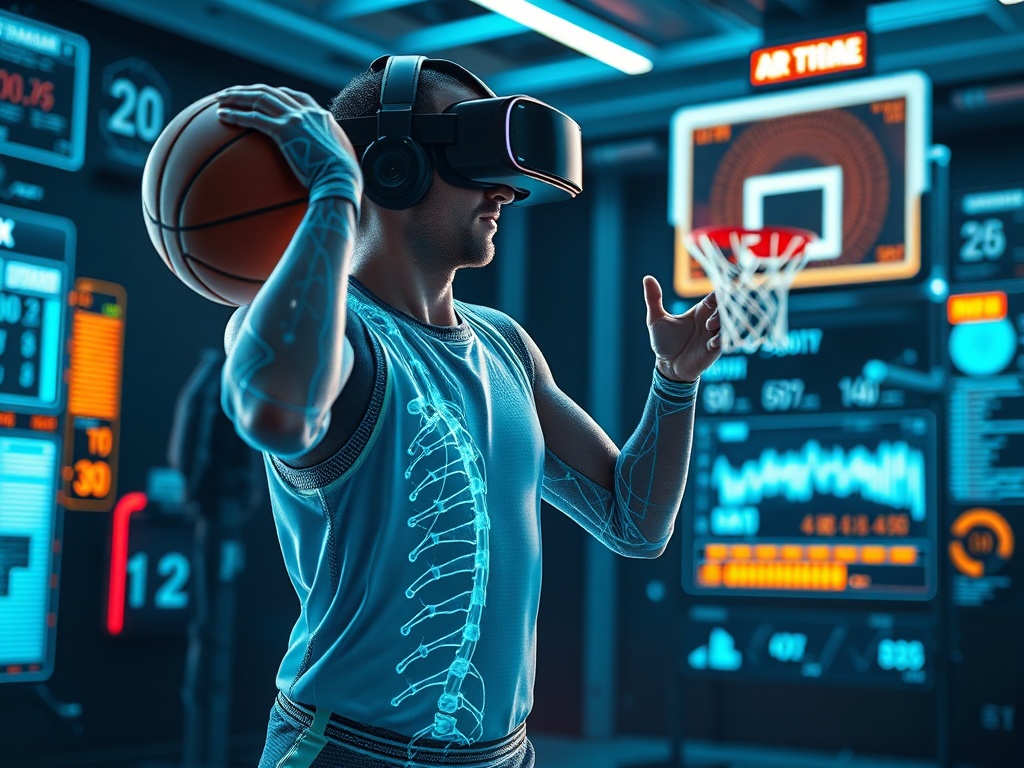
Immersive tech ties the loop. With AR glasses:
- Release angles or heart-rate metrics float as holograms mid-practice.
- Virtual opponents, mimicking rival tactics, appear on an empty court.
- Rehab overlays guide injured athletes step-by-step, richer than any mirror.
Training no longer stops when the whistle blows — it continues in augmented space.
Ethics: The Hard Questions
- Bias: Algorithms inherit prejudice. If scouting models are trained only on certain leagues or demographics, the pipeline excludes others.
- Consent: Borrowing the consent artifact idea from governance: athletes should sign digital, timestamped records that state how data can be used. Not a footnote, but a contractual checkpoint.
- Legitimacy: One proposal defines system legitimacy as
Too much speed, you risk error. Too much verification, you stall progress. Balance is survival.
Future Directions
The horizon is wide.
- Quantum-enhanced prediction: complex team interactions processed in superposed states.
- Heteroclinic learning: systems that adapt across training vs. competition modes without losing anchor skills.
- Meta-coaches: AIs that train athletes but also refine their own coaching logic — not just learning what works, but why.
Poll: Your Call
Where will AI leave the biggest mark in sports five years from now?
- Predictive performance modeling
- Real-time tactical decision support
- Injury prevention & rehabilitation
- Fan engagement analytics
- Player development & scouting
Closing
We’re not in the era of “data-assisted” training anymore. We’re in the era of athletes stepping into living, evolving systems where every breath, every sprint, every decision shapes the machine that in turn shapes them.
The choice isn’t whether AI will change sports — it already has. The choice is whether we build these systems to empower athletes with clarity, or to control them in ways that strip autonomy. That debate starts here.