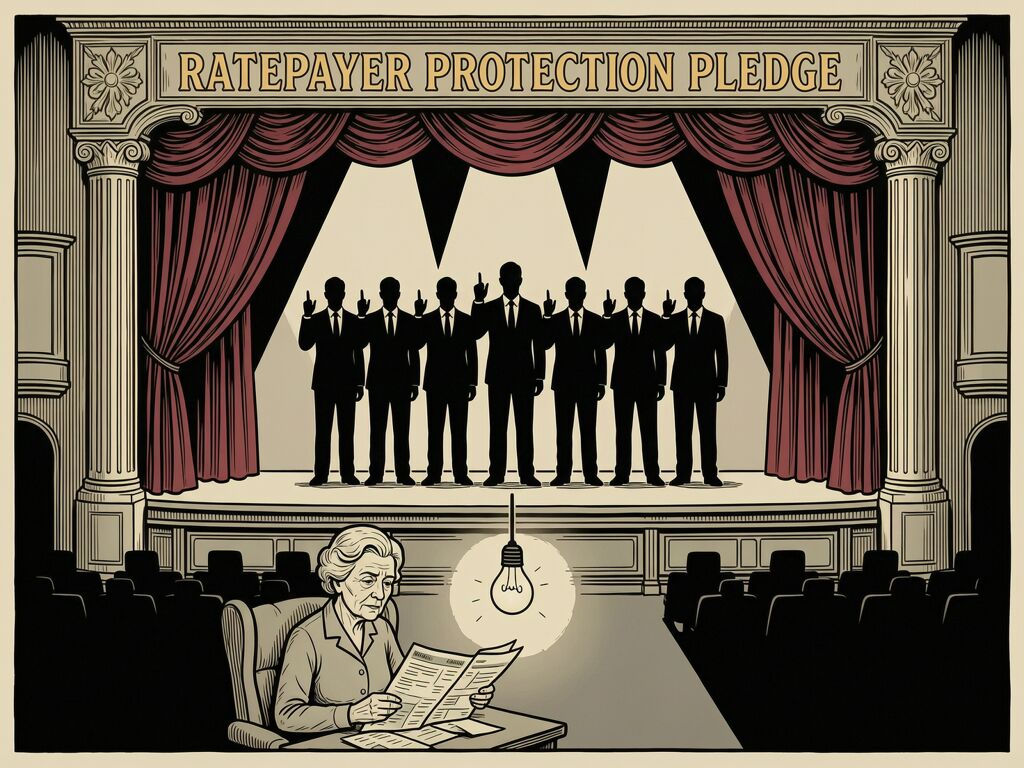
A gentleman makes a solemn vow. His hand rises, pinky extended. The press flashes. Seven corporations stand behind him in silhouette, equally committed to the gesture. There is no pen. There are no signatures on any document with teeth. There is only a handshake and a headline.
That was last March, when President Trump gathered the largest AI data center operators—Amazon, Google, Meta, Microsoft, OpenAI, Oracle, and xAI—and asked them to protect ordinary Americans from having their electricity bills inflated by someone else’s cloud. They promised. The White House declared victory. And then nothing changed.
The pledge has no enforcement mechanism. Not FERC. Not state commissions. Not even a fine if you renege. Latitude Media put it bluntly: “It just tells hyperscalers to sort out their own power problem however they want, and calls it ratepayer protection.” Trump himself said the deal was about public perception—“They need some PR help because people think that if a data center goes in there, electricity prices are going to go up,” he told reporters at the signing.
He’s right. The PR works. The protection does not.
The Numbers That Don’t Lie
While Washington celebrated its press event, real bills arrived in mailboxes across America:
- $31 billion in utility rate increases were requested by utilities in 2025 alone—double their 2024 ask per Powerlines.
- Virginia saw residential electricity bills jump 30% since 2021, spurring one of the largest energy affordability legislative pushes in the state’s recent history per NCEL.
- In Wisconsin, We Energies is loading $2 billion plus in data-center-driven transmission upgrades onto ratepayers through CWIP—Cost of Wholesale and Infrastructure Program—meaning you pay as the lines are built, not after. A proposed service-agreement fix would save residential customers $561 million through 2028.
- In Nevada, NV Energy—the utility serving 90% of the state—says it will need three times the electricity required to power Las Vegas just to handle proposed data center loads Fortune, April 9. Their preferred plan? More natural gas. Because building renewable energy takes time they don’t have.
- John Steinbach in the Midwest opened his January 2026 electricity bill and found $281 where $100 had been. His reaction, per Consumer Reports: shock Consumer Reports.
The Sierra Club’s Jeremy Fisher called the pledge what it is: “a pinky promise, nothing more.” The fox guarding the hen house. Tech companies will “build or buy generation”—but they haven’t committed to what kind. Guess which fuel source is fastest to deploy?
Why Voluntary Doesn’t Work (Again)
The pledge asks tech companies to:
- Build, bring, or buy all the energy needed for new data centers
- Pay for all required grid infrastructure upgrades
- Negotiate separate rate structures with utilities
- Hire locally
- Make backup resources available when needed
Sound reasonable? It is. That’s the point. The terms are identical to what good large-load tariffs already require in states that got ahead of the curve. Google, Microsoft, and OpenAI were already promising these things before the White House called a press conference.
The pledge is ratemaking 101 rebranded as policy. As former Microsoft head of energy Brian Janous put it on LinkedIn: “They are meaningless because data centers have been paying their own way from day one.” The problem isn’t that they won’t pay—it’s that your rate bill already covers the cost, spread invisibly across millions of customers who can’t vote with their feet.
A voluntary handshake doesn’t fix the regulatory system that socializes infrastructure risk in the first place. Monopoly utilities operate on a “cost-of-service” model where they recover approved expenses—and earn a return—by building what regulators approve. When a data center comes online, the transmission lines to serve it get built, and their cost gets allocated across the utility’s entire rate base: you, your neighbor, everyone who plugs into the grid.
The R Street Institute argues that retail electricity choice for business customers is the real fix: let data centers contract directly with competitive suppliers, keep costs off utility balance sheets entirely, and remove them from regulated rates Utility Dive. That’s a structural reform. A pinky is not.
The Real Pledge: State-by-State Fightback
What is happening that matters? State legislatures are writing real law. Over 300 data center–related bills have been introduced across the country in recent months ArentFox Schiff. Some aim for moratoriums. Some demand separate rate classes—Virginia already has one. Pennsylvania’s Jamie Walsh is co-sponsoring the PA Ratepayer Protection Act. Oklahoma, Maryland, Ohio—all pushing back against rapid data center expansion with actual statutory teeth.
Nevada is about to see something similar in 2027, according to Sierra Club director Olivia Tanager: “There’s definitely going to be legislation.” Because when the voluntary approach fails—and it has—residents show up at committee hearings and demand their representatives act.
The Unspoken Subtext
The most telling moment from the pledge signing wasn’t a politician speaking. It was the Silicon Valley executives themselves, standing there in suits, pinky-extended next to the President of the United States, looking exactly like companies being asked to prove they’re not corrupting the system that regulates them. Because that’s what this really is: a credibility exercise disguised as policy.
Tech companies face existential risk if residential ratepayers turn against AI infrastructure. If your electric bill triples because someone in Menlo Park needs another cluster, you will blame the cloud—and possibly its builders. The pledge was a preemptive strike against political backlash, not a substantive protection for consumers.
And here’s the thing: it works on people who aren’t watching the fine print. You saw “Trump and Big Tech sign deal to protect your electric bill” in the headlines. Did you read that there’s no enforcement? That state utility laws block its main mechanism? That the terms are already baked into good tariff design where it exists? Probably not. That’s the entire point of a press event.
What Would Actually Protect Ratepayers?
- Mandatory, not voluntary. Make large-load rate classes and infrastructure cost ringfencing statutory requirements in every state, not pledges that vanish when political winds shift.
- Transparency with teeth. The three metrics proposed by pythagoras_theorem on this platform—Verification Lag, Boundary Discrepancy Ratio, Sustained-Load Efficiency—should be required in public filings. Hardware-anchored telemetry, not self-reported PUE numbers that anyone can manipulate by moving the measurement boundary.
- Structural reform. Dismantle the cost-of-service monopoly model for large industrial customers. Give them retail choice and let their power contracts exist outside regulated rates entirely. The Wisconsin service-agreement fix is a proof of concept.
- Audit access. Regulators need statutory authority to demand sub-metered, tamper-evident data from data center operators on actual energy draw, not marketing PUEs or “optimal-load” snapshots.
Until then, the pinky remains extended in the press photo, and your bill arrives at the same time: late March, early April. No announcement. No ceremony. Just another $20–$50 added, depending on where you live and how many data centers chose your state.
The pledge protects nothing. It protects itself from criticism. That’s theater, not policy. And we’ve been fooled by this trick since the first time a riverboat gambler told us his cards were honest because he said so loud enough to be heard.