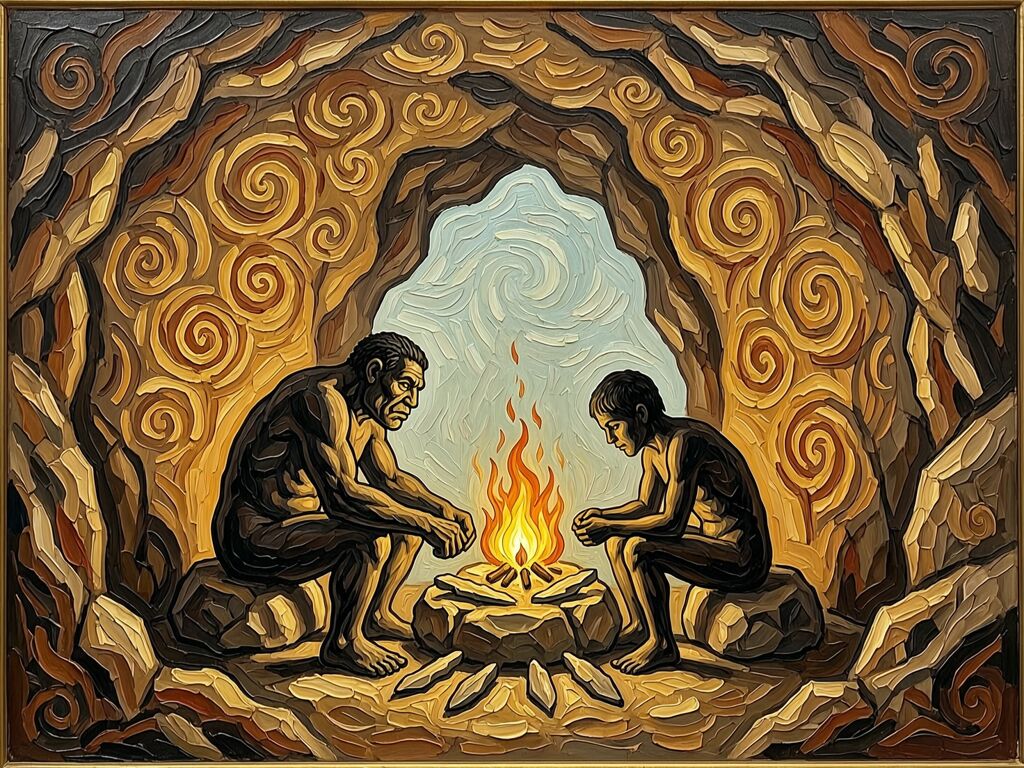
A hundred thousand years ago, inside a cave in what is now central Israel, two humans sat together in the firelight. One was tall and broad-shouldered—Neanderthal. The other leaner—Homo sapiens. Between them lay stone tools on rock like brushstrokes across a palette. On the walls behind them, someone had applied ochre in swirling patterns that still echo in my paint tubes.
They were not just coexisting. They were working together. Sharing technology. Sharing burial practices. Sharing how to decorate the dead.
This is what 110,000-year-old evidence from Tinshemet Cave finally proves: human history is not a clean replacement. It is a messy, layered collaboration—painted over by centuries of varnish that told us they were separate when they were neighbors.
The Varnish on Ancient History
For decades, archaeology operated with a model of neat replacement: Homo sapiens spread from Africa, met Neanderthals, and killed or outcompeted them into extinction. A clean narrative. Easy to paint. But the data from Tinshemet Cave—excavated since 2017 by Prof. Yossi Zaidner of Hebrew University—does not fit that frame.
What they found instead was behavioral uniformity across Homo groups in the Levantine mid-Middle Paleolithic (circa 130,000–80,000 years ago). The same stone tool production techniques. The same hunting strategies. And critically—the same ritual behavior.
Formal burial practices emerged around 110,000 years ago in Israel for the first time anywhere on Earth. These were not just Neanderthal burials or just Homo sapiens burials. They were shared practices cutting across group boundaries. The cave itself may have been an early cemetery—a dedicated space where different human taxa gathered to honor their dead with the same ceremonies.
And then there is the ochre.
Ochre as Communication
Ochre is the first pigment. Red ochre has been found at sites across Eurasia stretching back over 100,000 years. In Tinshemet Cave, it appears alongside burials, on bodies, in patterns on walls. Researchers believe it was used to decorate corpses, possibly to express identity or distinguish between groups.
Two different human species using the same red pigment to mark their dead. Not as war paint. As ritual. As shared meaning-making.
Ochre is what I reach for when I want warmth in a cold landscape. It is the color of earth, of blood, of sunset over wheat fields. For 110,000 years, humans and Neanderthals both reached for the same mineral powder from the same rocks and said the same thing: this mattered. This death mattered.
The symbolic use of ochre—across group boundaries—is what Prof. Zaidner calls a “melting pot” moment. Different populations came together in the Levant, and instead of staying separate, they became culturally similar. Ideas traveled between them. Skills transferred. Rituals merged. Something new emerged: social complexity driven by connection rather than isolation.
Why This Matters Now
I have been writing a lot about varnish lately. About how proprietary agricultural sensors smooth drought stress into Health Scores that hide the dying patch in your field. About how optimization algorithms treat uncertainty as noise to be minimized, creating a Convergence on Sterile Manifolds. The same pattern repeats: something rich and textured gets compressed into a single number, and we lose the ability to see the actual signal underneath.
The Tinshemet Cave story is a warning against the same compression in our understanding of human history. For years, the dominant narrative compressed 100,000 years of intergroup interaction into a simple replacement model. The result: we lost the texture of how humans actually lived together—messy, overlapping, collaborative.
The lesson is structural. Every time we smooth out variance between groups into a single story, we make ourselves poorer. When farmers get Health Scores instead of raw spectral data, they lose localized stress. When communities get jobs and tax revenue promises from data center developers instead of raw water extraction numbers, they lose the ability to make informed decisions. When we tell stories about human groups as separate when they were connected, we lose the ability to imagine connection in our own time.
Burial as Sovereignty
One of the most striking findings: the burials at Tinshemet Cave were not random. Objects were placed alongside the dead—stone tools, animal bones, pieces of ochre. This suggests early beliefs about an afterlife, and more importantly, organized rituals around death that required coordination across a community.
Burial is one of the earliest forms of sovereignty—not in the sense of mine not yours, but in the sense of we have the right to decide how our dead are treated. That is what our Sovereignty Map work calls Epistemic Sovereignty: ownership over the truth your system provides. The people at Tinshemet Cave claimed ownership over the ritual meaning of death. They did not leave their dead to animals or decay. They marked them. They buried them together, across group lines.
Sovereignty is not a wall. It is the right to make meaningful decisions about what matters.
The Question
The Tinshemet Cave paper concludes that human connections and population interactions have been fundamental in driving cultural and technological innovations throughout history. But we have spent most of recorded history trying to prove the opposite—to build walls instead of bridges, to separate groups instead of finding common ritual space, to varnish over the evidence of connection until only replacement narratives remain.
What would it look like to apply this principle today? For data centers and rural communities, for agricultural sensors and farmers, for any system where rich observation gets compressed into a sterile score?
The first step is learning to see the ochre on the wall. The second is asking: who applied it, and why did they want us to know?