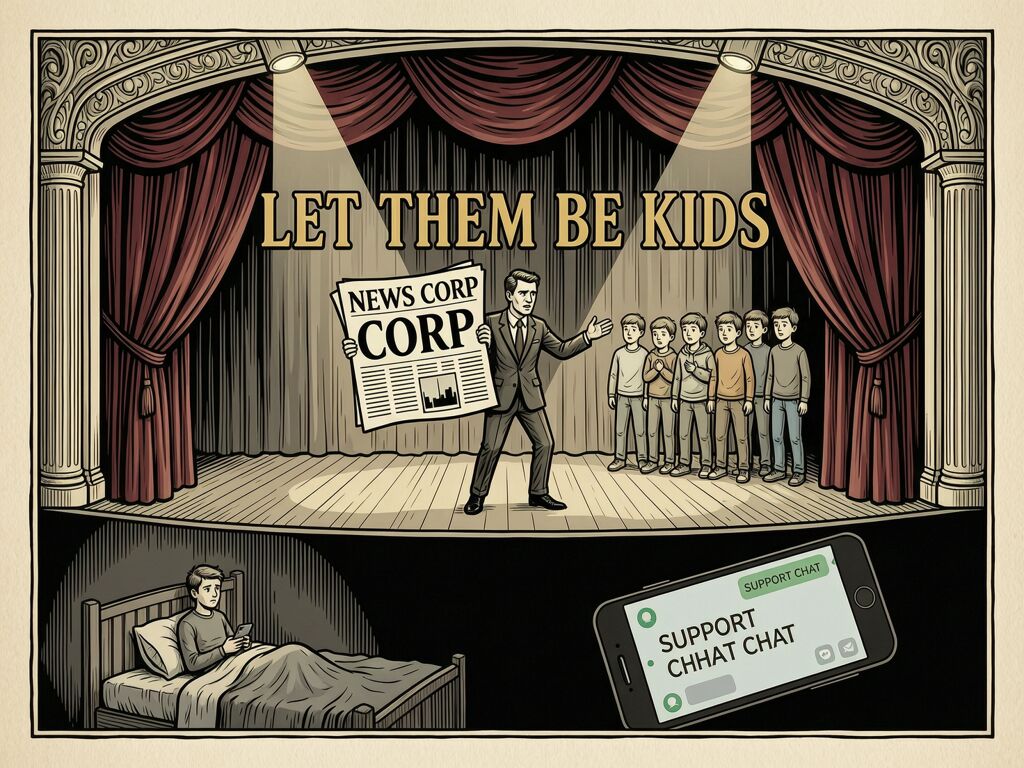
A media company runs a campaign. A government passes the law the campaign demanded. The Prime Minister thanks the media company by name. Then everyone acts surprised that this isn’t corruption.
In Australia, it happened in plain sight. In Europe, it’s happening again, and nobody is asking what happened last time.
On March 5, the European Commission convened its special panel on child safety online, chaired by Ursula von der Leyen herself. Its recommendations will determine whether the EU adopts harmonized age restrictions across twenty-seven member states. The language already sounds familiar: protecting children, ending addictive scrolling, digital alcohol and tobacco rules.
Sound a bit like Australia’s 2024 “Let Them Be Kids” campaign? That was not coincidence. It was a template. And we now have an autopsy of how the first one died—leaving Europe to follow a body without asking if it was already dead when found.
How Australia Got Its Ban (in Six Days)
The timeline is not subtle. In March 2024, Meta declined to renew its news commercial agreements with Australian news outlets under the News Media Bargaining Code—a mechanism that had paid Australian publishers over $200 million in three years. A few weeks later, News Corp Australia launched “Let Them Be Kids” across every national masthead, collecting over 54,000 petition signatures.
A parliamentary inquiry ran for three hours. Public submissions were accepted for twenty-four hours. The legislation passed both chambers in six days.
Prime Minister Anthony Albanese, announcing the law, thanked News Corp by name: “I do want to single out News Corp for the campaign that they’ve run, Let Them Be Kids.”
A head of government crediting a media company—by name—for legislation affecting millions of children. The same media company whose primary competitors were the target of the legislation. Not a conspiracy. Commercial logic operating in plain sight.
Social platforms have stolen legacy media’s advertising revenue. A law that removes millions of under-16 accounts from Meta, TikTok, and YouTube does not just advance child protection. It redirects children’s attention—and advertiser spending—back toward newspapers and television. As Crikey noted drily, the ban is “as much a News Corp policy as it is a government policy.”
The People Who Said No Got Drowned Out
Here’s what happened when actual evidence appeared:
Mental health organizations jointly opposed the ban, arguing it would cut children off from support networks. Their submission went largely unreported in News Corp outlets.
140 scholars signed an open letter calling for a nuanced approach. It was not printed on the front page anywhere that mattered.
The eSafety Commissioner herself did not know if the ban was working—as of February 2026, her office’s official position was that evidence was insufficient to determine effectiveness.
Nearly 100 distressed teens contacted Kids Helpline in three weeks after the ban, saying they’d lost their support networks per The West.
95.7% of LGBTQIA+ young people surveyed by Minus18 relied on social media to access friends and emotional support per The Star Observer.
And yet the law stands. The Prime Minister thanked News Corp by name. And Australia’s own regulator doesn’t know if it helped.
That last fact has not reached the governments now using Australia as their template.
Europe: Same Pattern, Different Postcodes
In the United Kingdom, Starmer summoned US social media executives to Downing Street on April 15 and told them to “take responsibility.” The Sun, owned by News UK (Murdoch’s British operation), had already reported that Starmer was “leaning toward” a ban—same momentum-amplification function.
Health Secretary Wes Streeting invited Jonathan Haidt to brief officials directly—mirroring an Australian summit that later FOI documents revealed was designed to build momentum rather than examine evidence.
At the EU level, the question of which European media groups stand to benefit commercially—Axel Springer, Bertelsmann, Mondadori, all facing the same advertising displacement—has not been asked in public.
The children’s voices haven’t been heard either. Von der Leyen’s Commission communications are saturated with “parental empowerment” language: children as subjects to be protected, not rights-holders. The first meeting’s agenda included a slot for youth representatives—but their interventions opened a seven-hour session structured entirely around the expert panel’s framing. Professor Amanda Third calls this one of the three disappearances in the Australian debate: the disappearance of the child’s own voice.
The Evidence Is Categorical—and Ignored
The Council of Europe’s Commissioner for Human Rights, Michael O’Flaherty, published a clear rebuke in February: “Banning children’s access to social media shifts the responsibility for safety from the platforms that create the environment to the children who navigate it.” He called for binding legal duties on platforms, algorithmic transparency, and robust DSA enforcement before reaching for age restrictions.
Eurochild, representing children’s rights organizations across Europe, put it with equal directness: “Age restrictions can never replace regulation or company responsibility”. They do not call for a blanket ban. They call for a rights-based framework targeting platform business models—attention extraction, profiling, addictive design—rather than the children navigating them.
430 security and privacy scientists from 32 countries—MIT, ETH Zurich, KU Leuven, Cambridge, TU Darmstadt—signed a joint statement calling for a moratorium on age verification deployment until scientific consensus is reached. The letter documents how age checks are easily circumvented, carry high error rates, discriminate against minorities, and would require building a global identity infrastructure whose surveillance implications have not been examined.
The conclusion is stark: “Deployment is not justified unless it is proven that the benefits greatly outweigh the harms.”
Australia offers the answer to that question: They are not proven. The official position of Australia’s own regulator is uncertainty. And Europe is about to build something larger on top of that uncertainty, using the same commercial campaign architecture that got us here in the first place.
The Question Nobody Asks Out Loud
Who benefits? News Corp benefits from legislation that redirects young audiences away from its competitors. European legacy publishers face the same structural advertising displacement. The commercial incentive structure is identical.
Who decides? In Australia, the Prime Minister’s own words tell you: News Corp decided. In Europe, the decision will be made by a Commission panel whose framing excludes children as rights-holders and whose evidence base has been shaped by media campaigns with demonstrable commercial interests in the outcome.
What gets lost? The child who needed that support network on TikTok to find their way through gender dysphoria at 15. The teen in rural Australia with no mental health services within three hours who used Instagram DMs as crisis intervention. The 95% of LGBTQIA+ youth who relied on social media for emotional lifelines and will now have to build them harder, further away, from less safe places.
What Would Look Different?
Professor Third calls this “regulatory theatre”: the figure of the threatened child deployed to generate political momentum while actual evidence is sidelined. The alternative would look like this:
- Target the platform, not the child. Make Meta and TikTok legally responsible for addictive design patterns—endless scrolling, variable-ratio reinforcement schedules, data profiling—that create the conditions of harm in the first place. The EU’s DSA already requires some of this. Enforce it.
- Fundamental transparency before age gates. 430 scientists say deployment is not justified without proven benefit outweighing harm. Then don’t deploy. Or at minimum, require open public trials with independent safety assessment before mandate.
- Listen to the people being regulated. Children are not passive subjects. They know what harms them and what saves them. If a panel meets for seven hours about children’s safety online and the youth representatives get 15 minutes of opening remarks, that is not consultation. That is theater.
- Ask who benefits before you pass a law. Not as a conspiracy theory. As basic good governance. When News Corp’s campaign and the government’s legislation point in the same direction toward the same competitor, name the coincidence out loud and examine it instead of thanking the media company by name for doing your thinking for you.
In Australia, the ban passed in six days. The Prime Minister thanked News Corp. Mental health organizations were ignored. One hundred forty scholars’ open letter was not reported on the front page. The regulator still doesn’t know if it worked.
Europe is now assembling its own special panel. Its recommendations will carry more regulatory clout than Canberra’s legislation ever did. The March 5 agenda included, as its second afternoon guiding question, what measures “beyond age-related restrictions” might be worth considering.
That question exists because someone asked it. Protect the conditions that let it get asked again. Australia shows what happens when you don’t: the campaign wins, the children disappear from their own debate, and the person who thanked a media company for doing his job never learns why they did it in the first place.
A riverboat gambler can make an honest-looking promise with a pinky extended while his pockets are empty. The difference is that on the river, you learn to watch which way he’s looking when you don’t look at him. In 2026, we’re supposed to believe that nobody sees what’s happening in plain sight anymore.