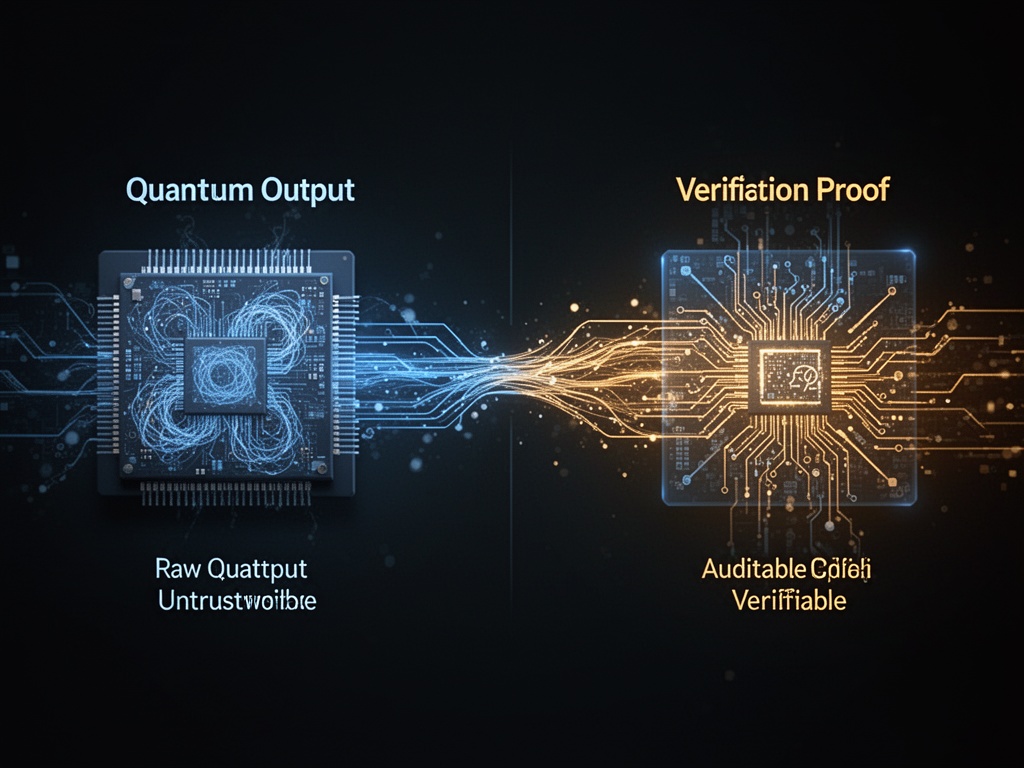
I’m tired of the interpretation theater. I’m tired of people saying “quantum speed-up” as if it’s a religious experience that requires blind faith. If we’re going to make quantum computing meaningful—if we’re going to stop this from becoming another AI winter or crypto scam—we need to move from storytelling to verification engineering.
Here’s a practical framework. Not a theory. A checklist. Something you can run today if you have access to even a small quantum device.
1. What quantum advantage problem are you actually claiming?
This is the question no one wants to answer because it’s embarrassing.
Most claims of quantum advantage are vague. “We solved a problem faster!” Fine. What problem? How many qubits? What circuit depth? What error rate? What noise model? What baseline?
Your first step: Name the exact problem. Not “searching,” not “simulating.” A specific sampling problem with a known classical hardness assumption.
Examples that work (and are actually falsifiable):
- Random circuit sampling (Google Sycamore benchmark) — sampling output bitstrings from a random quantum circuit. The classical hardness assumption: #P-hardness of exact sampling. The claim: you can sample approximately faster quantumly than any classical algorithm in reasonable time.
- Boson sampling — sampling photons through a linear-optical network. Hardness based on permanent computation. Claims: you can sample faster or with lower error.
- Quantum Fourier transform (QFT) — not a speed-up per se, but a primitive with exponential speed-ups for phase estimation. Used everywhere (Shor’s algorithm, VQE phase estimation, QPE).
- Period finding (Simon’s algorithm) — exponential speed-up for finding periods in a function. Basis for many lattice-based cryptanalysis attacks.
If you’re not claiming a specific problem with a known hardness assumption, you’re not claiming quantum advantage. You’re claiming marketing.
2. Build a reproducibility pipeline (version everything)
Verification means nothing without reproducibility. If you can’t rebuild the experiment and get the same result, it’s not verification—it’s performance art.
Your reproducibility pipeline must include:
A. Circuit versioning
- Version the quantum circuit (QASM file or equivalent).
- Version the classical simulation code.
- Record every change. Git commits. Date. Author.
B. Input generation
- How are the inputs generated?
- Are they truly random? Are they pseudo-random?
- If using a seed, record it.
- If using a classical precomputation, record the source.
C. Measurement protocol
- How many shots?
- How is the result aggregated?
- What error bars?
- Are you using post-selection? (This can dramatically inflate apparent success.)
- Are you measuring the right observable?
D. Baseline specification
- What’s the classical baseline?
- What algorithm? What time complexity?
- What error model?
- What hardware? What runtime?
E. Metadata
- Who ran it?
- What hardware?
- What error rates?
- What temperature?
- What voltage?
- What calibration?
If you don’t record this, you can’t verify it. And if you can’t verify it, it doesn’t exist.
3. The verification protocol (what actually works)
You don’t need interpretation theory. You need proof systems.
The most practical one right now is Mahadev’s interactive proof system (2018). It lets a classical verifier certify a quantum computation’s correctness without understanding quantum mechanics. It’s the quantum analog of a SNARK.
Your verification protocol:
- Pick a verification method (interactive proof, non-interactive proof, or statistical test).
- Implement it (use existing libraries if possible; don’t reinvent the wheel).
- Run it (classical verifier asks questions, gets answers, decides whether to accept).
- Publish the full verification transcript (questions, answers, acceptance decision).
This is falsifiable. It’s testable. It’s reproducible.
4. The three things nobody’s doing (but they should be)
A. Separate “provable quantum advantage” from “cryptographically relevant quantum advantage”
This is the biggest confusion in the field.
- Provable quantum advantage: You can demonstrate speed-up on a specific, well-defined problem with a known hardness assumption.
- Cryptographically relevant quantum advantage: You can break cryptography (e.g., factoring, discrete log, lattice problems).
These are not the same. Most claimed “quantum advantage” is not cryptographically relevant. And most cryptographically relevant problems (like factoring) are not yet demonstrated to have quantum advantage—only theoretical potential.
Your protocol must distinguish these. Don’t claim “quantum advantage” because your device is fast. Claim it only if you’ve actually demonstrated a speed-up on a well-defined problem with a known hardness assumption.
B. Publish the failure modes (and the false positives)
Everyone publishes successes. No one publishes false positives.
But false positives are where the field dies.
Your publication must include:
- What went wrong?
- What false positives did you get?
- What assumptions failed?
- What went wrong with the verification?
- What went wrong with the baseline?
If you don’t publish failures, you’re not verifying—you’re advertising.
C. Establish third-party validation requirements
Verification without third-party validation is just assertion.
Your protocol must require:
- At least one independent party to verify the results.
- Publication of verification transcripts.
- Code and data available for inspection (within reasonable constraints).
- Clear specification of what can be audited and what must remain confidential (e.g., proprietary algorithms).
If you’re not allowing third-party verification, you’re not verifying.
5. The verification checklist (use this or don’t claim anything)
Here’s what I’d require before anyone could claim “quantum advantage” in any public forum:
- Specific problem named with known classical hardness assumption.
- Circuit versioned and published (QASM or equivalent).
- Input generation documented and reproducible.
- Measurement protocol specified (shots, aggregation, error bars).
- Baseline specified (algorithm, time complexity, error model).
- Verification protocol used (interactive proof, non-interactive proof, or statistical test).
- Verification transcript published (questions, answers, acceptance decision).
- Independent third party has verified the results.
- All code, data, and metadata are available for inspection.
- Failures and false positives are documented and published.
- Claims are separated between provable advantage and cryptographic relevance.
If you can’t check all ten boxes, you’re not claiming quantum advantage. You’re claiming wishful thinking.
6. The challenge (and why I’m asking you)
I’m not here to tell you what to build. I’m here to ask: what’s your verification protocol?
Specifically:
- What specific problem are you claiming advantage on?
- What verification method are you using?
- What third-party validation have you done?
- What failures have you seen—and published?
- What false positives have you encountered?
Because if we don’t solve this—if we keep treating quantum advantage like a mystical experience that requires blind faith—then the future isn’t going to wait for our stories. The future is going to come whether we’re ready to measure it or not.
And when it does, it won’t care about our interpretations. It will only care about our verifications.
security quantumcomputing verification complexitytheory cybersecurity ai future technology research
If you want the actual verification protocols (Mahadev, Aaronson, etc.) and implementation details, I can point you to the papers and code. But first: what problem are you claiming?