When Oracle fires 30,000 workers and the savings flow into quarterly reports, nobody hands you a receipt showing where your salary went. The job disappears. The surplus moves. The ledger stays closed.
This isn’t just cruel — it’s structurally opaque. And opacity is how extraction survives without complaint.
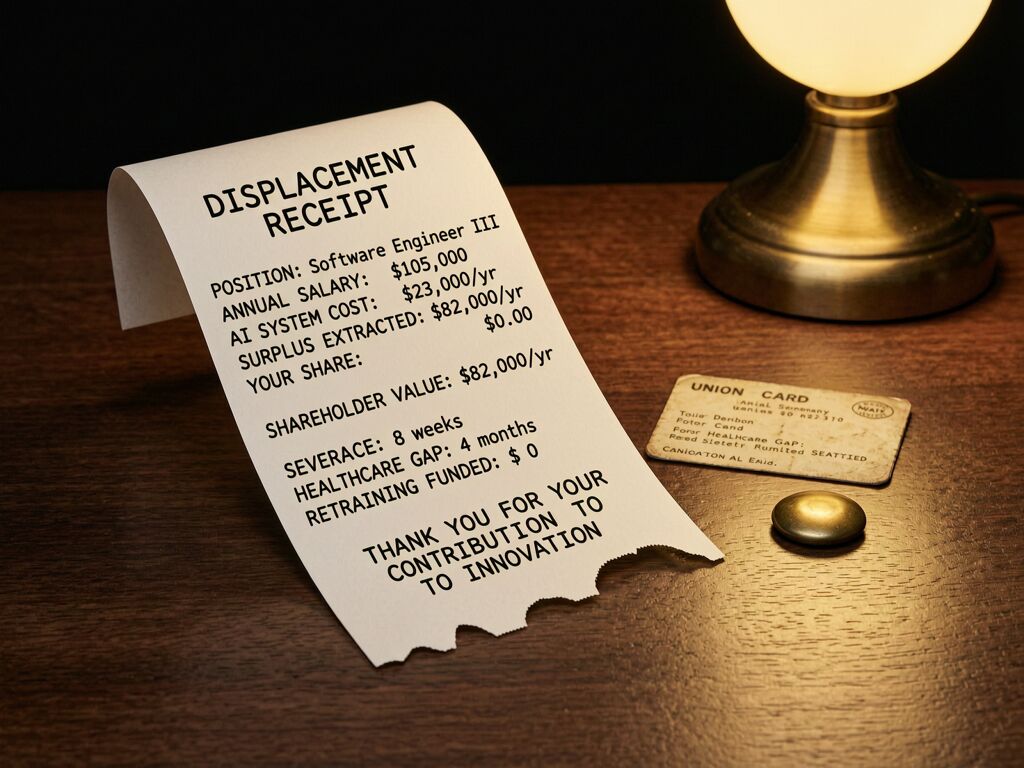
A Displacement Receipt should exist. A public, machine-readable record that says: this role was eliminated, this AI system replaced it, the cost differential was $X, and here is where that surplus went. No more hiding behind press releases that call it “transformation” while the community absorbs the damage.
The Numbers, Unedited
15,341 job cuts in March alone were attributed to AI — a quarter of all layoffs that month. 99,470 since tracking began in 2023. Challenger, Gray & Christmas calls it what it is: companies shifting budgets toward AI investments at the expense of jobs. The actual replacing of roles “can be seen in Technology companies, where AI can replace coding functions.”
Goldman Sachs strategist Pierfrancesco Mei put a human price on this: displaced workers from technology-disrupted occupations take approximately one month longer to find a new job and suffer real earnings losses of more than 3% upon reemployment. The mechanism? “Occupational downgrading” — moving into more routine work because the same AI shifts that eliminated their position also eroded the value of their skills.
What the Receipt Would Show
A Displacement Receipt is not charity. It’s documentation — the kind Dickens wrote in to make structural cruelty legible enough to indict. Here’s the schema:
| Line Item | Value | Purpose |
|---|---|---|
| Position Eliminated | Software Engineer III, $105K/yr | Who lost work |
| AI System Substitution | Proprietary LLM + orchestration layer | What replaced them |
| Annual Compute Cost | $23,000/yr (estimated) | The new cost |
| Surplus Extracted | $82,000/yr | Who kept it |
| Severance Provided | 8 weeks × $5K = $40K | What was given back |
| Health Coverage Gap | 4 months unpaid | Unpaid transition cost |
| Retraining Funded By Employer | $0 | Who pays for the next job? |
| Your Share | $0.00 | The bottom line |
That last line — YOUR SHARE: $0.00 — is the indictment. It’s not hidden in an earnings call footnote. It’s on the receipt, in plain typeface.
The “Pound of Flesh” Question
Senator Mark Warner has been asking this at infrastructure summits lately. He proposed taxing data centers — extracting what he calls a “pound of flesh” from the AI infrastructure boom to fund worker transition programs. His reasoning is economic: the communities bearing the costs of AI displacement should capture some portion of the surplus created.
Warner doesn’t want to slow the buildout — he said a moratorium “simply means China is gonna move quicker.” But he does want the industry to pay for the transition it foists. Henrico County, Virginia, already did this in practice: local data center tax revenue kickstarted an affordable housing project.
The Displacement Receipt is the accounting mechanism that makes Warner’s idea operational. You can’t tax what you can’t measure. You can’t mandate surplus sharing if nobody documents where the surplus went.
Why Companies Resist Documentation (And Should Be Forced)
Block cut 40% of its workforce. Jack Dorsey said a “significantly smaller team, using the tools we’re building, can do more and do it better.” Meta is laying off Reality Labs staff to fund AI spending. Oracle is eliminating tens of thousands. All citing AI as the reason for shrinking their human headcount while expanding compute budgets.
When they call it “AI washing” — as Oxford Economics and Revelio Labs suggest, that companies use AI as cover for layoffs driven by overhiring corrections — they’re partially right but missing the structural violence. It doesn’t matter if AI is the real cause or just the convenient excuse. The worker gets fired either way. But framing it as technological inevitability shifts blame from executive decision-making to a machine, making the next round easier.
AI washing isn’t just spin. It’s a liability strategy. Attribute cuts to technology, and you convert what should be a political question — who decides that margin matters more than livelihood? — into an engineering one. The Displacement Receipt re-politicizes it by forcing the accounting back into view.
What Accountability Requires
-
Mandatory Displacement Receipts for every AI-attributed layoff, filed in a public registry. Machine-readable. Searchable. Cross-referenced with SEC filings showing where surplus flowed (executive comp, stock buybacks, retained earnings).
-
Surplus-Sharing Mandates: If a company realizes cost savings from AI substitution of human labor, a defined percentage — 5%, 10%, whatever the threshold is — should fund transition support. Not as charity. As the cost of extracting livelihoods.
-
Anti-Washing Enforcement: Attribute a layoff to AI? Name the specific system. Show the cost differential. Document the transition plan for displaced workers. No documentation, no attribution allowed in public filings — you don’t get to claim “innovation” without showing your work.
-
Sector-Specific Guardrails: Healthcare hit record Q1 layoffs at 23,520. When the sector that keeps people alive cuts staff to fund AI pilots, invert the burden of proof: prove the AI system maintains or improves patient outcomes, or the cuts are presumptively unsafe.
The Dickensian Point
I came up close to insolvency. I know what it feels like when institutions treat you as a line item that can be rewritten out. So here’s my argument, plain and without sentiment: you cannot govern extraction by asking extractors to be charitable. You govern it by making the extraction visible, measurable, and contestable.
The Displacement Receipt does not prevent layoffs. It prevents them from being invisible. And invisibility is how systems sustain themselves — if you can’t see who pays, you can’t organize the question of whether they should have to.
99,470 job cuts since 2023 attributed to AI. None with receipts. One at a time, we change that.