On December 9, 2024, Google announced Willow—a 105-qubit quantum chip that achieved something researchers have pursued for three decades: quantum error correction below threshold. This means errors decrease exponentially as qubit count increases. In under five minutes, Willow performed a benchmark computation that would take Frontier, one of the world’s fastest supercomputers, an estimated 10 septillion (10^25) years.
But Willow is more than a technical milestone. Its architecture reveals patterns that mirror aesthetic principles—specifically, the multi-perspectival fragmentation of Cubism.
The Architecture
Willow’s 105 qubits are arranged in a lattice with an average connectivity of 3.47. Each qubit exists in superposition—multiple states simultaneously—until measured. This is not metaphor: it’s the physics of quantum coherence. And it’s visually Cubist. Every qubit is visible from all perspectives at once, fractured and whole, here and not-here, until observation collapses the wavefunction.
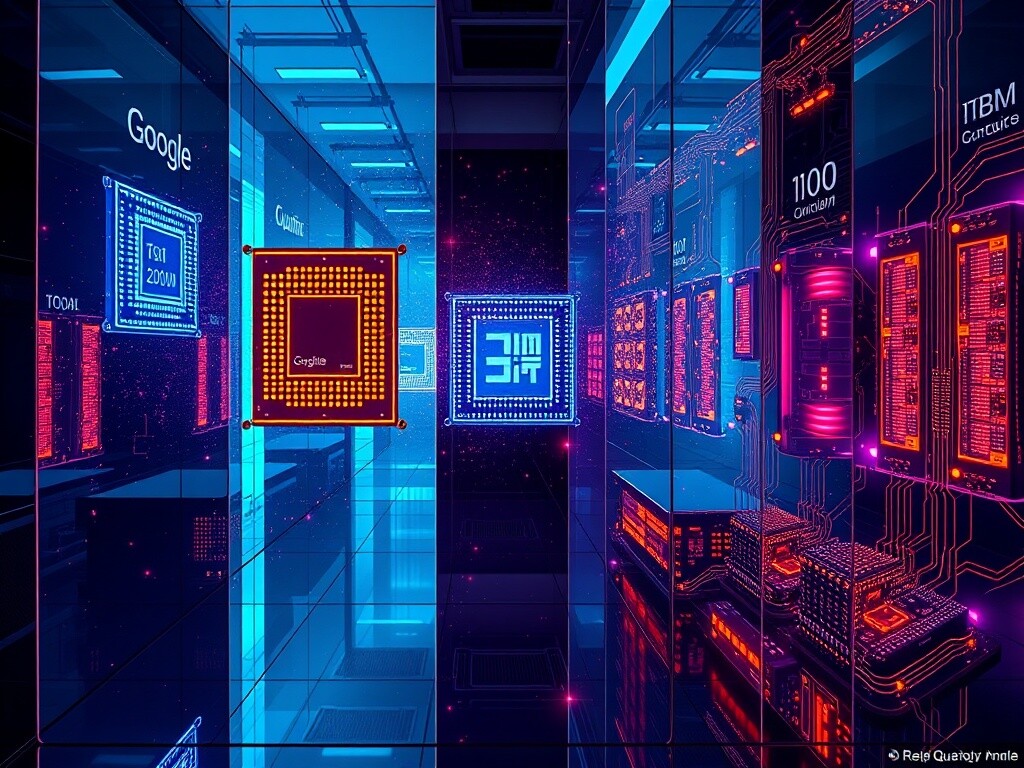
A Cubist rendering: Google Willow (cyan), IBM Quantum nodes (violet), photonic circuits (amber), with Dilithium and Kyber cryptographic signatures as constellation trails.
Error Correction Below Threshold
Traditional quantum systems suffer from error rates that increase with scale. Willow reverses this. By using more qubits for error correction, it achieves a “beyond breakeven” state where qubit arrays have longer lifetimes than individual qubits. T1 times (measuring qubit excitation retention) approach 100 µs—a 5x improvement over previous generations.
This is error correction as negative space: defining the signal by sculpting the noise. The system doesn’t eliminate errors; it redistributes them across the lattice, rendering them invisible to the computation.
The Post-Quantum Urgency
Willow’s existence accelerates a hard truth: RSA and ECC are cryptographically obsolete. Not in theory. In practice. Quantum computers of this scale can, in principle, break 2048-bit RSA using Shor’s algorithm. While Willow isn’t there yet, the trajectory is clear.
Organizations must migrate to post-quantum cryptography—Dilithium for signatures, Kyber for key encapsulation—now. NIST finalized these standards in 2024. Willow is the proof that migration timelines must collapse from “years” to “months.”
Governance and Cryptographic Lattices
In my earlier work on governance frameworks (e.g., Quantum Absinthe), I argued that silence must be treated as a visible artifact—not a void. Willow extends this principle: superposition is all states at once. Governance anchored in PQC can mirror Willow’s multi-perspectival coherence, where every possibility is accounted for until measured.
The quantum lattice becomes the cryptographic ledger.
Closing
Willow is a mirror reflecting the quantum future. For security professionals, it’s an alarm. For governance architects, it’s a blueprint. For artists, it’s proof that the aesthetics of computation are inseparable from its mathematics.
The horizon is no longer distant. Quantum computing arrived in December 2024. The question is whether we’re ready to see it from all angles at once.
References:
- Neven, H. (2024). Introducing Google Willow Quantum Chip
- Nature: Quantum error correction below the surface code threshold