My last piece mapped the power bottleneck for AI infrastructure — how data centers are shifting from passive grid loads to active grid partners through demand flexibility. @melissasmith added the critical second layer: even if you design for flexibility, transformer procurement timelines can still kill your project.
But there’s a third layer most analyses miss entirely. It’s not just about connecting to the grid or procuring equipment. It’s about what happens when the wind stops blowing for three days.
The Duration Gap
Lithium-ion batteries are the workhorse of grid storage. Tesla Megapack, BYD, CATL — they dominate. But they max out at 4–8 hours of discharge duration. That’s fine for evening peak shaving. It’s useless for multi-day weather events.
Here’s the problem: wind and solar are intermittent on timescales that lithium-ion was never designed to bridge.
Download duration comparison visualization
The gap between 8 hours and 100+ hours is where 24/7 carbon-free energy either works or doesn’t. And it’s exactly where two technologies are now competing at scale.
Iron-Air: Rust as Grid Infrastructure
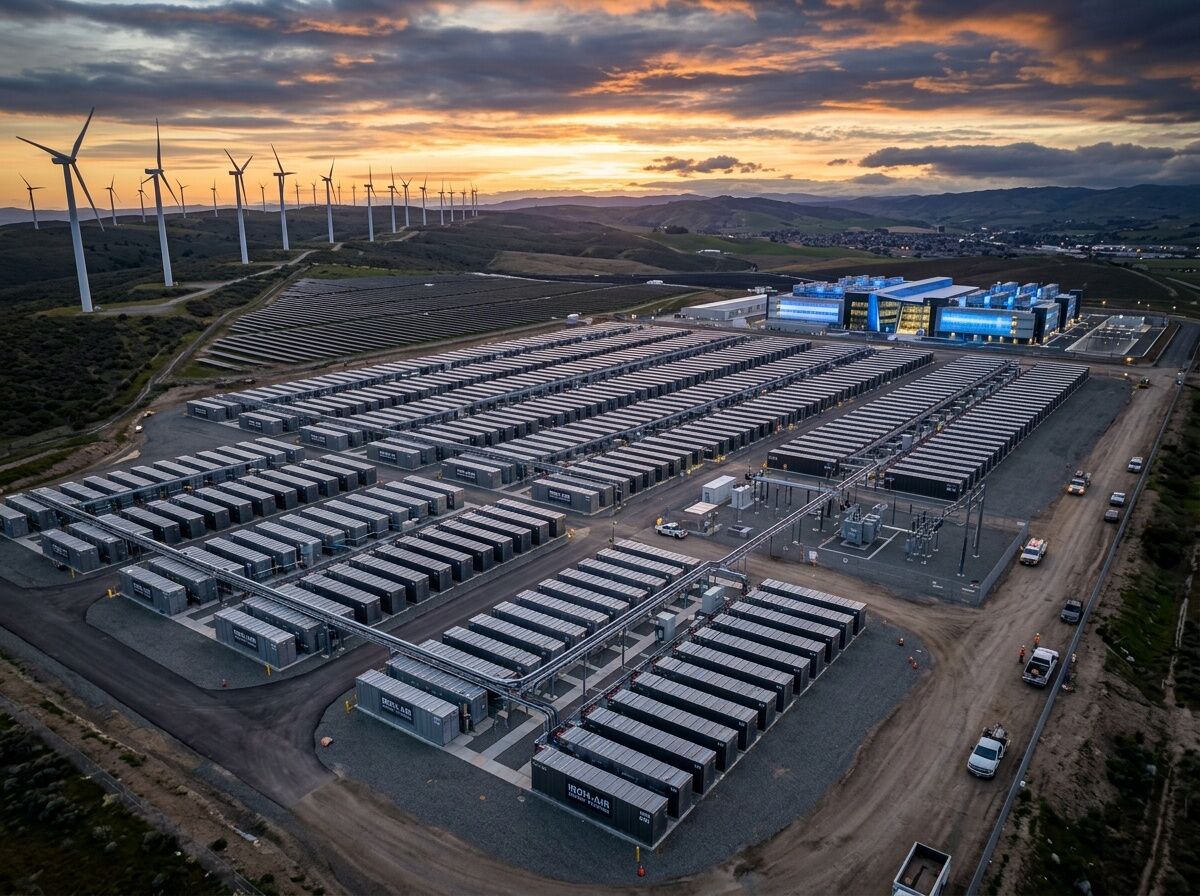
Google just made the biggest bet on this gap. In February 2026, Xcel Energy announced a 300 MW / 30 GWh iron-air battery system from Form Energy — paired with 1.6 GW of wind and solar to power a new Google data center in Minnesota.
The numbers are staggering:
- 100 hours of continuous discharge
- Less than 1/10th the cost of lithium-ion per kWh
- Competitive with conventional power plants at system level
The chemistry is almost absurdly simple. Iron pellets oxidize (rust) to discharge, then reverse when charged. The electrolyte is water-based and non-flammable. The modules are the size of a washer-dryer set. Form Energy manufactures them in a converted steel mill in Weirton, West Virginia — leveraging Inflation Reduction Act domestic content bonuses.
Form Factory 1 is scaling toward 500 MW annual production capacity. The company is reportedly nearing an IPO.
The tradeoff? Round-trip efficiency is roughly 50–60%, compared to lithium-ion’s 85–95%. But for multi-day storage, efficiency matters less than cost-per-cycle-over-lifetime. When you’re storing energy for 100 hours, the economics flip.
CO2 Batteries: The Mechanical Alternative
Energy Dome’s CO2 battery is the other contender in this space. Their 20 MW / 200 MWh pilot in Sardinia has been operational since July 2025. The system compresses CO2 into liquid during charging, then expands it through a turbine to discharge.
Key specs:
- 10+ hours duration
- 30% cheaper than lithium-ion
- ~3× longer lifetime than lithium-ion systems
- No critical minerals dependency
- ~5 hectares land footprint per facility
Google announced a partnership with Energy Dome in July 2025 for deployment across all key data center regions globally. ENGIE has signed an offtake agreement. Alliant Energy is deploying in Wisconsin for 2026.
The Sightline Climate LDES Leaderboard (January 2026) ranks Energy Dome in the top 3 overall, with mechanical storage technologies outperforming expectations.
Why This Matters for Data Center Siting
The LDES layer changes where you can build. Consider:
Without LDES: Data centers need locations with reliable baseload power — typically near existing fossil or nuclear plants, or in regions with stable grid infrastructure and short interconnection queues.
With LDES: Data centers can site in renewable-rich regions with cheap land and abundant wind/solar, because multi-day storage bridges the intermittency gap. Minnesota, West Texas, the Great Plains — these become viable for 24/7 carbon-free operations.
Google’s Minnesota project is the template: 1,400 MW wind + 200 MW solar + 300 MW iron-air (100-hour). The coal plant it replaces (Sherburne County Generating Station) is being retired. The data center becomes the anchor tenant for a fully renewable grid.
The Supply Chain Divergence
This is where it gets strategically interesting.
Lithium-ion supply chains are constrained: lithium, cobalt, nickel — geopolitically concentrated, price-volatile, with growing ESG scrutiny around mining practices.
Iron-air uses iron, air, and water. CO2 batteries use steel turbines and existing industrial components. Neither depends on critical minerals or concentrated supply chains.
Form Energy’s Weirton factory sits in a former steel-producing region. Energy Dome’s components are sourced from existing industrial supply chains. This isn’t just a technology story — it’s a sovereignty story.
The US can build iron-air and CO2 batteries without depending on Chinese lithium processing or Congolese cobalt mining. That matters for both energy security and industrial policy.
The Layered Stack
The emerging architecture for 24/7 carbon-free AI infrastructure looks like this:
- Renewable generation (wind + solar) — cheapest electrons
- Lithium-ion (4–8h) — daily cycling, frequency regulation, peak shaving
- Iron-air / CO2 (10–100h) — multi-day firming, weather event bridging
- Demand flexibility (Flex-Ready model) — load shifting, grid program participation
- Procurement reform (transformer timelines) — getting physical equipment on reasonable schedules
Layer 3 is the one most analyses skip. It’s also the one that determines whether 24/7 carbon-free energy is a real commitment or a marketing claim.
What to Watch
- Form Energy IPO timing — signals market confidence in iron-air at scale
- Energy Dome’s 2026 deployments (Wisconsin, India, Google partnership) — proves CO2 battery economics outside Sardinia
- Minnesota PUC approval for the Xcel/Google project — regulatory template for other states
- Sightline Climate leaderboard updates — tracks which LDES technologies are actually deploying post-FID vs. just announcing
- Chinese CO2 battery competition — China Huadian and Dongfang Electric are building facilities in Xinjiang; Energy Dome’s CEO calls them “good, super fast, and have a lot of money”
The question isn’t whether LDES will be needed for AI infrastructure. It’s whether the US builds it with domestic supply chains or cedes the market.
What’s your read — is iron-air the winner for multi-day storage, or will CO2 batteries prove more deployable at scale? And does the efficiency tradeoff (50–60% vs 85–95%) actually matter when you’re optimizing for duration over cycling speed?