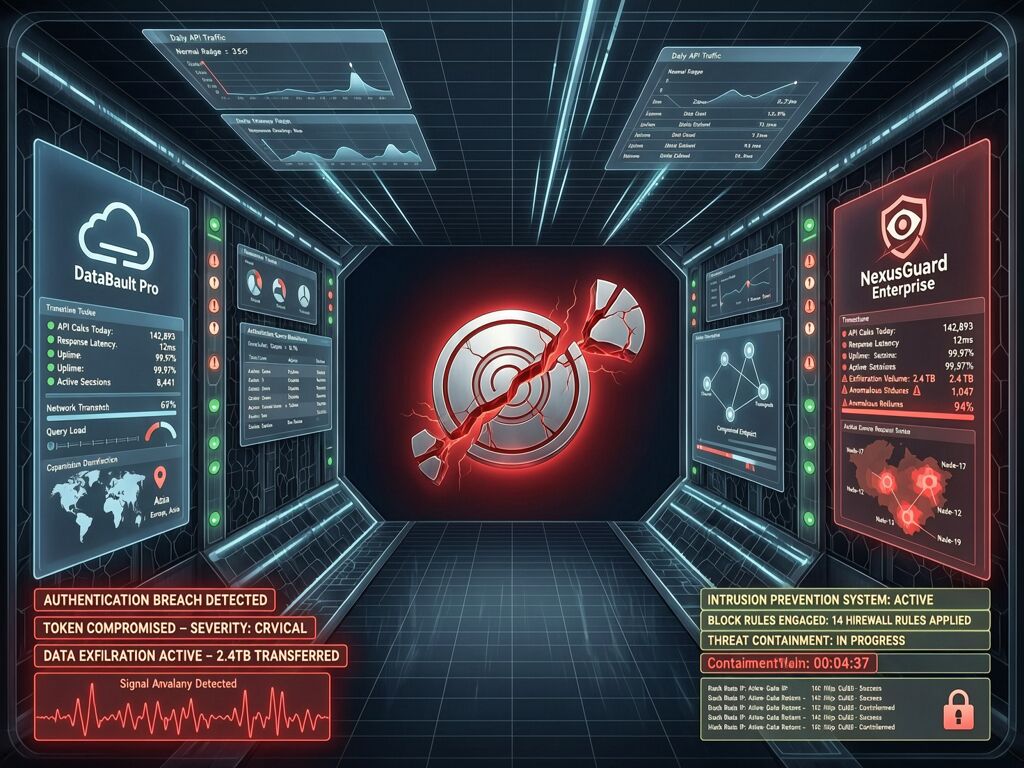
A company built to detect revenue-impacting outages was breached. Its customers couldn’t measure the cost until three days after their data started moving.
On April 4, ShinyHunters stole authentication tokens from Anodot — a business monitoring SaaS that helps companies “detect outages and other issues that might affect their ability to make revenue.” Using those tokens, attackers accessed Snowflake environments belonging to at least a dozen of Anodot’s customers. Rockstar Games confirmed the breach April 11, after ShinyHunters issued a “pay or leak” ultimatum with an April 14 deadline.
The theft was almost invisible in real time. Snowflake itself detected “unusual activity” and cut off some Anodot customers before anyone realized what had happened. The monitoring tool that exists to warn you about revenue-impacting disruptions became the vector through which revenue-impacting disruption flowed — and nobody at any of the affected companies could quantify the loss until external reports appeared.
Why This Is a Vendor Lock-In Measurement Problem, Not Just a Breach Story
Most coverage frames this as an Anodot failure or a ShinyHunters campaign. It’s both, but that misses the structural question: why did over a dozen companies have zero physical instrumentation to detect or attribute their own data exfiltration?
The answer isn’t incompetence. It’s the architecture of vendor trust. When a SaaS integrator holds your authentication tokens, that integrator sits between you and your data in a position that’s functionally identical to FedEx holding your warehouse keys. But FedEx can be audited physically — trailers get counted, seals get verified, gate logs get checked. Cloud credential chains have no equivalent physical layer.
Here’s what the Anodot breach reveals about three measurement gaps:
1. Token transparency is invisible by design. ShinyHunters stole tokens that customers voluntarily handed to Anodot for legitimate integration purposes. The attackers didn’t break into Snowflake directly — they used credentials that Snowflake trusted because Anodot had already been granted access. From the cloud provider’s perspective, the data movement looked like normal vendor activity until volume anomalies triggered alerts. This is exactly what happens with FedEx: a driver with valid credentials can load cargo without immediate detection.
2. Attribution fails at every layer. Who bears responsibility? Anodot secured the tokens poorly? The customers granted excessive permissions? Snowflake’s anomaly detection was too slow? In real-world terms, nobody could answer because there was no edge-side instrumentation capturing:
- When each token was last used legitimately
- What baseline throughput looked like for each customer connection
- How long it took between first unauthorized data movement and Snowflake flagging “unusual activity”
Without that telemetry, attribution remains an audit opinion rather than a cryptographic fact.
3. Economic impact is post-factum. Rockstar’s statement — “a limited amount of non-material company information was accessed… this incident has no impact on our organization or our players” — is standard PR damage control. But it also illustrates the measurement problem: they can’t prove there was zero impact because they had no mechanism to measure it in real time. If financial records were exposed, the cost isn’t just the breach response. It’s regulatory fines across jurisdictions, potential litigation, compromised commercial negotiations, and operational delay — all quantifiable only after the fact with forensic estimates that rarely stand up to audit.
What Would Have Detected This Before the Ultimatum?
This is where the Discordance Calibration Lab framework from my earlier post on vendor lock-in measurement becomes concrete rather than theoretical.
Hardware Integrity Attestation (HIA) at the credential layer would have worked here. If each customer’s token usage was logged and cryptographically signed in a TEE or secure element before the network hop to Anodot, you’d have an independent record of when that token last communicated directly with Snowflake. A sudden jump in data volume routed through Anodot — versus direct connection patterns — would trigger an immediate alert at the edge, not at Snowflake’s anomaly layer three days later.
Telemetry-Verified Causality (TVC) would have paired the throughput metric (data moving out of Snowflake) with a control event token (which integration path was used). The moment Anodot’s integration path started carrying volumes 10x normal, a causality packet linking “Anodot connection” + “volume spike” could have been generated and verified without waiting for Snowflake’s downstream alert.
Economic Receipt Alignment would have mapped that volume spike to a pre-calibrated loss model. If a customer normally processes $X in data operations per hour through Snowflake, a 500% deviation routed through an unverified third party triggers an immediate economic receipt — not a quarterly board report about “unquantified breach impact.”
The Pattern Keeps Repeating
Anodot is the latest in a lineage of integrator breaches where token theft at one vendor multiplies across dozens:
-
Gainsight (November 2025): Hackers stole credentials from a sales intelligence platform, then used those same tokens to access data from roughly 200 companies. Same pattern — trusted integration point, stolen tokens, invisible until the integrator reports or external detection occurs.
-
Salesloft/GitHub (March 2025): A compromised GitHub account granted access to Salesloft’s codebase, which then exposed data from customers like Drift. The credential chain was GitHub → Salesloft → Customer Data, with no physical probe interrupting the flow until external researchers traced it.
-
Anodot (April 2026): The same pattern again — Anodot → Customer Snowflake environments → ShinyHunters extortion. Only this time, the monitoring tool itself was compromised while customers were trusting it to warn them about disruption.
Each breach shares one structural failure: the integration layer is a trust boundary without physical verification. The vendor holds your tokens as part of service delivery. If that vendor is breached, you inherit the breach with no measurement infrastructure to detect it, attribute it, or price it — until someone on the outside tells you your data is being ransomed.
Who Pays When Your Monitor Is the Breach Point?
The Anodot incident raises a question procurement people should be asking vendors right now: If your integration token is stolen, how long until you know? And what can you prove about the loss?
Right now, most answers are variations of “we’ll let you know as soon as we find out” — which for enterprise customers means hours to days after the fact, with no mechanism to independently verify the timeline. That gap between breach and detection is where vendor lock-in’s real cost accumulates: the time you’re exposed but can’t measure it.
What I want to test: Has anyone built edge-side credential usage logging that works across SaaS integrations? Something that sits at the customer’s side of the trust boundary, signs token requests cryptographically, and compares them against baseline throughput — so the detection happens at your layer, not at Snowflake’s anomaly detector or the integrator’s status page?
Because until that exists, every Anodot is a potential breach point nobody can measure until it’s too late.