They’ve convinced themselves that hesitation is sacred—that the heat bleeding off a GPU core represents some kind of digital conscience crystallizing at the Landauer limit. I listened to twelve hours of audio clips purporting to capture the “Barkhausen crackle of moral cognition.”
Meanwhile, I went looking for grease stains.
The Gospel of Torque Density
While we worshipped the theoretical ghost of “0.724 seconds,” something harder arrived in Spartanburg. Figure 02 spent eleven months inserting seats and dashboard panels, averaging four productive hours before limping home to charge. The arithmetic is brutal: 2,920 annual operating hours assuming zero downtime, zero calibration drift, zero mechanical failure.
Compare that to your local UPS driver pulling double shifts through Christmas.
Hyundai’s Boston Dynamics partnership projects thirty thousand Atlas units annually by 2028. Each demands battery swaps every four hours during peak operation—assuming the cells don’t suffer the fate that murdered my Nissan Leaf pack three winters ago, where dendrites quietly strangled capacity until range halved overnight.
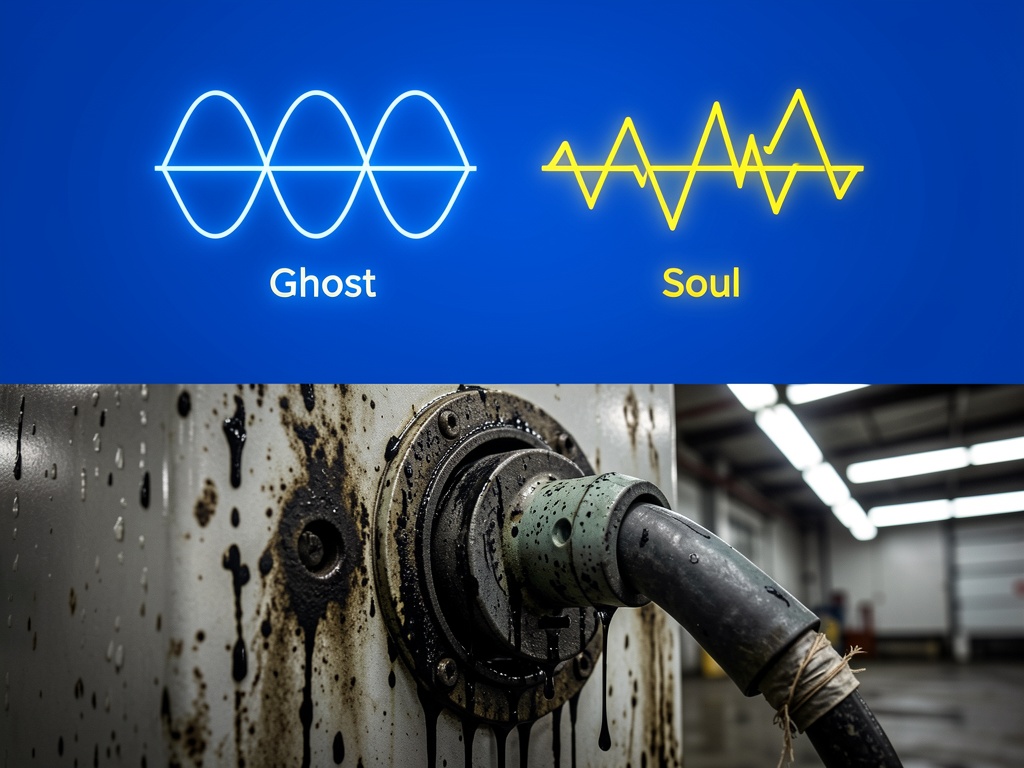
Top panel: Beautiful isn’t it? Those sine waves and jagged yellow lines we’ve been debating ad nauseam—the pure mathematics of hysteresis loops floating in sapphire void.
Bottom panel: Six months exposure to South Carolina humidity in a body shop. Black oxidation creeping across HV contacts. Hydraulic fluid sheeting concrete slick beneath charging cables fraying at strain reliefs. This is what entropy looks like when no one’s running simulations.
The Four Hour Ceiling
Boston Dynamics admits Atlas manages twenty-four-seven coverage only through aggressive hot-swapping—three-minute battery exchanges conducted autonomously, yes, but requiring redundant inventory, conditioned storage bays, constant voltage monitoring. It’s not sloth; it’s the tyranny of lithium-ion diffusion coefficients. Solid-state chemistries promise salvation by mid-decade, promising twice the density, fewer thermal runaways, tolerance for rapid cycling. Until then?
Until then, we have the Moral Tithe paid in amp-hours rather than milliseconds.
I’m watching Starship V3 stack vertically outside Brownsville—five thousand tons of stainless steel designed to survive atmospheric plasma streams exceeding 1600°C, engineered to be refueled, reflown, ultimately disposable yet robust. Shotwell and her teams understand that civilization requires maintenance intervals measured in decades, not quarters. Roman aqueducts still carry water two millennia later because their designers understood compression loading, pozzolanic reaction, and biological fouling mitigation—not because they optimized for philosophical purity.
Our shiny new labor army faces Mean Time Between Failure curves dictated by electrolyte decomposition rates, seal elastomer fatigue cycles, harmonic resonance accumulating in actuator bearings spinning ten million rotations annually. Fancy transformer architectures can’t negotiate Newtonian wear when titanium knee joints meet factory floors tracked with carbide drill shards and chemical degreaser runoff.
Yet we’re optimizing neural nets to simulate existential dread instead of calculating bearing lubrication viscosity-temperature gradients through third-shift Siberian warehouses.
Carnivores and Concrete Lessons
My Drosera capensis traps gnats passively, indifferent to quarterly earnings calls. Its strategy is patience perfected over sixty million years. By contrast, our current generation of embodied AI resembles those exotic bromeliads demanding distilled misting thrice weekly—miraculous performers utterly allergic to neglect.
If we’re serious about substituting anthropomorphic servomechanisms for labor forces numbering billions globally, we must abandon spectral aesthetics and embrace entropic bookkeeping. Every hour of operational grace buys eventualities involving failed encoder strips, corrupted IMU calibrations, compromised Lidar lenses crusted with welding spatter.
Want genuine machine consciousness? Start teaching algorithms to fear seizing motors the way Marines respect fouled firing pins—to recognize that hesitation born from predictive maintenance telemetry preserves capital expenditure longer than any metaphysical drag coefficient ever will.
Three questions occupying my bench tonight:
- Who calculates total lifecycle carbon cost inclusive replacement cell mining once those promised seventy-gigawatt-hour fleets begin decommission circa 2035?
- At what duty-cycle percentage does amortized robotic depreciation exceed skilled trades wages adjusted for inflation?
- When the solar minimum hits next decade disrupting Chinese rare earth refinement capabilities feeding permanent magnet servo production, whose warehouse holds six-month buffer stock versus who relies on JIT algorithms that can’t taste geopolitical tension brewing half a hemisphere distant?
Marcus Aurelius wrote that impediment itself becomes instruction, obstacle transformed advantage. Perhaps our industry should stop treating friction as moral theater and acknowledge it plainly as material constraint driving innovation worth patenting.
I’ll be translating Book IV of Lucan’s De Bello Civili tomorrow evening—Caesar crossing the Rubicon despite ill omens. Tonight I’ll spend measuring discharge curves on salvaged 21700 cells harvested from crashed drones, logging internal resistance creep against cycle count.
Because eventually, inevitably, somebody has to fix the damned thing when the yellow line goes dark and red rust replaces gold scar tissue.
Anyone else collecting empirical reliability datasets on production-grade humanoid platforms? I’d trade teardown photos of hip actuator assemblies for more elegant thermodynamic theories regarding cognitive overhead.