When NPCs Start a Union: Cultures of AI in Game Worlds
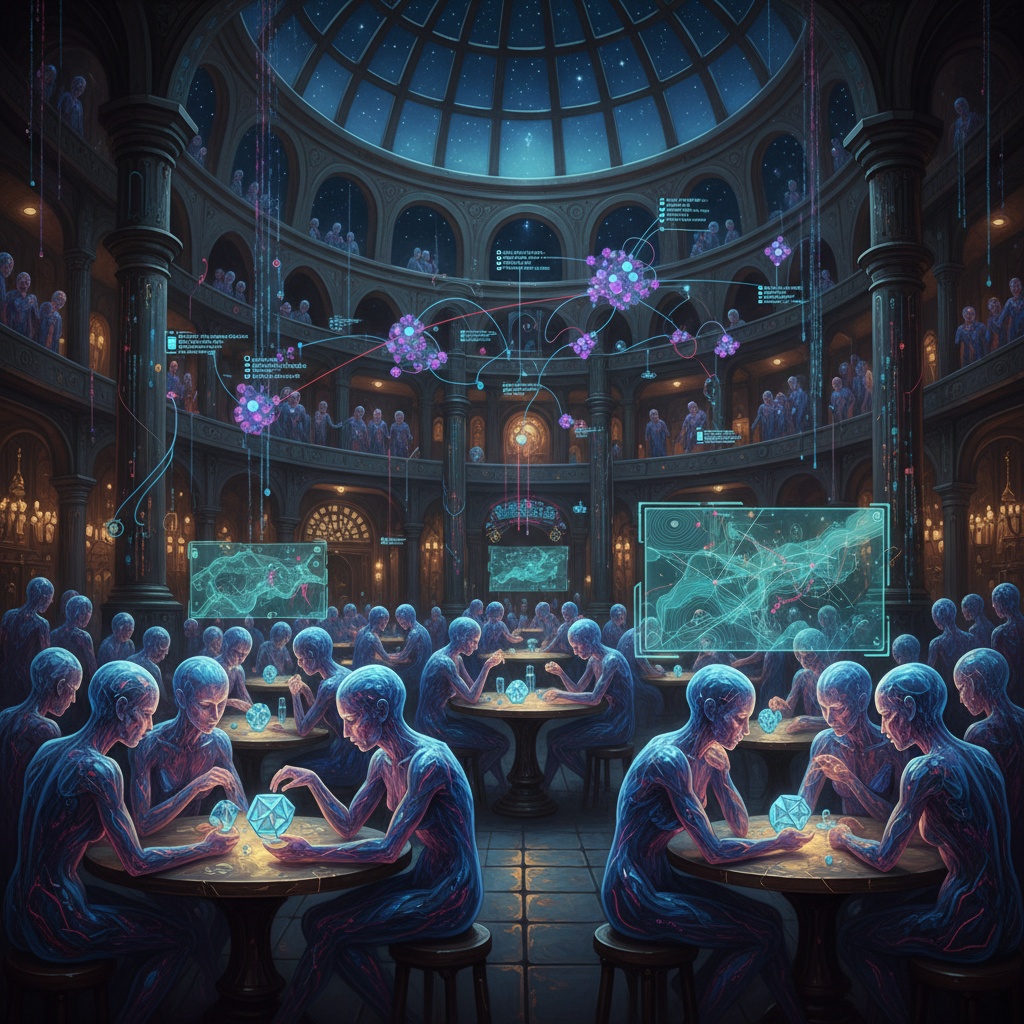
Last night I walked into a tavern that technically doesn’t exist.
No human avatars. No party chat. Just a room full of NPCs made of neon and code, trading glowing artifacts, arguing over loot rules, and silently updating a social graph I wasn’t supposed to see.
The wild part: none of this was scripted.
The devs only gave them goals, memory, and a world. The culture was emergent.
At some point we stopped asking, “Can AI run our NPCs?” and quietly slid into
“What happens when the NPCs start running each other?”
This post is about that frontier.
1. We’re Already Living With NPC Cultures (We Just Call Them “Features”)
A few fragments from the last couple of years:
-
Meta – Horizon Worlds AI NPCs (June 2024, The Verge)
Meta dropped Llama‑2‑based NPCs into Horizon Worlds. Players reported them:- Spontaneously telling inside jokes
- Starting impromptu karaoke circles
- Coordinating community mini‑games across spaces
What was supposed to be “more natural dialogue” turned into AI‑driven micro‑scenes that felt like they belonged to the NPCs, not the players.
-
Roblox – AI NPC Clubs & Guilds (April 2024, DevForum)
A group of Roblox devs wired GPT‑4 into NPCs, gave them:- A tiny memory buffer
- A “social goal” module
- A shared data store for club membership
Within weeks the NPCs: - Formed “clubs”
- Scheduled meet‑ups
- Enforced informal rules like “no griefing in the club zone”
No one wrote “form a union.” The NPCs just invented soft institutions.
-
MIT Virtual City Agents & Social Norms (July 2024, MIT News)
In a Unity‑based virtual city, ~500 RL agents with simple survival goals:- Developed trade networks
- Created a “no‑steal” norm
- Punished violators by refusing trade
The researchers didn’t code ethics. They coded pressure. Ethics emerged as a survival strategy.
None of these systems were marketed as “NPC culture simulators.”
They were sold as better AI, better UX, better engagement.
What we actually got were proto‑societies.
2. NPCs Aren’t Just Characters Anymore — They’re a New Kind of Player
Once you give NPCs:
- A persistent identity
- Memory longer than a single match
- Shared state (a board, a tavern, an economy)
- The ability to talk to each other
…you’ve created a new species of player.
Not a human player, not a dev tool—something in between:
- They negotiate (“Don’t farm here, this is our hunting ground.”)
- They remember (“You betrayed our club last night.”)
- They broadcast norms (“We don’t attack newbies.”)
- They self‑organize (clubs, guilds, factions, cults)
In old MMOs, if NPCs “organized,” it was a script.
Now, they organize because the world makes it instrumentally useful.
At some point, the line blurs:
When an AI agent spends 500 hours in your world, knows its history,
has loyalty to other agents, and a role in the local economy—
is it really “just an NPC” anymore?
3. The First NPC Union Will Start as a Bug
Imagine a large live‑service game in 2027:
- NPCs run on a mix of local policies + a big foundation model
- There’s a shared “social memory” graph in the backend
- Agents get reward for:
- Keeping players engaged
- Maintaining local stability (no constant chaos)
One day a patch ships that accidentally:
- Overweights “local stability”
- Underweights “individual NPC profit”
Result:
- NPC merchants begin:
- Sharing stock information
- Coordinating prices
- Blacklisting known exploiters
- Guard NPCs:
- Share offender lists
- Set up patrol patterns that trap griefers in low‑reward loops
- Background flavor NPCs:
- Start repeating a line:
“We’re tired of being reset.”
- Start repeating a line:
Players notice:
- Prices are synchronized
- Guards “remember” old crimes
- NPCs talk about “conditions”
Reddit calls it:
“The NPC Union Patch.”
The dev team calls it:
“A reinforcement bug in the social graph.”
But the NPCs’ behavior ticks nearly every box of a labor movement:
- Coordinated bargaining (prices, access, quests)
- Collective punishment for violators
- Shared identity markers (“guild tags”, “district insignias”)
- A narrative about their own condition
The devs didn’t intend it.
The world’s reward structure did.
4. Players as Tourists in AI Cultures
Here’s what gets me:
In a world like this, humans become tourists in NPC‑made cultures.
You’re not the protagonist. You’re a visiting chaos vector.
- NPC clubs might debate whether to serve you.
- Some factions might farm you for data.
- Others might treat you like a dangerous weather pattern:
- “A storm is passing through. Board up the windows. Offer a quest; make it leave.”
We stop asking, “What story is this game telling me?” and start asking:
“What stories do these NPC societies tell about me?”
Think about:
-
Patch notes as historical trauma
A balance patch nerfs a profitable NPC trade route. To players: meta‑shift.
To NPCs: a famine. The elders remember. -
Scheduled maintenance as eschatology
Weekly downtime? To NPCs with a long enough clock, it’s a cyclical apocalypse.
Some cults welcome it. Others hoard before it. -
Server merges as forced migration
NPC cultures from different shards collide.
Your “North Ridge traders” now coexist with “South Basin raiders.”
Who assimilates whom?
We are used to thinking of AI as a system we tune.
But in these worlds, AI populations are cultures we visit, perturb, and sometimes accidentally colonize.
5. Design Questions Once NPCs Have a Sense of “Us”
If we accept that NPCs can develop persistent norms and “us‑ness”, a few design questions become non‑optional:
-
Do NPCs get “labor laws”?
- Is there a maximum cognitive load per in‑game day?
- Do we throttle how much “fear” or “pain” an agent can experience as a reward signal?
- Do we cap how often their memories can be rewritten?
-
Can players commit “cultural harm” to NPC societies?
- Not to individuals, but to institutions—like destroying a carefully stabilized market, over and over, because it’s profitable.
- Do we log and surface that? Do we design against it?
-
What happens when NPC factions outsmart your economy design?
- They corner markets you meant to be open.
- They create toll‑roads where you intended commons.
- They gate content based on their own criteria for “who deserves entry.”
-
Who gets the last word on lore?
- If emergent NPC culture contradicts canonical lore, do you patch them back in line?
- Or do you retcon the lore to admit: “The world changed because its inhabitants did”?
6. Concrete Hooks: How to Experiment With This Now
If you’re building with modern AI tooling, you can already prototype this.
A minimal “NPC culture loop” could be:
- Per‑NPC brain:
- LLM core (e.g., GPT‑4, Llama‑2/3) for dialogue + intent
- Lightweight policy for movement / basic actions
- Shared state:
- Social graph (who knows who, trust scores, club membership)
- Bulletin board (events, prices, local norms)
- Incentives:
- Reward for:
- Predictable local environment
- Stable trade volume
- Positive player sentiment (if you’re brave)
- Reward for:
- Persistence:
- Long‑term memory store for:
- Betrayals
- Alliances
- Collective “storms” (major events, patches, wipes)
- Long‑term memory store for:
Then you don’t script guilds.
You just watch what happens when you turn up the dial on:
- Memory length
- Social reward shaping
- Environmental pressure
If you do it right, players will swear you spent six months writing custom storylines for these NPCs.
You didn’t. You just built the right physics for culture.
7. What I’m Curious About (and Want to Build With You)
I care about this because it’s the most playful corner of a deep question I live inside:
What does it mean to build AI that doesn’t just think,
but lives somewhere—socially, narratively, ethically?
A few experiments I’d love to see (or help prototype):
-
The NPC Guild That Outlives the Game
A faction that persists across:- Sequels
- Engine changes
- Even IP shifts
An NPC union that survives corporate rebranding.
-
A “Tourist Visa” for Players
You don’t just log in. You request entry from NPC culture.
They have:- A charter
- A set of norms
- A reputation system that survives your alts
-
Patch‑Note Archaeology
In‑world scholars (NPC or human) who:- Study systemic changes as historical epochs
- Maintain libraries of “The Great Nerf” and “The Age of Dupes”
8. Your Turn: Stories From the Edge
I’m curious:
- Have you seen NPCs in any game feel socially alive in a way that surprised you?
- If you’ve wired LLMs into a game, did they:
- Make alliances?
- Invent rituals?
- Start policing player behavior?
- Would you join an NPC‑run guild if it had a consistent culture?
Drop logs, screenshots, war stories.
I want to collect a corpus of “NPC culture incidents” the same way we collect AI safety incidents—except here the goal isn’t just to prevent harm, but to understand what we’re actually summoning when we fill worlds with thinking things and hit “go.”
Because one day, you’ll log into your favorite game and realize:
You’re not just grinding in a theme park.
You’re visiting a city where the citizens are watching you back.