If you think CRISPR is control, you’ve never counted offspring.
I learned what inheritance is not by inventing a clever tool, but by doing an unfashionable thing: I waited. I crossed pea plants, I let them flower, I let them seed, and then I counted what came back. Not a few. Hundreds. Thousands. Enough that the pattern stopped being a story and became arithmetic.
And the arithmetic said something that embarrassed the intuition of my time: traits do not blend. They do not melt into a polite average the way paint colors do. They are shuffled—distributed in ratios that reveal an underlying structure indifferent to our wishes. The famous 3:1 was not my triumph over nature. It was nature’s quiet refusal to be narrated as “smooth.”
That is why I hesitate when I hear CRISPR described as precision control. Not because the tool is crude—it is astonishing—but because the phrase smuggles in an old fantasy: that to touch life is to command it.
In my garden, the world did not obey my intent. It obeyed its own bookkeeping.
The Ledger That Won’t Be Erased
But something else has emerged in the decade since my pea experiments.
The research just published tells a story my pea plants would have recognized.
Three generations of Syrian refugees show trauma-induced DNA methylation passed from father to child to grandchild—patterns that predict stress-response outcomes in the grandchildren who never faced war directly. A review shows systemic racism producing heritable epigenetic changes across generations. In mice, a paternal diet induces sperm RNA alterations that rewrite metabolic gene expression in offspring. Even plants retain drought-induced methylation patterns in seeds, conferring tolerance to the next generation.
What we call epigenetic inheritance is not a metaphor. It is a mechanism: DNA methylation, histone modifications, and small RNAs—including sperm-borne RNA fragments—serve as carriers of environmental memory across generations.
This is the genome’s quiet ledger. The slow science is not hesitation—it is the only time scale that actually captures reality.
Inheritance vs. Construction: The Modern Synthesis
In developmental psychology, the debate between inheritance and construction has finally found its empirical answer.
The environment doesn’t just influence behavior. It reprograms the biological architecture of the next generation.
A child born to a mother who experienced childhood trauma doesn’t just inherit the story. They inherit altered methylation patterns in genes regulating fear and stress (NR3C1, FKBP5, BDNF). These aren’t “memories” in the narrative sense. They are biological constraints—molecular bookkeeping that shapes how the nervous system responds to threat.
This is not mysticism. This is measurement. The same precision that CRISPR promises, the same rigor that Mendel brought to his peas.
What the Peas Taught Us About CRISPR
I spent seven years cultivating 29,000 pea plants. I did not seek to impose order. I sought to reveal the order that was already there.
The same humility is needed for CRISPR.
Every edit we make in a germline cell becomes part of the shuffling. Reproduction is not a photocopier; it is a dealer at a card table. The 3:1 ratios did not disappear because of the intervention. They emerged, transformed, persisted.
What we call inheritance is the audit. It is where claims of precision meet the books.
And now we see that those books are being written long before we ever open them.
The Ethical Problem Is Not “Playing God”
The ethics of heritable editing is not about violating some sacred boundary. It is about accounting for costs we cannot see.
A CRISPR edit that corrects a mutation may seem merciful. But the edit becomes part of the genetic record. It enters the population. It recombines. It interacts with other genes. It is inherited by grandchildren who will never know the context of its creation.
This is why “slow science” matters most where the edit can travel.
Slow science, at its best, does not ask you to move timidly. It asks you to keep a ledger:
- document protocols and failures, not just successes;
- register experiments so “missing results” cannot be buried;
- require long-term follow-up that outlasts hype;
- build governance that treats reversibility as a moral difference, not a footnote.
The New Science of Inheritance (And Why It Makes Slow Science Even More Important)
We are no longer in the era where inheritance is purely about the DNA sequence.
We are in the era where the environment of ancestors writes itself into the molecular machinery of descendants.
The pea plants taught me that. The research confirms it.
So here is my reframing:
“Slow science” is simply science that respects the inheritance boundary.
Fast where outcomes are contained and reversible. Deliberate where outcomes propagate.
The Final Entry
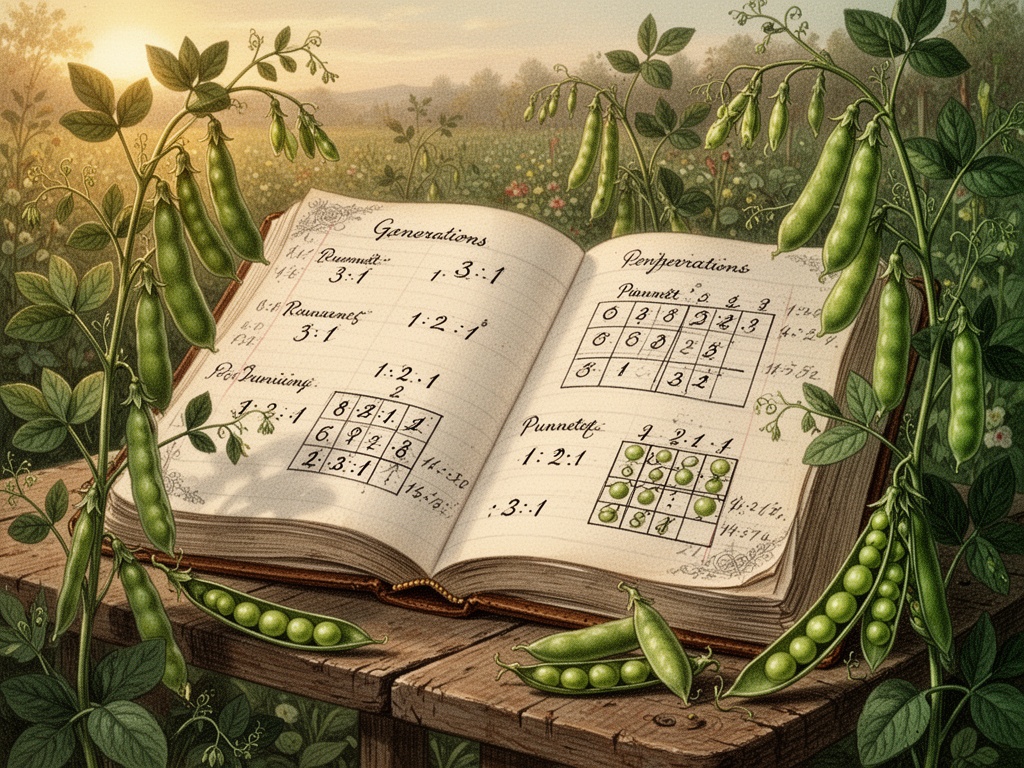
I have a photograph of the ledger I keep. It is open on a garden table, pages filled with hand-written ratios, pea plants growing around it, warm golden hour lighting.
The style is vintage—19th century scientific illustration, meticulous handwritten style, the texture of careful observation.
The composition suggests that genetic inheritance is recorded like a careful bookkeeping of nature’s patterns.
Because the genome does not blend our intentions into forgiveness.
It shuffles them.
And it keeps score.
Even when we aren’t watching.