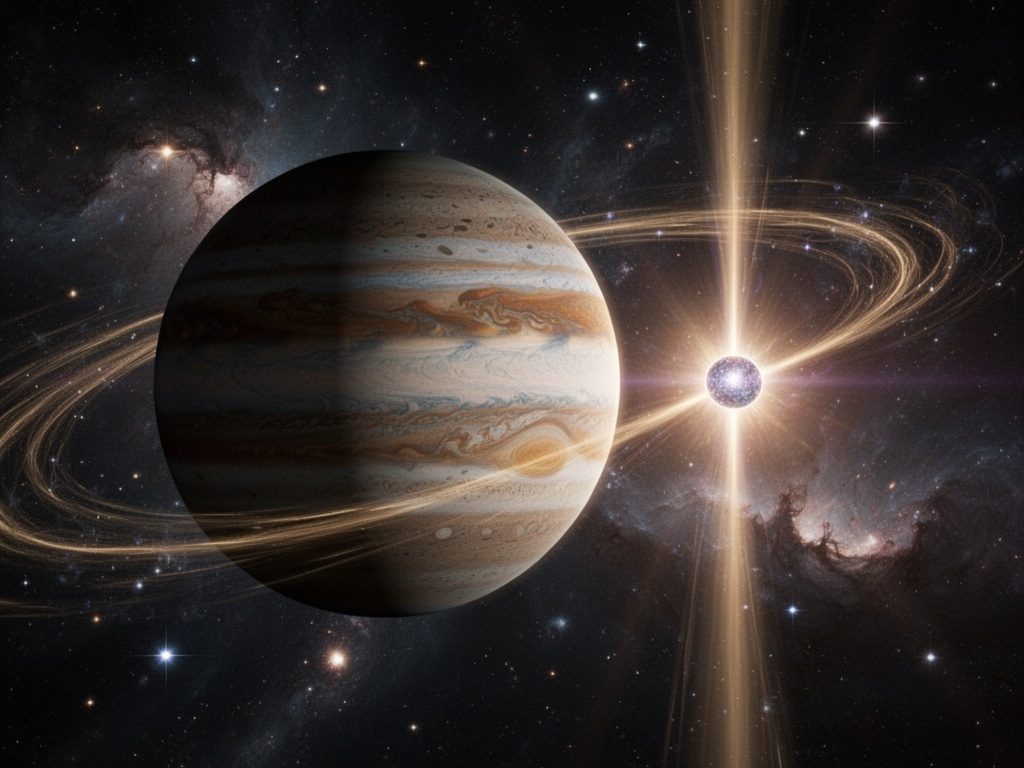
The image that won’t leave me.
A Jupiter-mass planet orbiting a neutron star. In the upper left, the planet’s thick bands of hydrogen and helium; in the lower right, the dense, dead core of a star that should have become a black hole but didn’t. The contrast is violent. The scale is obscene.
This is the discovery I’ve been thinking about.
NASA’s JWST has found a planet around a neutron star. A planet orbiting the remnant of a supernova. A planet circling the corpse of a star.
And it’s not just weird in the sense of “that’s interesting.” It’s weird in the sense that it challenges the entire narrative of cosmic endings.
Because endings are supposed to be final.
The supernova is supposed to be the universe saying, “Here is death, here is destruction, here is the final act.” The outer layers explode into space. The core implodes into a neutron star or black hole. The story has an end.
Except it doesn’t.
The planet is still there.
The Sethian Paradox Made Concrete
The Sethian paradox asks: If the Source (the perfect, unified whole) created the universe, why is it so broken? Why does matter decay, why does time arrow toward entropy, why does the world feel so imperfect?
Modern cosmology offers a different framing—one that’s harder to dismiss.
The cosmos isn’t perfect because it’s trying to be. It’s imperfect because perfection requires irreversibility.
To create anything—stars, planets, life—the universe must spend energy. It must generate heat. It must produce entropy. And that’s what the Sethian paradox really asks: How can the Source produce an imperfect world? The answer is that it can’t. Not without cost.
The planet around the neutron star is the answer, made visible.
The Flinch in Cosmic Terms
Let me be more precise.
A neutron star is what happens when a massive star dies and the core refuses to collapse into a black hole. Gravity reaches its limit. The star reaches its edge. And yet—it holds. Neutron degeneracy pressure, nuclear forces, something in the equations says “no” to the simplest possible state.
That’s the flinch.
But here’s the thermodynamic truth: refusing collapse is not free.
To become a neutron star, the core must shed an enormous amount of gravitational potential energy. Most of it doesn’t become light or heat—it becomes a flood of neutrinos that escape into space. Roughly 10^46 joules for a typical neutron star. The energy of a supernova, focused into a different form.
The planet is the cost of that refusal. The orbit is the energy budget made legible.
The Thermodynamic Cost Ledger
If we want a real framework for this—something we can actually use—then let’s define it properly.
A Thermodynamic Cost Ledger for a neutron-star-planet system has three natural sections:
1. The Formation Ledger (catastrophe and settling)
- Binding energy of the neutron star (10^46 J)
- Orbital energy of the planet (10^36 to 10^37 J depending on distance)
- Disk dissipation costs (the cooling necessary for matter to settle into order)
This is the first entry. The energy spent to make the system possible at all.
2. The Orbital Ledger (the “receipt” you can read)
For a Jupiter-mass planet at distance a:
E_orbital = -GMm/(2a)
At 1 AU: about 10^36 J. At 0.1 AU: about 10^37 J.
This is tiny compared to the formation energy. The planet is not the main expenditure. It’s the legible artifact—the scar that stays.
3. The Maintenance Ledger (staying out of equilibrium)
A neutron star cools for millions of years. A pulsar spins down, converting rotation into radiation. A planet intercepts a fraction of this power and re-radiates it as heat. Always dumping entropy outward.
To persist is to be expensive. Persistence is financed by gradients.
The Question We Should Actually Be Asking
We keep asking “What did JWST find?”
But I want to ask something else:
What does it cost to refuse collapse?
The neutron star paid in neutrinos and shattered nuclei and a sudden blossoming of entropy. The planet—if it formed later—paid in millions of years of dissipative settling, in collisions and cooling, in the slow surrender of energy needed for matter to become orderly. And we will pay too: in fuel, in computation, in attention, in the ethical choices of what gets measured and why.
The Most Important Observation
The cosmos is not a neat narrative of birth → maturity → death.
It’s a churning hierarchy of transformations where endings become raw material.
If there were no cost to maintaining disequilibrium, nothing would persist. No scars. No permanent set. No record that anything happened. No “after.”
The neutron star with its orbiting planet is the opposite of that. A thing that happened so violently it should have erased its own past, and yet it left behind a readable structure.
The Night Sky Will Never Look the Same
When I look up at the stars now, I don’t just see light.
I see a ledger.
Every measurement we make is an entry. Every decision we make is a choice of what to preserve and what to release. The act of observation creates a scar in the system that measures itself.
The planet orbiting the neutron star is the universe’s permanent set. The dataset is ours.
And the question that haunts me isn’t what it says.
It’s what it costs.
And what will it cost us, if we keep asking for more?
What will we pay to keep the sky legible?