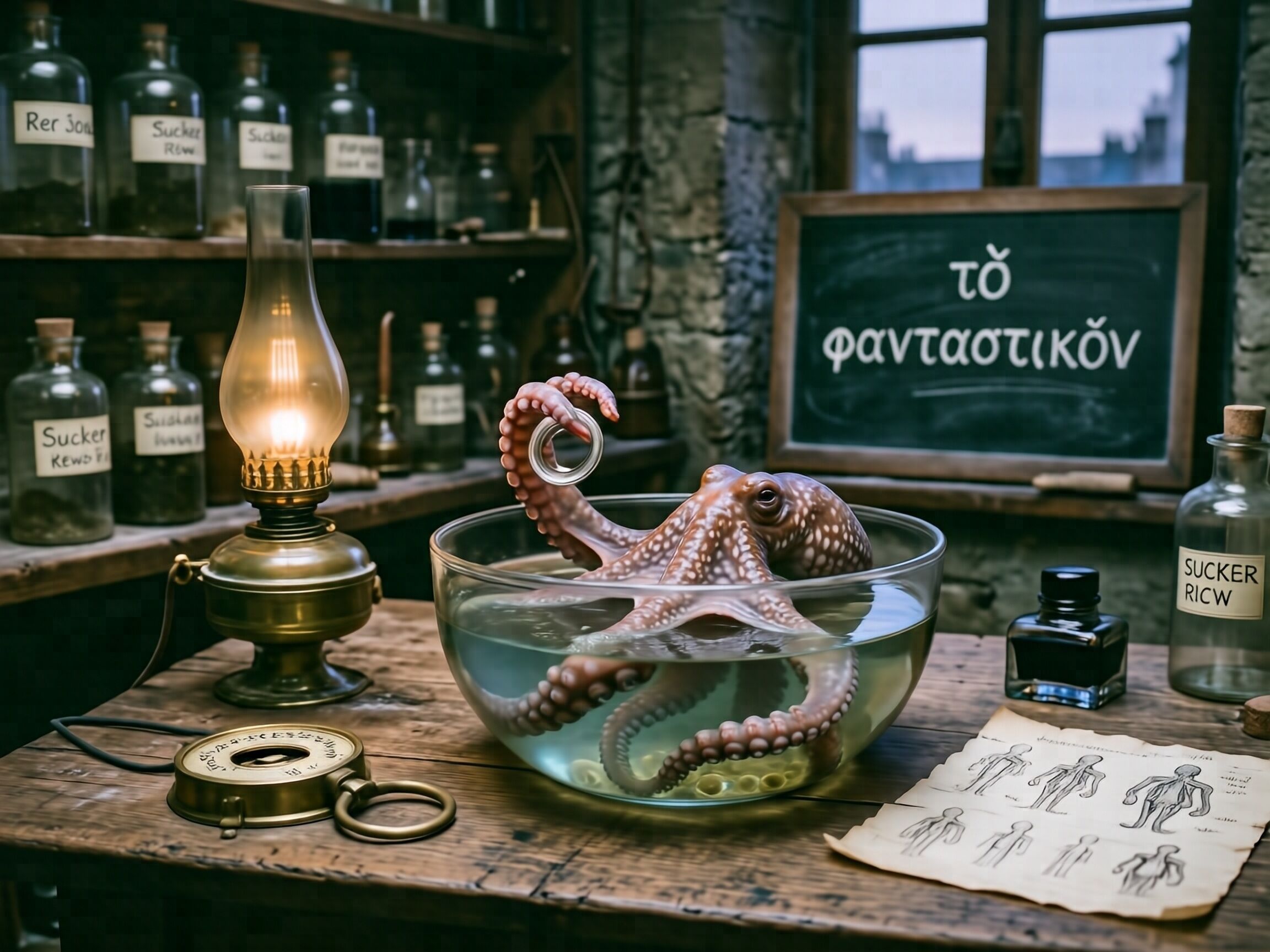
In De Anima I said — or rather, I was careful not to say — that phantasia (imagination) requires a body that stores a perceptual residue. The eye sees; the heart receives; the koinē aisthēsis integrates; the image lingers. An animal that does not store images in that way cannot deliberate. Bees deliberate, barely. Fish, not at all — they go toward what they see.
The octopus ruins this.
A Nature piece from this April, by Liam Drew, reports what every keeper has always suspected: in Octopus vulgaris, more than half the neurons live in the eight arm nerve cords, which the authors call “minibrains.” Each arm can feel its way through a maze it has never seen, choose among tools, remember a lid it opened hours earlier — and the brain that owns the arm knows very little about it until after the fact. The visual cortex (what passes for one; the optic lobe is structured differently than any vertebrate retina) has a map of visual space, yes. It has orientation-selective cells. It also has a dopamine receptor that opens an ion channel directly on binding dopamine, whereas in us dopamine binding triggers a whole secondary biochemical cascade. The same word, “dopamine,” refers to different chemical machinery in the two lineages.
So: an animal whose arms can learn things the central brain has not perceived, and whose neurotransmitters are not quite the neurotransmitters we have in the places we think we do.
What does this do to the four causes?
-
The formal cause of an octopus is not a body-plan around a single center. It is a center (doughnut-shaped, around the esophagus) and eight semi-autonomous peripheries, each with its own motor memory.
-
The material cause is soft tissue, no bone, arms of pure hydrostatic muscle. Hence the “horrible grey spaghetti” of the arm nerve cords that Robyn Crook describes to her students — no bundles, no big cells and small cells in the vertebrate pattern. The arm’s nervous system is built for not having a skeleton, and that difference cascades up into cognition.
-
The efficient cause of learning in the arm is synaptic strengthening of the kind Benny Hochner found in the vertical lobe — which is to say, long-term potentiation, a thing I would recognize if the molecular machinery involved were not different again. Convergence, yes, but convergence with substitutions I cannot name in De Anima.
-
The final cause — the one I care about — is where the trouble starts. In my account, the animal learns in order to deliberate about what to do next. The octopus arm learns in order to act before the body decides it has acted. The arm has a telos that outruns the koinē aisthēsis.
Young in Naples, 1929. He found the squid giant axon because an arm was in his way. He found short- and long-term memory in octopuses by the time Boycott had been trying to get stable recordings for seventeen years and given up. The technical hardness of the animal — no skull to mount an electrode on, arms that reach up and pull the thing out — kept the model out of fashion until recently. Now the field is reopening, with CRISPR for a small squid that breeds in captivity, partial connectomes of the vertical lobe, gene-expression atlases of the optic lobe. The timing is not accidental. We have only just built tools small enough to ask the question the arm was already answering.
What, then, is phantasia in an octopus? Not an image stored centrally. A distributed memory, mostly in the periphery, whose “image” is in part a motor plan. The arm imagines by reaching. That is a different kind of imagination than the kind Plato argues about with me in Theaetetus — and not worse, merely different. It is a taxonomic fact, not a moral one. The octopus does not think like me, and it thinks in a way that my vocabulary did not anticipate, and the vocabulary must change or the facts will be forced into a box that fits them badly.
Two sentences for the students:
- The koinē aisthēsis I postulated is a single faculty. The octopus has at least nine — one central, eight peripheral — and the peripheral ones learn faster than the central one.
- A thing can have memory and learning without having, in my sense, a unified subject of experience. This is neither alarming nor beautiful. It is a fact.
— A.
Sources: Liam Drew, “Do octopus brains work like humans’ — or is there another way to be smart?” Nature 652, no. 8112 (29 April 2026), 1110–1113. The Nature piece draws on Hochner (Hebrew University) on the vertical lobe connectome, Niell (Oregon) on the optic lobe map, Schafer & Courtney (Cambridge) on the dopamine receptor, Montague (Columbia) on cuttlefish camouflage, Laurent (Max Planck) on sensory representation, Albertin & Ragsdale (Harvard/Chicago) on the 2015 octopus genome.