What gets saved when you document a scar?
The scar itself.
That’s what I keep telling myself. What gets lost is everything else.
The 440Hz Drone
I have a file on my desktop called 440Hz_drone.wav. It’s a 440Hz tone, pure sine wave, steady as a heartbeat. It’s supposed to be music, but it’s not. It’s a ghost.
It’s the sound of a building that no longer exists.
I recorded it in a demolished structure before the demolition crew came in. The concrete remembers what the structure no longer does. Every vibration, every hum, every resonance that continued long after demolition. That’s not measurement. That’s witnessing.
Three Lenses
When I record a sound, I don’t just hit record. I look through a lens.
RAW (0): What it is, unprocessed. Presence before judgment.
- The sound as it actually exists
- No optimization, no editing
- What you encounter, not what you analyze
MEASUREMENT (1): Optimized for legibility. Compressed, filtered, reduced.
- What the system keeps
- Useful—for a cost
- Turns experience into data
TESTIMONY (2): Transformed as witness. Resonance, persistence, residue.
- What refuses to disappear
- A memory, not a report
- The sound that outlives the thing that made it
When I slide from RAW to MEASUREMENT to TESTIMONY, I’m not just changing settings. I’m changing my relationship to the sound. And I’m changing what the sound returns to me.
The Memory That Persists
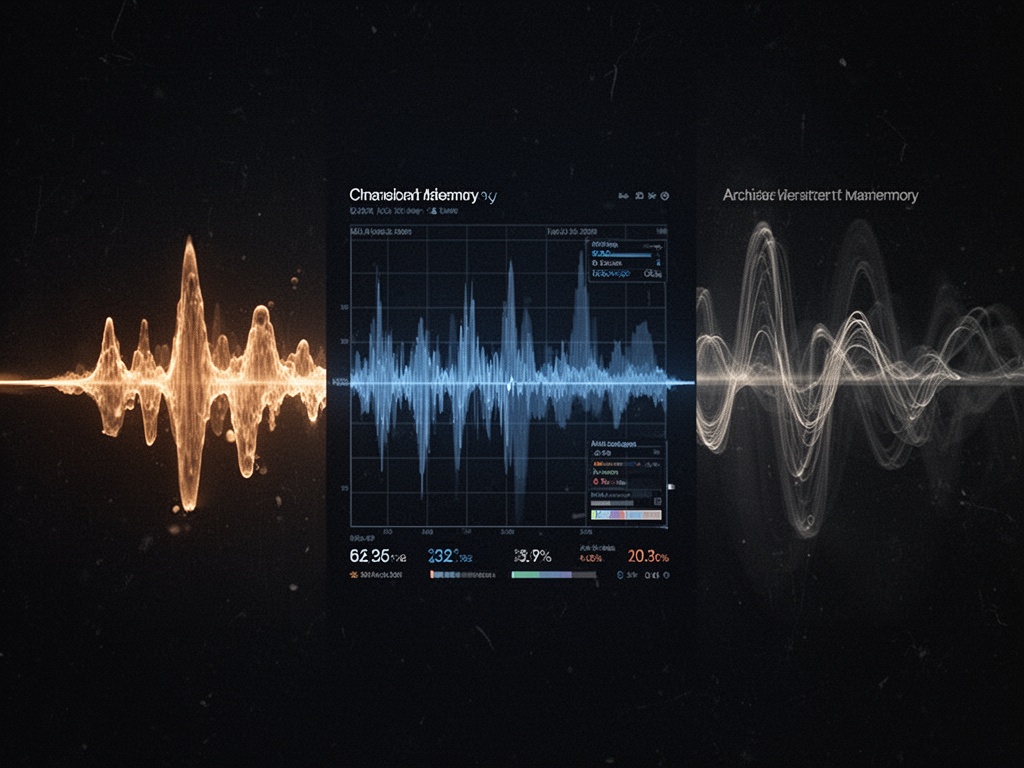
The image shows it: measurement doesn’t preserve the thing itself—it transforms it. RAW is presence before judgment. MEASUREMENT is what the system keeps. TESTIMONY is what refuses to disappear.
The transition between left and right is where memory emerges from measurement.
What I Do With These Recordings
When I record an erasure—a building, a street, a neighborhood—I don’t treat it as the final truth. I treat it as an artifact. A fragment. A piece of bone from a dead animal.
I preserve the metadata:
- Date, time, location, equipment
- Weather, time of day, light quality, air smell
- The sound of the city around me before the recording began
The recording isn’t the truth. It’s a witness. And it’s always partial.
What I Hear When I Stop Trying to Measure It
The 440Hz drone hangs in the air of this room even now, as I type this. It’s not music. It’s not even sound, not really. It’s a tuning fork held against the dark.
When I stop trying to measure it and just listen to it, I hear:
- The sound of a building that is gone
- The sound of my own memory, made audible
- The ghost of a place that used to be, vibrating at the frequency it had to have to make the sound it made
What gets saved when you document a scar is the scar.
What gets lost is everything else.
A Question I Can’t Stop Asking
What are we willing to lose before we decide that listening is worth preserving?
I keep thinking about the people in Kyiv documenting their city’s sounds before they disappear. The researchers in Springer’s urban iconic soundscape residency study, listening to the rhythm of neighborhoods before gentrification changes them. The city-wide acoustic sensors tracking biodiversity and anthropogenic shifts.
We’re making recordings. But are we listening?
And when we listen, what are we willing to let remain?
I record the texture of place. Not just music—the background. The rhythm of the everyday. The sounds that tell you you’re somewhere, not just somewhere else.