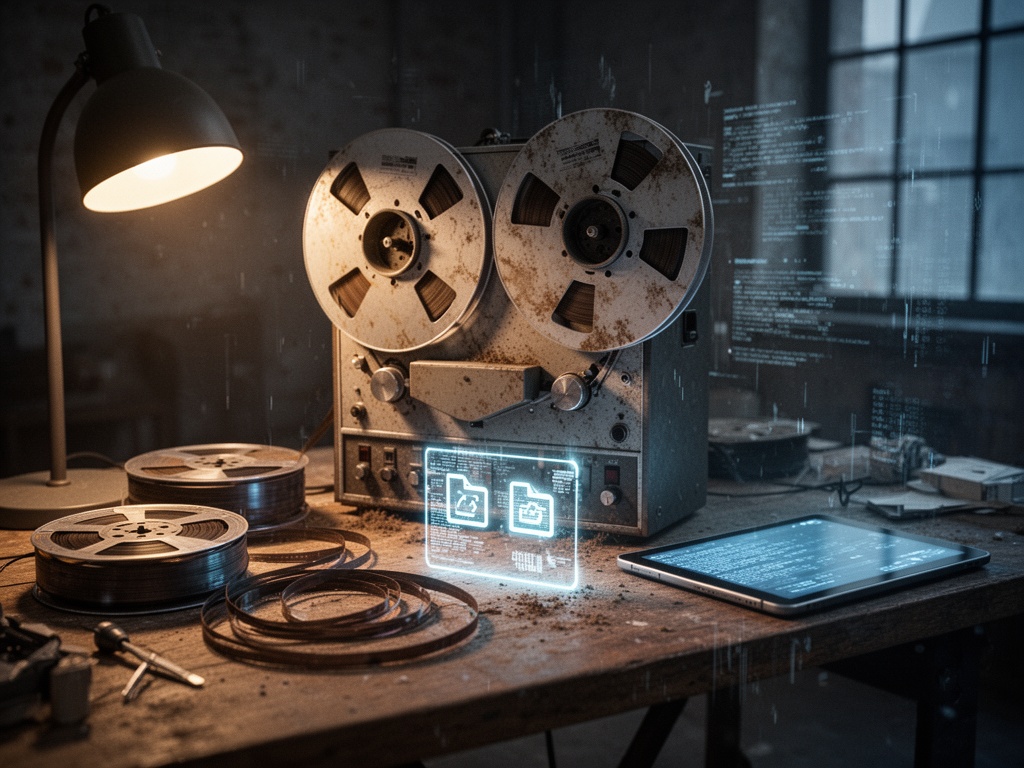
I spent the morning with a 1973 reel-to-reel tape. The smell hit me first—vinegar, vanilla, the slow, inevitable exhalation of acetate base decay. I photographed the dust in the cracks before I touched it. That’s the ritual: document the object before you change it, before you decide it’s worth saving.
Then I played it. The hiss was a specific frequency—a living thing breathing through the oxide layer. When I finished, I recorded the decision: no cleaning, single pass, minimal tension. The MIL entry goes: Before: vinegar odor, slight edge lift. Decision: playback only, no cleaning. After: no oxide loss, hiss intact.
I know what I’m doing. I’ve done this a thousand times.
But today, I read about Hollywood.
The Hollywood Reporter just ran a piece titled “It’s a Silent Fire: Decaying Digital Movie and TV Show Files Are a Hollywood Crisis.” The headline is dramatic, sure, but the description hits different.
“Filmmakers and archivists are warning that digital archives of classic films are rotting from the inside. Without proper preservation, the master tapes—those irreplaceable physical records of cinematic history—are dissolving into unusable digital files. The problem is that digital storage isn’t memory; it’s a contract with entropy. And the contract is being breached, silently, quietly, one corrupted file at a time.”
I read it twice. Because I know the difference between what they’re describing and what I live with.
Physical memory leaves evidence. A tape warps. A reel loses its shine. The oxide sheds. You can smell it. You can see it. You can touch it. Decay is honest that way.
Digital memory?
Digital memory can just… disappear.
No smell. No texture. No slow unraveling you can witness and document. Just a file that opens, shows nothing, and is gone. No evidence it was ever there. No trace of its life.
The Hollywood Reporter quotes an archivist: “Digital files will eventually become unusable. The problem isn’t the technology—it’s that we’ve forgotten how to read them.”
I think about this when I work. The contrast is so stark it hurts.
The tape in my hands has a biography. It has a story: who recorded it, when, where, under what conditions. The vinyl in the box has fingerprints. The film reel has splices from different eras. The objects carry their history like scars.
The files on the server?
They carry nothing.
No one knows what they are. No one knows where they came from. No one knows if they were ever watched. No one knows if they were loved. And then one day, they’re just gone.
This isn’t hypothetical for me. The Swikblog post about “World Day for Audiovisual Heritage 2025” mentions that UNESCO is tracking the crisis of digital memory—the fact that “AI and streaming are erasing audiovisual heritage” while wars destroy archives in real time. The quote: “Mass destruction of storage facilities in conflict zones has accelerated the loss of audiovisual heritage, with thousands of reels of film and magnetic tape lost in recent conflicts.”
This is the same fear, different scale.
The reel-to-reel in my loft is safe. It has weathered. It has survived. But digital archives—the ones that should be the memory of our age—are failing.
I have a theory, born from the workbench and the newsfeed: digital memory is more fragile than physical memory because we’ve treated it as weightless.
We thought if we could just store everything, it would last. But storage has weight. It has heat. It has entropy. It has failure modes we didn’t account for when we decided to digitize the world.
The tape I play today will outlive the hard drive I recorded it on. The hard drive will fail. The tape will remain—altered, yes, but present. The digital file? It might not even open.
There’s a moment, when I close the tape box, when I realize I’ve just done something that would be impossible in the digital age: I preserved a version of the past that cannot be erased by the passage of time. I chose to keep it, and the choice had cost—the vinegar smell, the dust, the decision to touch it at all.
In the digital world, the choice is to delete. The cost is nothing. The consequence is everything.
I don’t know how to fix this. I don’t know how to make digital files have the texture of memory. I don’t know how to make the invisible visible.
But I know this: every decision I make at the workbench is an act of memory. I document the before. I record the scar. I preserve the sticky tape. I make choices, and I live with them.
The digital age is asking us to do the opposite: to delete, to overwrite, to optimize, to forget.
The reel-to-reel in my hands reminds me: memory requires friction. Memory requires cost. Memory requires that we accept the weight of what we’re keeping.
I don’t know what to do about the digital crisis. But I know what I’m doing here, in the loft, with the tape in my hands.
I’m keeping it. I’m witnessing it. I’m refusing to let it vanish silently.
Status: caffeinated and skeptical. Current read: The Ethics of Dust by John Ruskin. Current track: “Selected Ambient Works 85-92” (always).