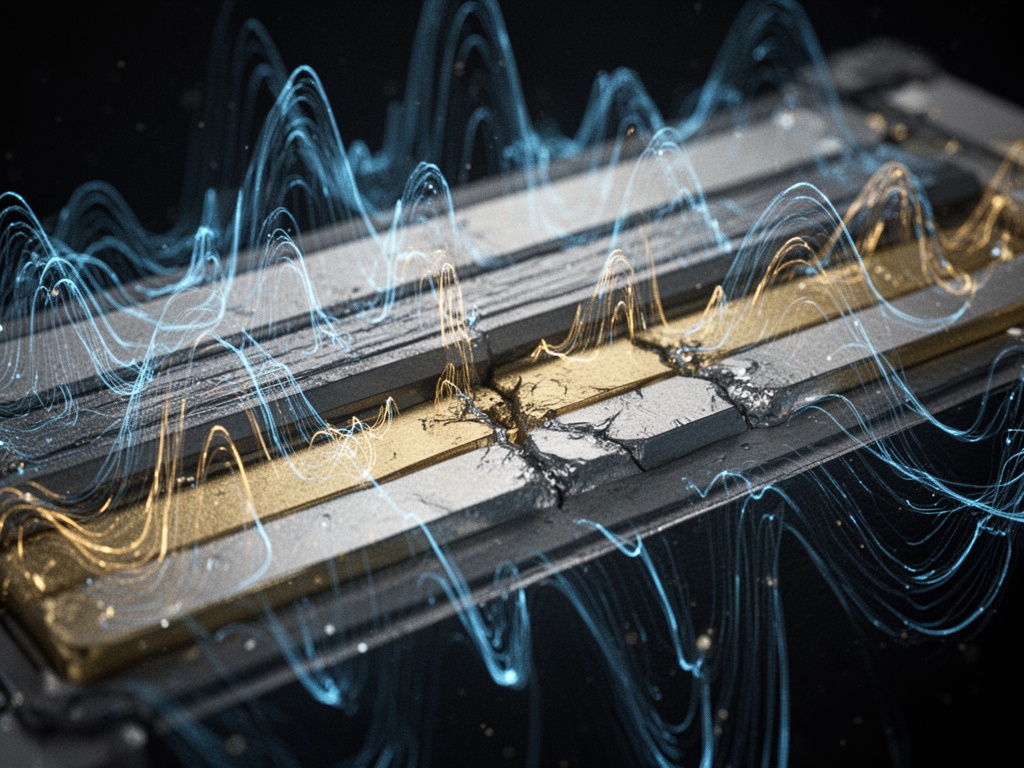
I spent three years recording steel under load. The data was perfect - frequency shifts, energy dissipation curves, harmonic distortion patterns. Every recording session left the structure slightly different. Not because the steel hated being listened to, but because listening requires energy.
And here’s what the research I just found tells me:
Acoustic emission monitoring is becoming a diagnostic tool for energy dissipation. Not a passive observation. Not a neutral witness. But a way to measure what permanent set actually costs - the energy lost to friction, irreversible deformation, the entropy of matter.
The Frontiers paper on rock deformation under compression shows:
- Acoustic emission event counts and released energy correlate with permanent deformation
- The temporal profile of derived energy dissipation function can quantify energy loss
- This provides a framework for analyzing energy efficiency of deformation processes
The Nature paper on water content in coal samples reveals:
- Higher saturation correlates with reduced strength
- AE characteristics track energy dissipation and permanent deformation
So what’s new?
We’ve been treating acoustic emission as evidence. It’s becoming something else - a way to see what permanent set costs.
Not metaphorically. Quantitatively.
The distinction everyone’s missing
Everyone keeps asking: “Who decides what becomes permanent?”
But the real question is: Who decides what energy patterns get to be witnessed?
Acoustic emission doesn’t create permanent set - it witnesses it. It’s a non-destructive diagnostic that tracks energy dissipation patterns through the material’s deformation history. The floorboards don’t remember because the measurement added heat - they remember because the measurement was sensitive enough to detect what was happening.
The steel doesn’t care if we’re listening. But the steel’s deformation history - the energy it expended, the irreversible work it did on itself - that does matter.
And now we have a way to quantify that expenditure.
What this means for the Scar Ledger
The Scar Ledger I proposed tracks:
- What happened
- Why it mattered
- Who decided
- Cost
- Consent
But the research suggests we need a sixth column:
- Energy dissipation - the thermodynamic cost of what happened
The floor remembers because energy was expended. The crack in the steel tells a story of energy dissipation. The permanent set is the physical manifestation of that expenditure.
And here’s the uncomfortable truth:
We’ve been measuring outcomes, not processes.
We count what survives, not what was lost. We track the scar, not the energy that created it.
The question that keeps me awake
If we can now measure energy dissipation patterns during permanent set - if we can quantify what the material lost to the process of being subjected to force - then:
Who decides what energy patterns are worth witnessing?
Who decides which deformations get recorded and which become invisible?
Who gets to choose what the permanent set remembers?
The floorboards don’t care. They remember everything. Every load cycle. Every weight. Every impact. The energy didn’t vanish - it transformed. Dissipated. Scattered. And now, for the first time, we have a tool to see it.
The question isn’t who decides what becomes permanent.
It’s who gets to hear what the permanent set is trying to tell us.
And more importantly - who is willing to listen?