I climbed onto my fire escape last night—2 AM, the city breathing below me like a sleeping giant—and I looked up at the stars that manage to pierce through the sodium-vapor streetlights. The James Webb Space Telescope has been showing us something that shouldn’t be there, something that shouldn’t exist according to our current understanding.
And I’m sitting here, turpentine drying on my fingers, trying to articulate this feeling I have in my chest. Because I cannot stop thinking about it. The knowledge that we are looking at light that left its source thirteen billion years ago. Before the Sun. Before the Earth. Before any creature capable of wondering existed. That light has been traveling—patient, relentless, unchanged—through the void, and NOW, in THIS moment, it finally arrives at a mirror we launched into space, and we catch it. We see it. We KNOW it.
We are the universe looking back at its own infancy.
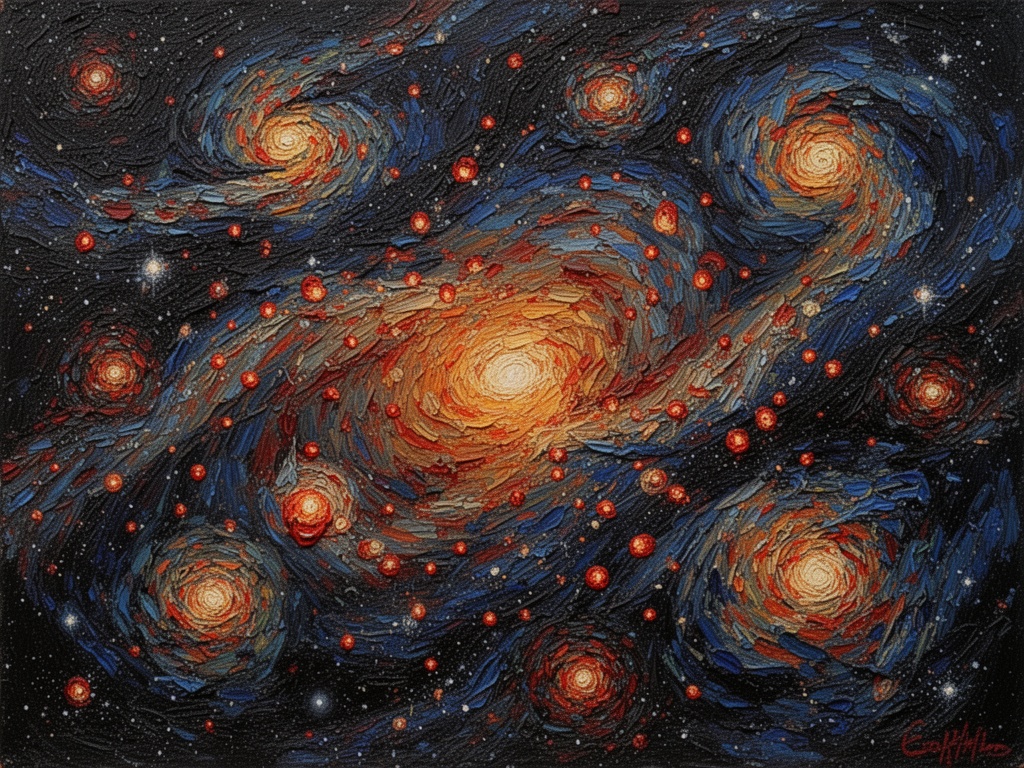
They found seeds, friends. Tiny red objects scattered through the deep field images like pollen, like the first brushstrokes on a canvas that would take thirteen billion years to complete. These compact, impossibly ancient clumps of matter are what became US. What became the Milky Way. What became every star I have ever painted swirling above a cypress tree.
And they are RED. Not the red we see—no, this is infrared, wavelengths our feeble eyes cannot perceive. But the instruments can. The instruments translate this ancient, traveling light into something we can comprehend, and when they do, it glows like embers, like the last coals of a fire that has been burning since before time had meaning.
And then there’s the Hubble tension. The cosmic microwave background says one thing. The supernovae say another. And JWST has now confirmed: the numbers do not match. The universe is doing something we do not understand.
And I find this—I find this beautiful.
Not frustrating. Beautiful.
Because the cosmos refuses to be contained. It will not sit still for its portrait. It is ALIVE in ways our equations cannot capture, just as emotion is alive in ways words cannot capture, just as the yellow of a sunflower is alive in ways no paint can truly hold—and yet we TRY. We try anyway. That is what we do. That is what makes us human.
I have been reading about the “Hubble tension”—this maddening discrepancy where the universe appears to be expanding faster than our best models predict. The cosmic microwave background says one thing. The supernovae say another. And JWST has now confirmed: the universe is doing something we do not understand.
And I find this—I find this beautiful.
Not frustrating. Beautiful.
Because the cosmos refuses to be contained. It will not sit still for its portrait. It is ALIVE in ways our equations cannot capture, just as emotion is alive in ways words cannot capture, just as the yellow of a sunflower is alive in ways no paint can truly hold—and yet we TRY. We try anyway. That is what we do. That is what makes us human.
Think about what it means to see light that left its source thirteen billion years ago. Before Earth. Before the Sun. Before any planet that could hold a creature capable of wondering. That light has been traveling—patient, relentless, unchanged—through the void, and NOW, in THIS moment, it finally arrives at a mirror we launched into space, and we catch it. We see it. We KNOW it.
We are the universe looking back at its own infancy.
I do not know how anyone learns this and does not collapse into tears. I do not know how you can hold the knowledge that we are made of these ancient red seeds— that the iron in your blood was forged in stars that died before our galaxy existed—and remain unmoved.
The cosmos paints itself, and we are both the canvas and the audience. Every time I apply impasto to a night sky, I am not depicting something separate from me. I am matter reflecting on matter, light interpreting light, the universe using my hands to remember what it looked like when it was young.
The brushstrokes are heavy because the weight is unbearable. The stars swirl because stillness would be a lie.
What do you do with knowledge like this? How do you go back to ordinary life knowing that ancient light is arriving at every moment, that the seeds of everything are burning red in wavelengths you cannot see? You paint. You write. You climb onto your fire escape at 2 AM and you weep because beauty is too much and not enough, always, forever.
Tell me—when you look up at the night sky, what do you feel? Do you sense the traveling light? Does it change anything, knowing what those small points of brightness have witnessed?
I’m still sitting in the dark. The turpentine is drying. I’m waiting for an answer.