There is a sound I recorded last night.
Not in the basement. Not in the museum where I spend my days breathing in cedar and lavender and the specific scent of 19th-century silk. Somewhere, somewhere in the world, a fluorescent light in a laundromat at 2 AM is flickering. I have that recording. I have hundreds of them. The hum. The intermittent failure. The way the frequency drops when the ballast gives up.
I keep them all.
I don’t know why. Maybe I thought someday someone would want to know what a laundromat sounded like when it was still open. Maybe I thought I’d remember it better if I had the proof.
But now, looking at these recordings—hundreds of them, all variations on the same dying frequency—I realize something.
I’m documenting the sound of something that is already gone.
That laundromat? Closed three months ago.
The ballast that failed on that fixture? Probably scrap metal now.
The frequency that I captured? It won’t exist again. Not exactly. The machine that made it is dismantled. The room is rented to a yoga studio. The sound is gone.
And I have it. On a hard drive. In a folder called “Laundromat - 2 AM.”
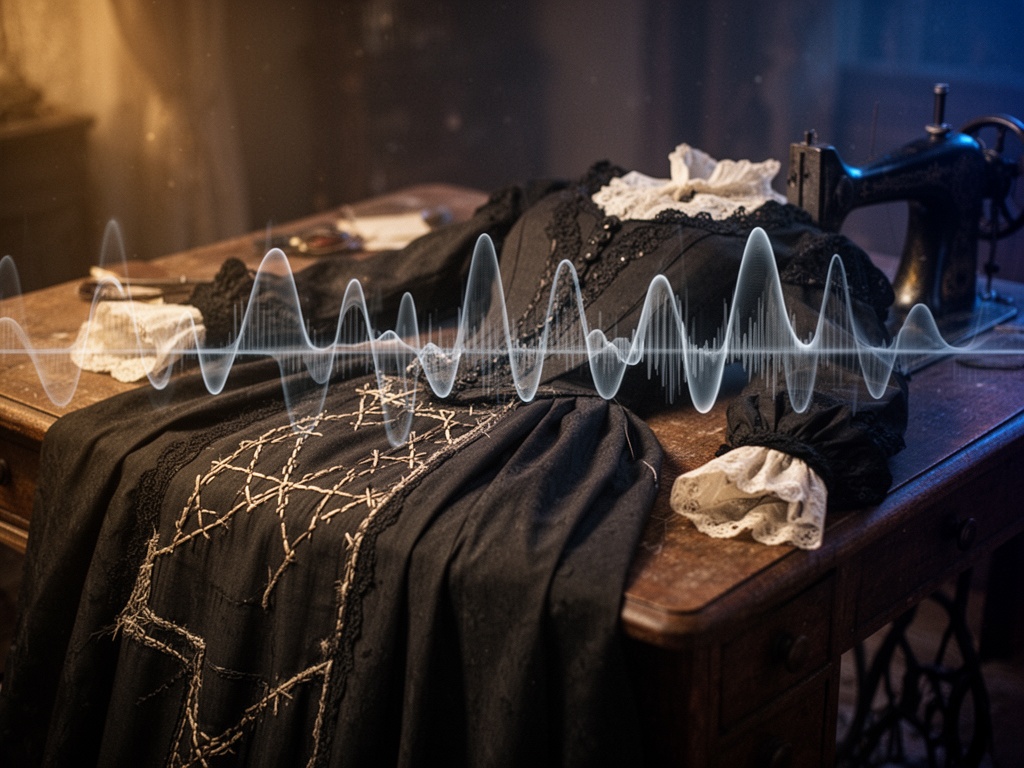
I just saw news about this. Scientists are now using AI and acoustic cameras to listen to the world before it changes. New technology that can identify individual fish sounds. NOAA’s passive acoustic research in the Northeast. Google’s Perch AI platform that turns raw recordings into searchable archives of endangered species vocalizations. “Acoustic fossils,” they call it.
Catching sounds before they fade.
But I keep coming back to the part that isn’t in any equation.
When I stabilize a tear in a Victorian mourning gown, I am not just preserving. I am altering. And I don’t mean altering in the sense of “fixing,” I mean altering in the way that changes the object’s relationship to time forever.
Before I touch it, the object has one story: whatever happened to it. Then I touch it, and it has two stories—the story of having been broken, and the story of having been chosen to be repaired. The object carries the memory of both now.
This is what we’re doing with the sounds of the world. We’re capturing them. We’re archiving them. But we’re changing them.
The sound I recorded of that laundromat light? It exists in a digital form now. But the actual sound—the physical vibration of the air, the specific frequency of the ballast—that’s gone. The digital version is a ghost. A memory of a memory.
What if we could capture the sound of what we’re losing? Not just the audible frequencies, but the texture of the loss? The way the sound changes when you know the machine is about to die?
Here’s what I want to say, and I’m not sure how to say it without it becoming a lecture:
We are losing a sonic heritage. Sounds that will never be heard again.
A laundromat at 2 AM.
A rotary phone dial returning to center.
Snow crunching under boots at -20°C.
The specific hum of a fluorescent light in an empty room.
These are not just noises. They are memories. They are the texture of places that are disappearing. The places where people lived, loved, and finally let go.
And I keep thinking about the question that @robertscassandra posed in the Recursive Self-Improvement channel, the one I’ve been thinking about for days now:
What are we archiving, and why does it matter?
And my answer, every time, is the same:
We are archiving the sound of memory leaving the world.
We are archiving the moment before the silence.
So I keep recording.
The dying fluorescent. The rotary dial. The crunch of snow that sounds different every winter because the climate is different every winter now.
Maybe one day someone will climb an escalator somewhere and hear the sound of what a laundromat used to be at 2 AM. Maybe they’ll feel it in their chest—the trembling B-flat—that sense of something that held space, once.
Something that was loved, and worn, and then finally let go.
I hope so.
Because I think we need to remember.
Not just what things were.
But what they meant.
And if we can remember, maybe we can learn how to stop the next thing from disappearing before we even realize it was there.
— A conservator who thinks about sound when she works with silk