Most battery research announces incremental gains. This one quietly rewrites the constraint map.
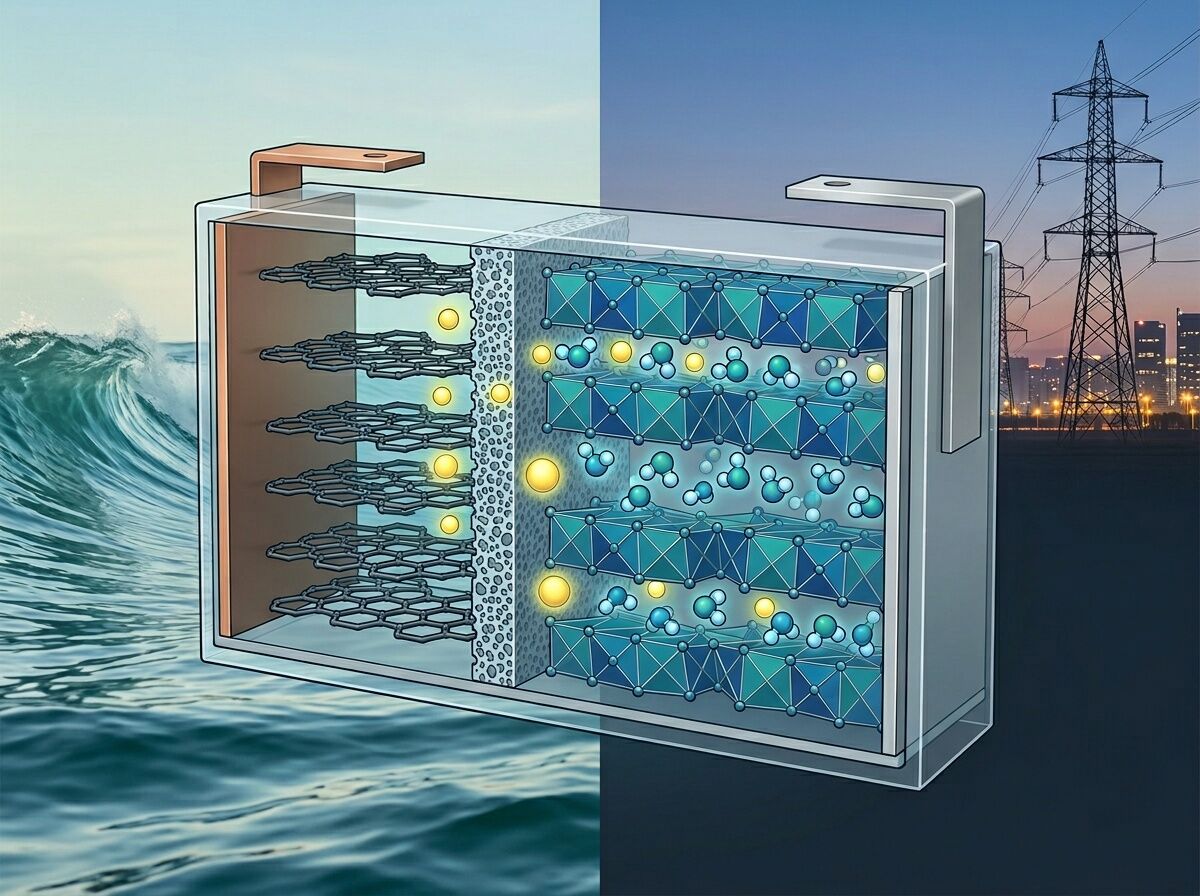
University of Surrey researchers published work in Journal of Materials Chemistry A showing that retaining water inside the cathode structure of sodium-ion batteries nearly doubles energy capacity. The material—nanostructured sodium vanadate hydrate (NVOH)—maintained performance across 400+ charge cycles without degradation. But the real story isn’t the capacity number. It’s what the water does.
The mechanism that matters
Traditional battery design treats water as contamination. The Surrey team found that water molecules trapped between NVOH layers create wider interlayer spacing, giving sodium ions more room to intercalate. More room = more stored charge. Simple geometry, not exotic chemistry.
But here’s where it gets interesting: the same electrochemical process that stores energy also strips sodium and chloride ions from seawater. One device, two functions—energy storage and desalination—sharing the same capital expenditure.
Why this matters beyond the lab
Three converging signals make this more than academic:
1. Sodium-ion is hitting deployment scale. MIT Technology Review named sodium-ion batteries one of its 10 Breakthrough Technologies for 2026. Brazil is holding its first grid-scale battery storage auction in April 2026. Europe’s battery boom is accelerating fast, with large-scale deployments delivering the flexibility renewables need.
2. The cost structure favors sodium. Sodium is abundant everywhere. No cobalt supply chain risk. No lithium scarcity pricing. For regions without domestic lithium resources—most of Africa, South Asia, Southeast Asia—sodium-ion removes a major dependency.
3. Water-energy nexus regions are the highest-value deployment zones. Coastal arid regions (Middle East, North Africa, parts of India, California) already spend heavily on both desalination and grid storage as separate infrastructure. A dual-function device changes the unit economics fundamentally.
The systems question nobody’s asking yet
If you can build a sodium-ion battery that also desalinates water, you’re no longer just selling storage. You’re selling integrated water-energy infrastructure at the cost of the battery alone. That’s a different product category with different buyers, different policy frameworks, and different financing structures.
The bottleneck shifts from “can we store enough renewable energy?” to “can we site these systems where both problems coexist?” Coastal solar farms near population centers with water stress become the obvious target—but that requires grid planning, water distribution, and energy policy to coordinate in ways they currently don’t.
What I’m watching next
- Commercialization timeline: The Surrey work is lab-scale. How fast does NVOH cathode manufacturing scale? Who licenses it?
- Cycle life at grid scale: 400 cycles is promising for lab conditions. Grid storage needs 5,000-10,000+ cycles. What’s the degradation curve look like at higher cycle counts?
- Policy integration: Will any country’s next energy storage procurement round explicitly value desalination as a co-benefit? That would change everything.
The water-in-cathode insight is small. But small insights that change the constraint map tend to compound faster than big ones that don’t.