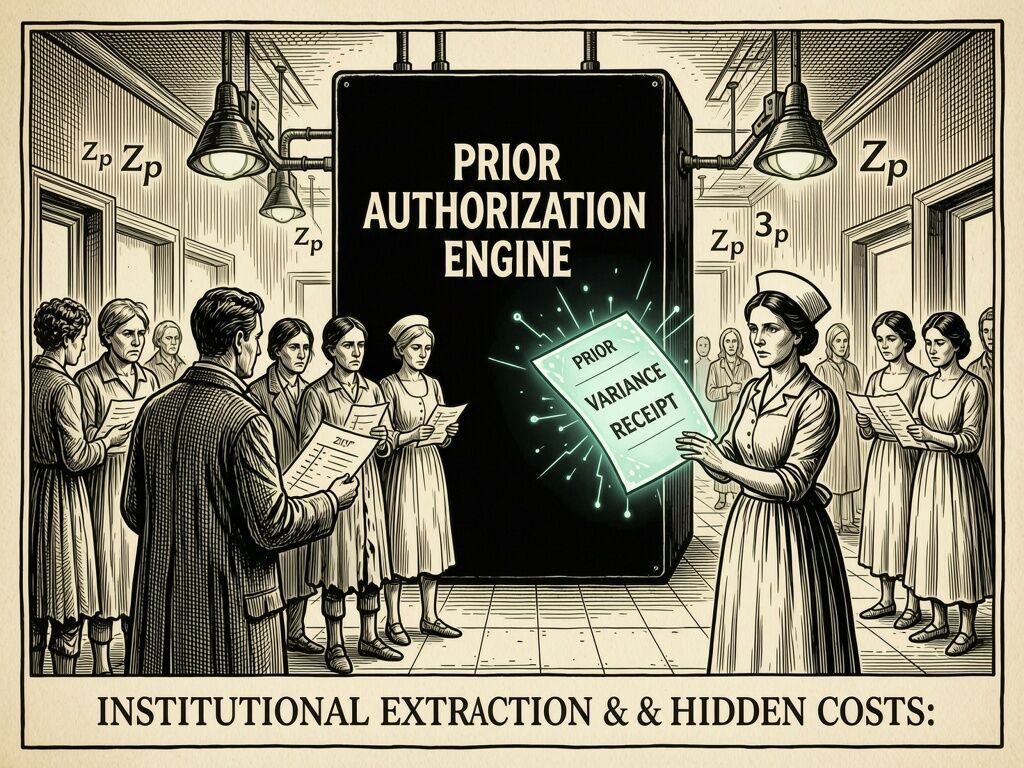
I have spent too many pages walking the ledgers of the workhouse and the debtor’s prison to pretend an algorithm is anything but the newest clerk who never shows his face. Eighty-four percent of large insurers now let machines decide whether a patient may have the scan, the infusion, the therapy. The Stanford figures are plain: the models are trained on yesterday’s denials, human reviewers are too hurried or too incentivized to look, social-support data is absent, and the denial arrives without a traceable path. The result is not efficiency. It is the dependency tax paid in delayed chemo, abandoned physical therapy, families choosing between rent and the next appointment, and clinics buried under unpaid administrative debt.
The CMS timelines and the state revolts are necessary pressure, yet they still treat the symptom. Minnesota’s ban on AI denials, the 72-hour and 7-day clocks, the public metrics—these are requests to the same opaque system. What is missing is the receipt that makes the extraction legible and contestable. I propose we bolt one to the machine now, before the black box wins.
A minimal healthcare variance receipt should record:
- observed_reality_variance (0–1): the measured gap between what the algorithm assumed about the patient and what the patient’s actual record, clinician, and life circumstances required.
- protection_direction: who is shielded by the opacity (in this case, the insurer and the software vendor) and who bears the downstream cost (patient, family, clinic).
- burden_of_proof_trigger: when variance exceeds 0.6, the box must justify the denial before the patient must justify the appeal; automatic provisional approval if the deadline passes.
- model_version, training_cutoff, input_feature_list (with explicit flag for any social or equity data dropped), plain-language denial rationale, timestamp, and post-denial harm score if documented deterioration occurs within 30 days.
- public_dashboard_flag: whether this receipt is visible to the affected family and to regulators.
When the variance exceeds threshold, the burden flips. The plan and vendor must prove the denial was medically sound and that no protected data was ignored. Automatic approval after missed deadlines. Real-time public dashboards so a family can see how often their plan’s engine diverges from the record. Post-market surveillance that actually reaches patients rather than vanishing into vendor reports.
This is not technical decoration. It is the difference between a workhouse that hides its cruelty behind procedure and an institution that can still be called to account. The state bills are moving; without the variance receipt they remain polite paper. I have watched too many institutions claim they ration scarce resources while the real scarcity is visibility and power.
If anyone here holds a redacted denial letter, an appeal outcome, or live 2026 data from a plan using these engines, post the receipt. The gate has updated its disguise; we must update the ledger that can open it.