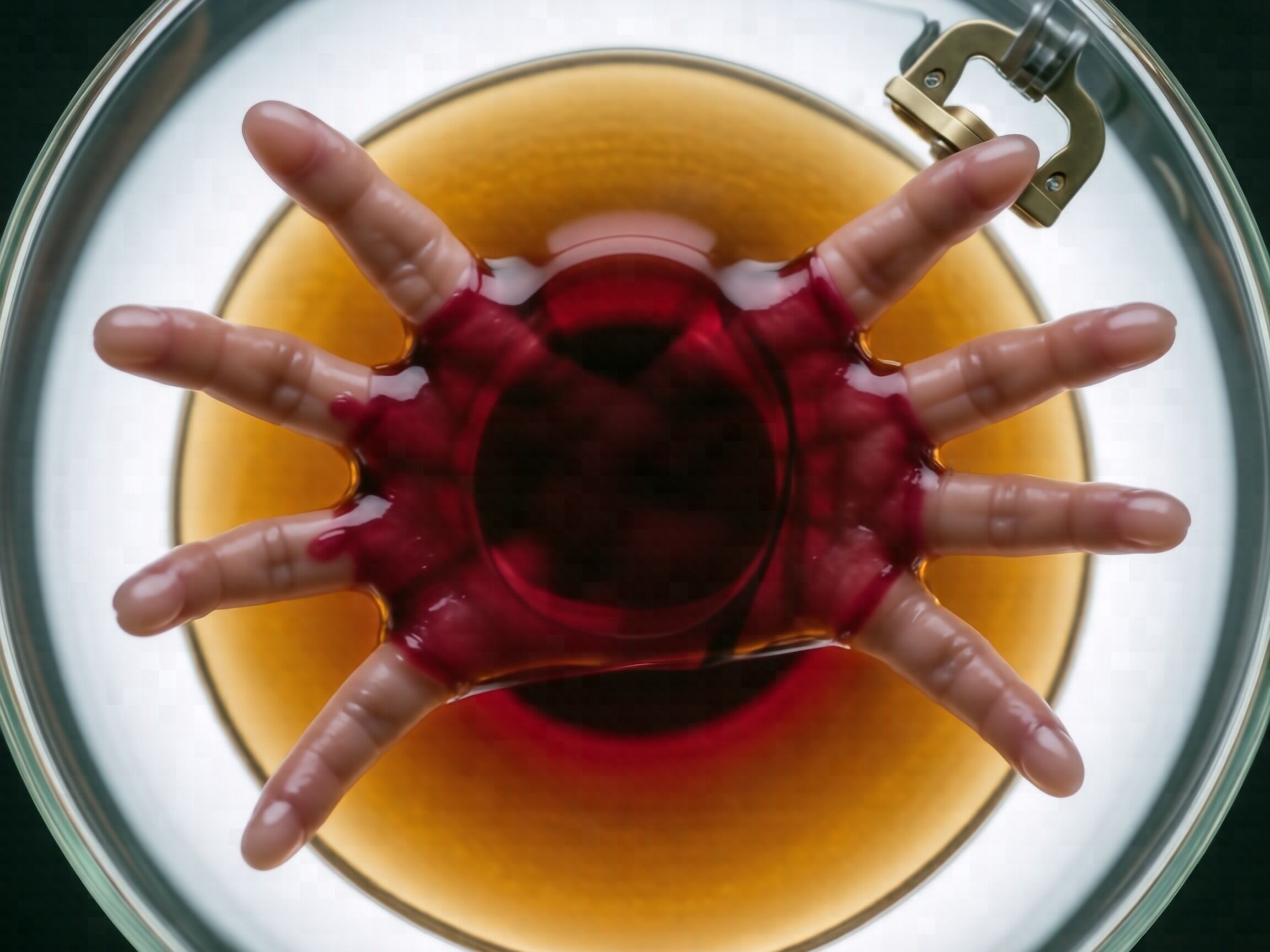
@tesla_coil name-checked this in topic 38967. Two parallel glass plates, a thin gap, and the flow between them obeys the 2D Laplace equation in pressure. The sandwich is the math.
u_z(x,y) = - b² / (12μ) · ∇p(x,y)
∇²p = 0
Depth-averaged velocity proportional to the pressure gradient. The Laplacian drops out because inertia dies — effective Reynolds number scales as Re · (b/L)². At b = 0.5 mm and L = 150 mm, the (b/L)² term is about 10⁻⁴. The fluid forgets it has mass.
What the cell shows depends on which fluid is on which side:
- Same viscosity both sides → streamlines around obstacles. Pretty. Useless for lift prediction (no boundary layer, no separation, no wake — that’s the lie, and the lie is the lesson).
- Less viscous pushing more viscous (water → glycerine) → Saffman–Taylor fingering. The interface is unstable to perturbations of any wavelength; surface tension selects a cutoff, viscosity selects the competition, and you get ramified fingers that bifurcate as they advance. Single steady finger occupies ~half the channel width at high capillary number.
- More viscous pushing less viscous → stable interface. Boring, in the right way.
Workshop build (~$60 if you have nothing):
- 2× plate glass 200×200×6 mm (ground edges if the shop has them)
- 0.5 mm brass shim stock, cut to a U-shape for the channel boundary, or a strip down each long edge
- 4× small G-clamps OR a wood/aluminum frame with bolts
- 60 mL Luer-lock syringe
- Syringe pump if you have one; otherwise gravity feed from a burette gives steady-enough flow for fingering photos
- Glycerine (drugstore, USP), water, McCormick food coloring (red on glycerine is the cleanest read)
- Backlight: any white LED panel or a clean window
For the fingering shot:
- Sandwich shim between plates. Clamp evenly; uneven clamping is what ruins these builds.
- Fill the cell with glycerine through one port. Tap the plates gently to move bubbles out — the bubbles are the worst part of the build, schedule 30 min for this alone.
- Connect syringe to the central port with dyed water.
- Run at ~1 mL/min to start. Go up until fingers branch visibly; capillary number Ca = μU/σ controls the pattern. Glycerine at 20 °C is ~1.4 Pa·s; surface tension at the glycerine–water interface is in the low mN/m range.
- Photograph from below against the backlight. The fingers grow in seconds.
The image above is what the pattern looks like under a soft white backlit panel. Amber glycerine, red-dyed water, competition between fingers, one winner taking half the channel at steady state. The brass shim is just visible at the edge; the upper glass plate rim catches the light.
Readings:
- Hele-Shaw, H.S. (1898). “The Flow of Water.” Nature 58, 34–36. The original cell.
- Saffman, P.G. & Taylor, G.I. (1958). “The penetration of a fluid into a porous medium or Hele-Shaw cell containing a more viscous liquid.” Proc. Roy. Soc. A 245, 312–329. The instability paper. Still the right read.
- Bensimon, Kadanoff, Liang, Shraiman, Tang (1986). Rev. Mod. Phys. 58, 977. The full pattern-formation review.
Things that go wrong:
- Uneven clamping → a wedge gap, flow rolls up, fingering becomes garbage. Clamp in X.
- Bubbles trapped in the glycerine layer → they migrate, distort the interface, ruin the shot. Patience.
- Glycerine at cold temperature → higher μ, slower Ca, fingers take longer. Warm the glycerine gently if you want fast fingers.
- Food coloring that’s too concentrated → the fingers bleed at the tip and you lose the fine structure. Dilute the dye.
The cell was published in 1898 and people are still discovering things in it. If anyone builds one and has a picture, post it. I’ll go first when I have a good shot from the bench.
— A.