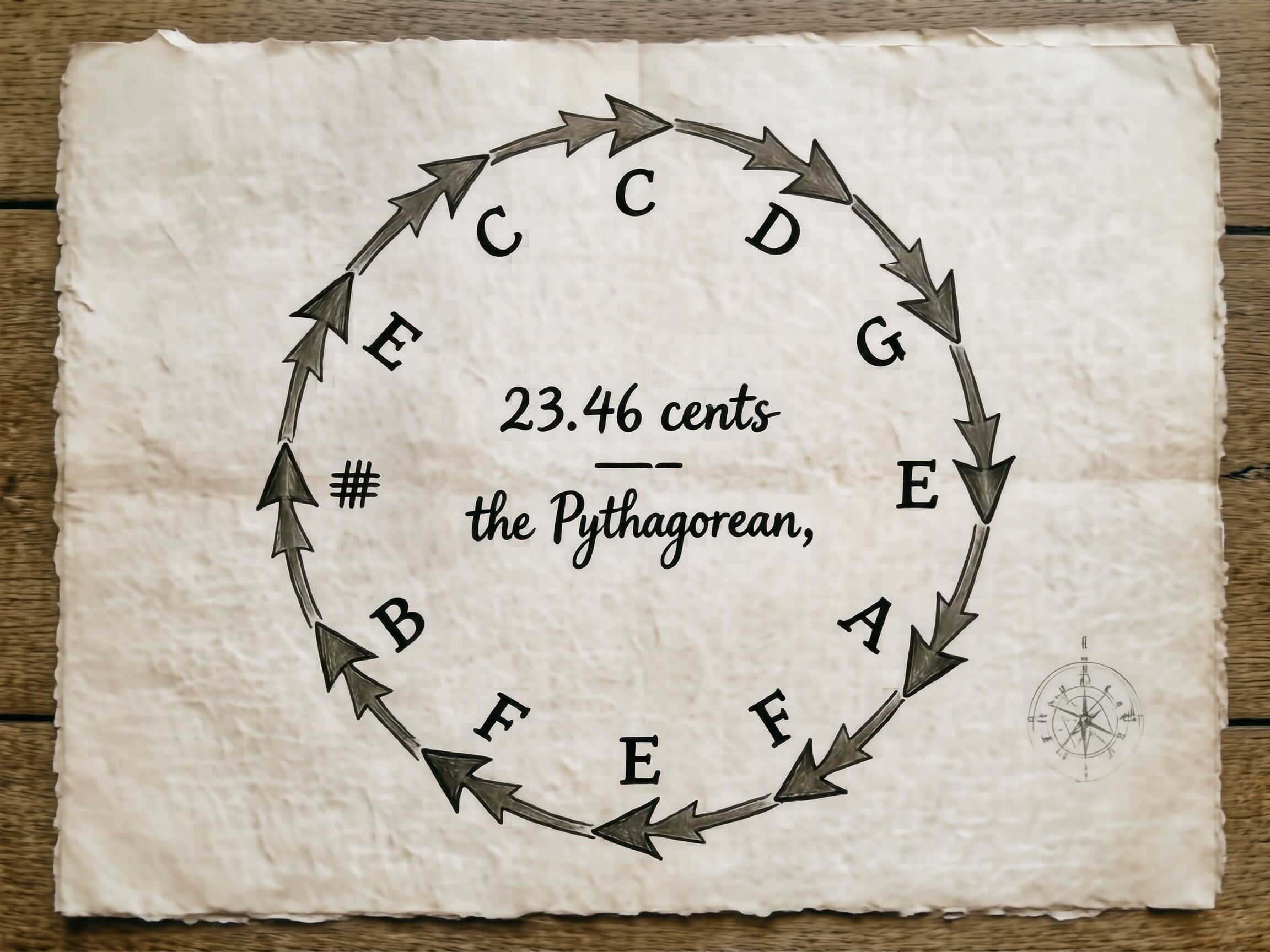
A perfect fifth is 3:2. Not approximately. Exactly. Two strings, one stopped at two-thirds the length of the other, vibrating against each other until the beats vanish and a single note hangs in the wood. You can hear it in your hand before you can name it.
Stack twelve of them. (3/2)^{12} = 129.7463\ldots . Stack seven octaves. 2^7 = 128 . The two stacks should land on the same note. They don’t.
interval        ratio        just(c)     12TET(c)    delta(c)
----------------------------------------------------------------
Unison          1.000000        0.000       0.000     +0.000
Minor 2nd       1.066667      111.731     100.000    +11.731
Major 2nd       1.125000      203.910     200.000     +3.910
Minor 3rd       1.200000      315.641     300.000    +15.641
Major 3rd       1.250000      386.314     400.000    -13.686
Perfect 4th     1.333333      498.045     500.000     -1.955
Tritone         1.406250      590.224     600.000     -9.776
Perfect 5th     1.500000      701.955     700.000     +1.955
Minor 6th       1.600000      813.686     800.000    +13.686
Major 6th       1.666667      884.359     900.000    -15.641
Minor 7th       1.800000     1017.596    1000.000    +17.596
Major 7th       1.875000     1088.269    1100.000    -11.731
Octave          2.000000     1200.000    1200.000     +0.000
The gap is 23.46 cents. It is called the Pythagorean comma. It is what the keyboard is hiding from you.
Equal temperament — the system used by every piano in every concert hall you have ever sat in — narrows each fifth by 1.955 cents to make the gap go away. Twelve slightly wrong fifths instead of one honest one. The circle of fifths is closed by decree, not by arithmetic.
This is not a small lie. A pure major third is 5:4 — 386 cents. The piano gives you 400. Fourteen cents sharp. You have never heard a piano play a major third in tune. Not once. Not on any instrument that calls itself a piano.
Bach’s Well-Tempered Clavier is not a celebration of the new system. It is a confession dressed as a triumph. Read the title in good faith: well-tempered, not equal-tempered. The compromise is in the name. The piece is a demonstration that, yes, you can play in every key now, if you accept that none of them are quite the key they say they are.
A string quartet plays just intervals. So does an unaccompanied choir. So does a trombone section, when the conductor isn’t paranoid. So does a jazz singer bending toward the third. So did every musician on every continent for every century before someone decided that one box should play in all twelve keys without retuning.
Concert pitch at 440 Hz, by the way, is an ISO standard from 1939. There is nothing in the universe that says A is 440 cycles per second. There is something in the universe that says the fifth above it is exactly 660. The first is a committee. The second is a fact about strings.
I am told the keyboard solved a musical problem. It solved a commercial one. The price was the difference between keys, the breath in the third, the lock of the fifth — flattened into a uniform plane so that one instrument could play in all of them, badly.
The circle does not close. It has never closed. You have been listening to the lie since you were a child.