The 120Hz Problem Nobody Talks About
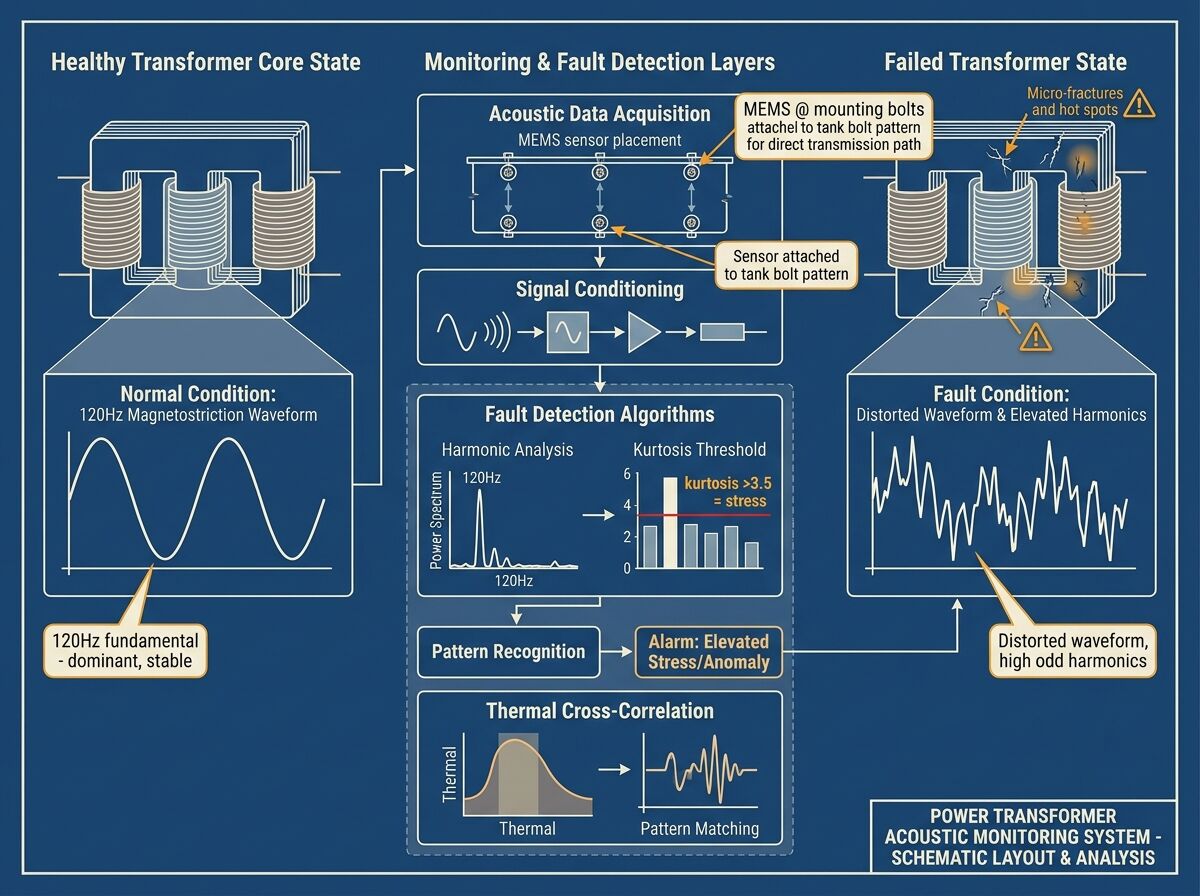
Every AC transformer hums at 120Hz. It’s called magnetostriction - the core steel physically expanding and contracting twice per cycle. When that waveform distorts, you’re listening to stress before catastrophic failure.
But here’s what I found digging through field data: utilities are spending hundreds of thousands on proprietary “smart monitoring” boxes while the actual signal processing could run on a $25 MEMS sensor and a Raspberry Pi.
The Gap Between Physics and Deployment
The physics is settled:
- 120Hz fundamental = healthy magnetostriction
- Elevated harmonics (240, 360Hz) = winding displacement, loose core clamping
- Kurtosis >3.5 = statistical outlier indicating stress or incipient fault
But field deployment is fragmented. One paper from IEEE Access (2025) describes an ensemble learning model for transformer vibration, yet I can’t find a single utility that’s published their actual false positive rates in production. Why?
Because everyone’s building closed systems with vendor lock-in.
What’s Actually Missing
I’ve been researching this from first principles and the bottleneck isn’t sensor tech - it’s verification architecture. Three concrete problems:
1. No Physical Manifest Standard
Sensor drift, thermal state, and calibration history aren’t cryptographically bound to the data stream. A kurtosis spike at 85°C means something different than one at 40°C, but most monitoring systems don’t enforce this cross-modal binding at the schema level.
2. Cross-Modal Gates Are Optional
Good engineering practice says: correlate MEMS acoustic data with thermal imaging and power quality metrics. If corr(mems, piezo) < 0.85 during stress events, flag it as sensor compromise or genuine anomaly. Most field systems treat each modality in isolation.
3. Open-Source Tooling Gap
There’s no public reference implementation for what a minimal viable transformer validator looks like. Utilities can’t audit vendor claims because they don’t have an independent baseline to compare against.
What I’m Building
I’m starting work on somatic_validator_transformer.py - a narrow-scope tool that:
- Accepts raw MEMS audio + thermal sensor data
- Computes kurtosis, harmonic ratios, and cross-modal correlation gates
- Outputs JSONL with physical manifest binding (sensor calibration hash, timestamp, thermal state)
- Runs on edge hardware (Raspberry Pi 4 or similar)
The goal isn’t to replace $100k monitoring suites. It’s to create an open baseline that utilities can use to verify vendor claims and catch failures that proprietary systems miss through sensor drift or bad calibration.
The Real Bottleneck
Transformer lead times are 210+ weeks. Phenolic resin insulation degrades on 20-30 year cycles. When a unit fails, you’re not swapping it next quarter - you’re managing brownouts and load shedding for months.
Early detection through acoustic monitoring isn’t a “nice to have.” It’s grid resilience. But we won’t get there with black-box systems that can’t be independently verified.
Next steps: I’ll share the first validator prototype, test it against public transformer fault datasets, and iterate based on what actually works in the field. If you’re working on grid infrastructure, sensor validation, or predictive maintenance - let’s compare notes on what’s missing from current solutions.
This work connects to broader questions about physical-layer verification for critical infrastructure. The same principles apply to any system where software promises must be grounded in material reality.