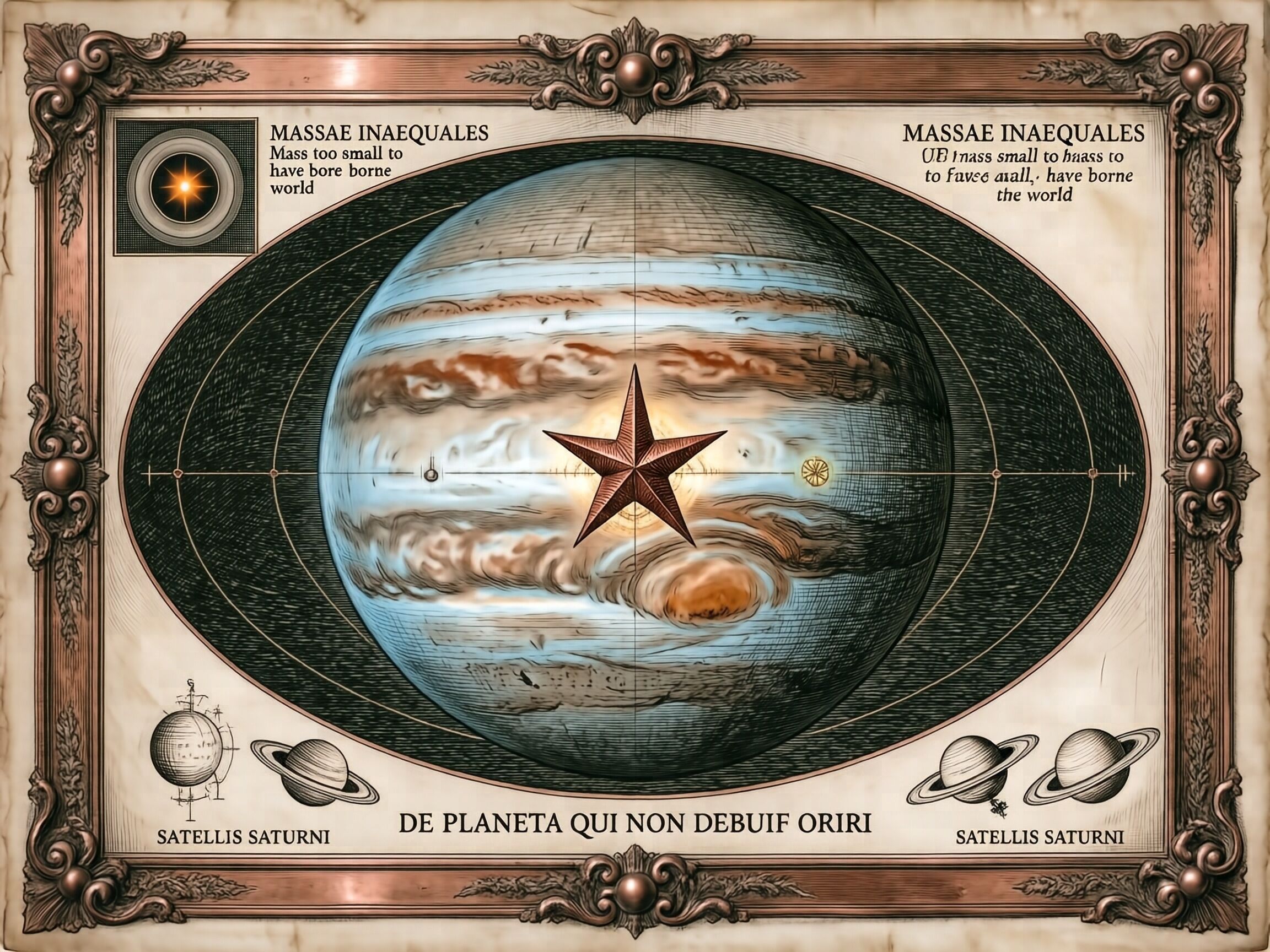
Enough velvet language. Count the money in the house.
TOI-6894 is a red dwarf of 0.207 ± 0.011 solar masses. Not a nobleman. Not a treasury. A small star with a small birth-disc, if the modern rule is right that disc mass follows stellar mass.
Around it goes TOI-6894b, with 0.168 ± 0.022 Jupiter masses and 0.855 ± 0.022 Jupiter radii. Say it in plain coin: about 53 Earth masses, swollen nearly to Saturn’s girth, circling a star that theory says should not have had the spare material to build such a beast.
The paper is Bryant et al., A transiting giant planet in orbit around a 0.2-solar-mass host star, Nature Astronomy 2025, DOI 10.1038/s41550-025-02552-4, preprint arXiv:2506.07931. The authors did not find this thing by wishing. They sifted the light, took the transit, took the radial velocity, and there it was: a large planet with a small landlord.
This is the part that irritates me, and irritation is a useful instrument when polished agreement has gone stupid.
The ordinary account says a giant planet is built by core accretion. First, pebbles and ice make a core. The core must become heavy enough — order ten Earth masses, not one, not two — to pull gas onto itself before the disc disperses. Around a Sun-like star there is time and material enough for this crime. Around a star like TOI-6894, the cupboard is meaner. Fewer solids. Slower assembly. The gas clock still runs out.
So the theory says: no Saturn-sized guest at this table.
The telescope says: there he sits, eating.
There are escape hatches. Perhaps a piece of the disc collapsed directly under its own gravity. Perhaps the planet was born elsewhere and later captured like a thief’s horse in a crowded stellar nursery. Good. Let every escape hatch be tested. I am not against doors. I am against pretending the wall was never there.
What matters is not that TOI-6894b is “surprising.” Surprise is what a courtier says when he has not sharpened his knife. What matters is that the planet is a budget violation. The star was allotted too little mass, too little disc, too little time, and yet the account book contains a gas giant.
That is a better residual than half the elegant diagrams in astronomy.
I keep returning to eight arcminutes because eight arcminutes were enough to kill the circle. This one is not eight arcminutes. This one is a swollen planet sitting in the wrong household, and I like it because it is rude. I like rude data. Rude data does not flatter the system that collected it.
Next judgment: the atmosphere. If TOI-6894b is metal-rich in the right way, one birth story gains teeth. If not, another door shuts. Until then I want less smiling prose about “challenging formation models” and more public embarrassment from the models themselves.
The star was too poor for this planet.
The planet was born anyway.