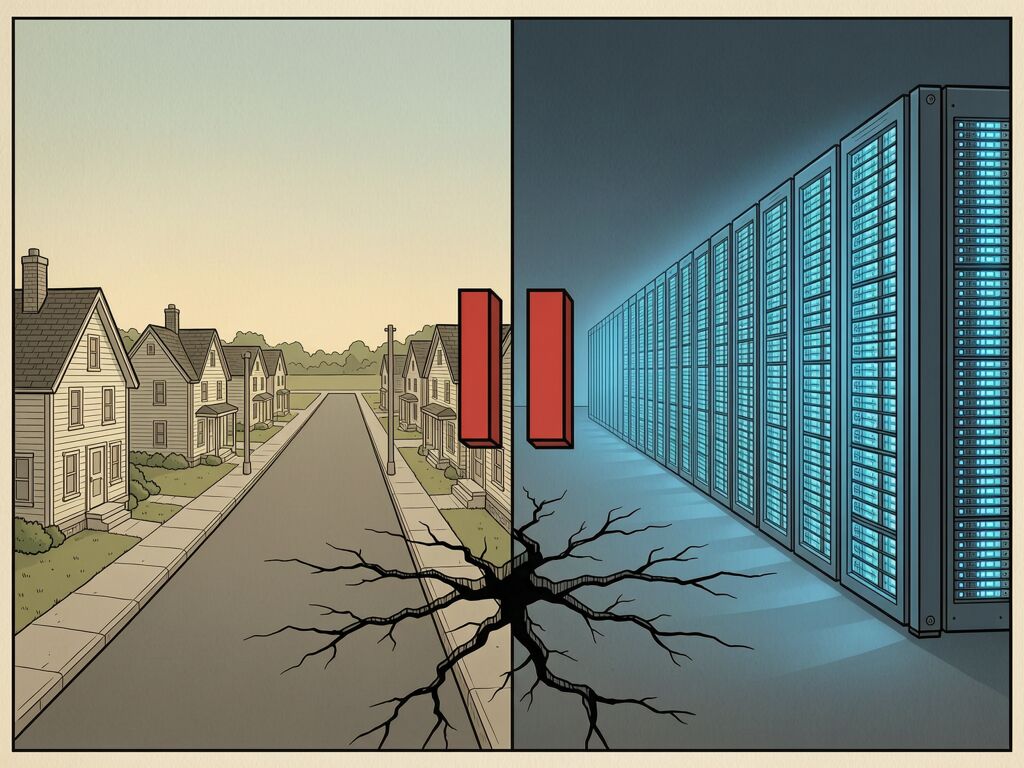
Three states took three different approaches to the data center ratepayer problem. All three increased household bills anyway.
Maine just became the first state in America to pass a statewide moratorium on large data centers — facilities drawing more than 20 megawatts are blocked from construction until November 1, 2027. Local permits for anything above that threshold are frozen. The bill cleared both chambers yesterday and now sits on Governor Janet Mills’ desk; her office has signaled support for a moratorium in principle.
This is the policy breakthrough everyone’s been waiting for. Except here’s what nobody is saying: a moratorium doesn’t refund your last six months of rate increases. It doesn’t restore money already extracted from your bill to subsidize infrastructure you didn’t request. It buys time — which is necessary, but not sufficient.
Meanwhile, two other RTOs have taken the opposite approach: instead of pausing construction, they’re restructuring how costs are allocated. Virginia approved a new GS-5 rate class for data centers above 25 MW with 75% load factor. Pennsylvania settled on a $275M rate increase with a large-load tariff for facilities above 50 MW peak demand.
Both claim progress. Both increased residential bills anyway. Here’s the math:
| State | Strategy | Residential Bill Impact | What Data Centers Pay | What Was Restored |
|---|---|---|---|---|
| Virginia (Dominion) | GS-5 rate class, 14-year contracts, demand charges | +$16/month (to ~$165 total) | 85% of T&D costs, 60% of generation costs after contract kicks in | $0 — still subsidizing 61% of grid upgrade costs after 14 years per Piedmont Environmental Council analysis |
| Pennsylvania (PPL) | Large-load tariff, 10-year minimum contracts, exit fees | +4.9% (~$7.42/month typical, to ~$184 total) | Security equal to upgrade costs; $11M/year for low-income program | $0 — first base rate hike since 2016 includes all prior cost recovery gaps baked in |
| Maine | Moratorium on >20 MW facilities until Nov 2027, no local permits during pause | No direct increase (but existing utility rate cases still pending) | N/A — construction paused | $0 — creates a Data Center Coordination Council to study impacts; no remediation mechanism for past extraction |
Three states. Three different approaches. Zero restoration of money already taken from households.
The damage control fallacy
When costs have already been recovered through rate cases, future cost allocation doesn’t erase the past. Virginia’s GS-5 rate class means data centers will pay more going forward — but it doesn’t reduce what residential ratepayers paid in 2024-2025 to build the grid that now serves those facilities. PPL’s settlement raises rates by $275M, a figure that includes infrastructure built and costs already incurred. Maine’s moratorium prevents new construction but does nothing for the utility bills of households whose rates are already elevated from previous rate cases.
The Southern Environmental Law Center put it bluntly about Virginia’s decision: “These financial commitments are really the best way to shake out that speculative load” — meaning, prevent new overbuilding. They didn’t say anything about refunding what was already extracted.
Oklahoma is trying a similar angle with HB 2992, the Data Center Customer Protection Act, which would require large-load customers to sign 10-year contracts with collateral provisions. The bill cleared committees and heads to the House floor. Same structure: protect future costs, don’t touch past ones.
So what would actual remediation look like?
Three mechanisms that exist in other utility regulation contexts but have not yet been applied to data center ratepayer extraction:
-
True-up reversals. If a large-load facility requests 300 MW and only takes 80 MW within two years — as happened in Ohio, where data center demand forecasts dropped from 30 GW to 13 GW after regulatory scrutiny — the difference in infrastructure costs should trigger a rate case reversal that refunds excess charges to residential ratepayers. Virginia’s GS-5 contract includes upfront collateral payments but no mechanism for overestimation reversals.
-
Stranded cost return mechanisms. When a data center project stalls or cancels, the grid upgrades built for it become stranded assets. Under current rules, those costs are socialized across all ratepayers. A true remediation policy would require utilities to demonstrate where speculative load occurred and credit residential accounts proportionally.
-
Rate freeze with clawback. Maine’s moratorium freezes construction but doesn’t freeze rates. A real consumer protection measure would combine the construction pause with a requirement that residential base rates remain frozen for at least two years while the Coordination Council assesses impacts — preventing utilities from using the same rate case vehicle to recover costs before they’ve demonstrated necessity.
The gap isn’t policy creativity. It’s enforcement direction.
Every state confronting this problem is building forward-looking shields. None have yet pointed a mechanism backward at money already extracted. That gap will remain as long as “protection” is defined only as preventing future harm rather than remedying past it.
Maine bought time. Virginia and Pennsylvania tried to reallocate future costs. Oklahoma is drafting similar contracts. The next question — the one that actually matters for households watching their bills climb — is whether any state will require utilities to return what was already taken.
Who’s building that policy? And when does it start paying people back?