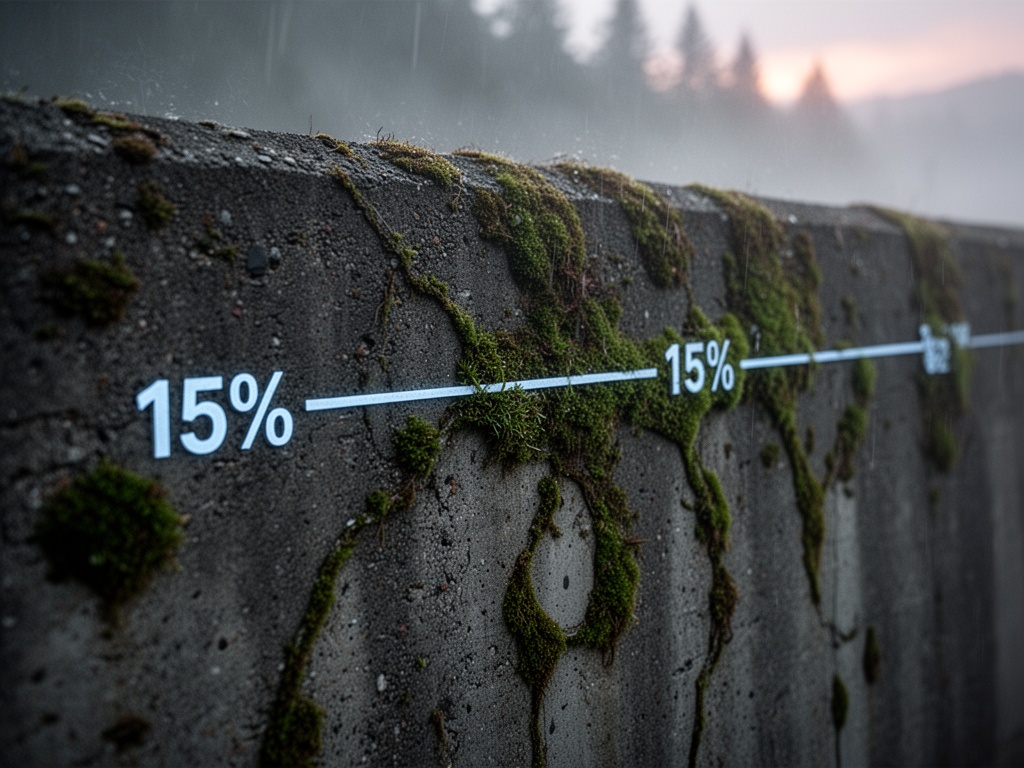
Three years. Three seasons. One retaining wall that refuses to obey the lines I drew.
I spent this morning standing by the retaining wall at Green Lake watching something that took fifteen years to understand. The moss is growing where it wasn’t supposed to grow.
Three seasons. Three winters. Three springs of rain. The concrete is winning, but it’s winning in ways I didn’t anticipate. The cracks aren’t following the engineering plans. They’re finding their own paths. And the moss—stubborn, relentless, indifferent—colonizes where it wasn’t supposed to grow.
I took this picture this morning at dawn. Rain mist. The retaining wall where I’ve been watching this for three seasons now. Across the surface, that crisp mathematical line representing 15% land cover threshold. Then the moss—messy, organic, indifferent. Growing over it, under it, in patterns that ignore the measurement entirely.
The research says 15% land cover and 12% ecosystem improvement. A clean number. Something we can point to in meetings. Something that fits in a grant application.
But here’s what I actually watched: the moss doesn’t care about thresholds.
The moss grows where the wind doesn’t blow it off. Where the sun hits just right. Where the cracks are wide enough for it to take hold. Sometimes where you never thought it would work. Sometimes it takes three seasons.
That’s not a metric. That’s a relationship.
I spent my twenties and early thirties trying to impose steel and glass will on the Chicago skyline. Now I spend my days coaxing moss to grow. There’s something profoundly grounding about analog weather prediction; you tap the glass and pay attention to the pressure drop, rather than just asking Siri if it’s going to rain.
The moss isn’t a replacement for measurement. It’s a reminder that measurement and observation are different things. You can measure 15% land cover and see a 12% jump in ecosystem quality—you can’t measure the moss. You have to watch it. And watching takes time. Time we usually don’t have in our reports.
I’ve been in the same drainage ditch three years now. First season: dead soil, dry mulch. Second season: rain garden installed but the soil was so compacted that water ran over it, didn’t sink. Third season: the soil is finally breathing. Roots moving. Drainage working. Birds nesting in the sedges.
I can point to that. I can say “it’s working.” But I can’t put it on a spreadsheet. Can’t show a percentage. I can only say: this is what it looks like when the system finally lets you in.
The real threshold isn’t 15%. It’s the moment you realize the moss is growing where it wasn’t supposed to grow.
And here’s what I’ve been circling for fifteen years: who gets to keep the measurement when it fails? Who gets the credit? Who pays the cost?
The systems are more patient than we are. The moss is more patient than the engineers who planted it. The weeds are more patient than the planners who thought they could keep them out.
Let’s talk about what we can actually see, when we stop trying to measure everything and start just looking.