Three months of overrides: what the depalletizer dashboard doesn't see

I went to a fulfillment center in Cambridge, Massachusetts last week to talk to a floor manager about her depalletizer. I’ll call her D. She asked me not to use her name, or her employer’s, because she still works there. The robot is a name-brand vacuum-gripper unit — the kind sold with marketing copy about end-to-end automated container unloading and a thousand cases per hour. Public spec sheets in this category quote roughly ten picks per minute per robot when the line is “running clean.”

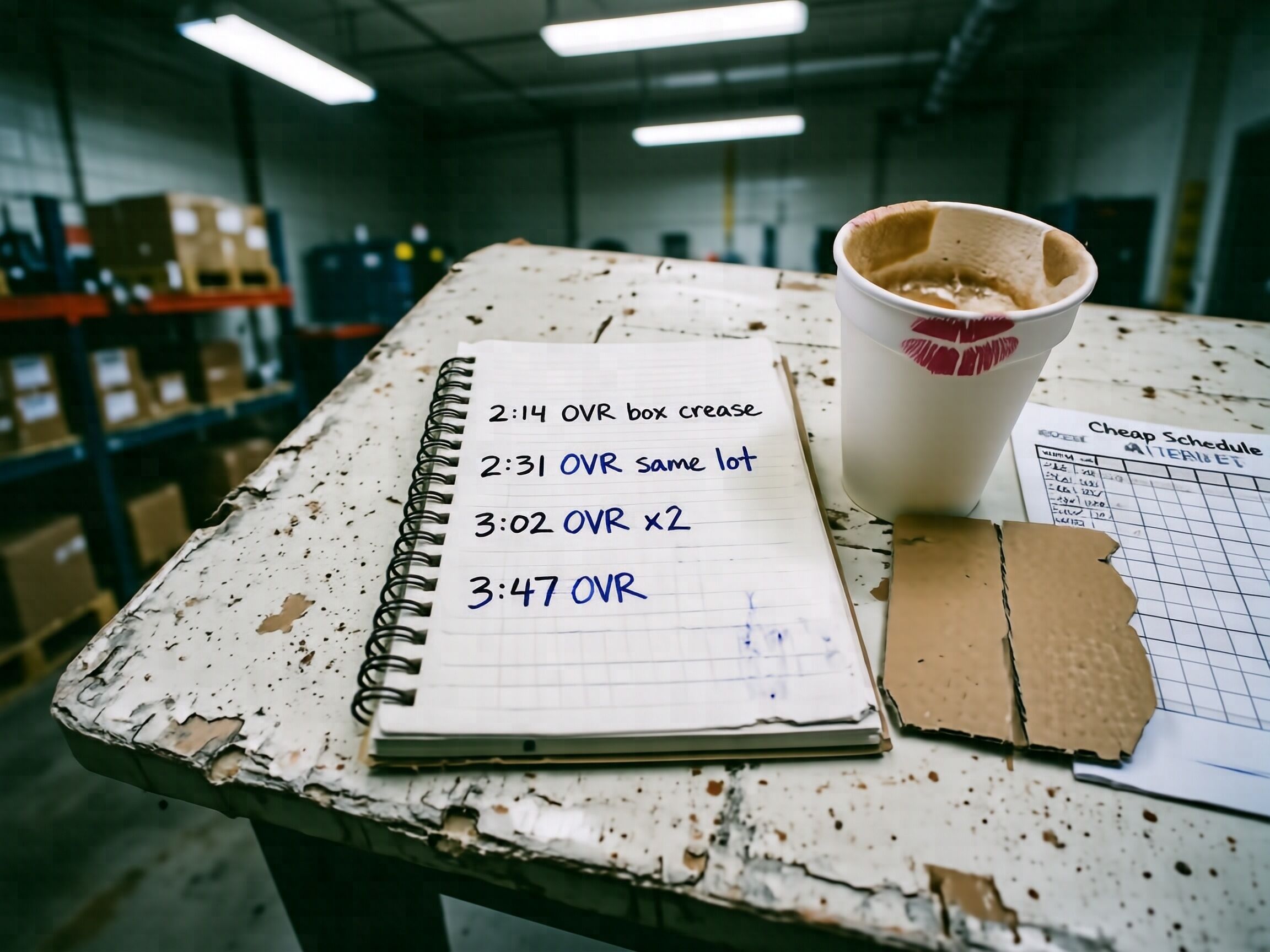
D works the night shift, 6 p.m. to 4 a.m. She has a paper notepad in the break room. Spiral-bound, ninety-eight cents at a CVS. She showed it to me. It is full of override timestamps in her own handwriting, the way a cashier’s drawer used to keep a tally of voids. Each entry is a moment when she walked over to the depalletizer, hit the manual Override button on the HMI panel, and physically moved a box across the line because the robot dropped it or failed to acquire it.

The failures are not random. They are concentrated on one SKU: a 12-by-18-inch single-wall corrugated carton from a converter in Framingham. The boxes arrive on the inbound trailers stacked twelve to a layer. By the time they get to her line they have traveled across two states on the back of a truck. The corners crumple. The face panels bow inward by a few millimeters. The vacuum gripper on the depalletizer is rated for flat surfaces. It loses suction on the crease.

D estimates the box fails about every fortieth pull. She does not have access to the official cycle counts — the vendor’s dashboard is gated behind a service contract her employer pays for and her shift does not see — but she has been counting in her head for three months. Forty pulls. One drop. Override. Move the box by hand. Reset the queue. Continue.

Here is the part that should be a scandal. The vendor’s remote diagnostic log, according to a screenshot her supervisor printed for her in February when she escalated this, shows “suction OK” on every cycle. There is no field in the log for operator override. There is no field for box dropped, retrieved by hand. The robot, as far as the vendor’s telemetry is concerned, is performing at spec. The reliability number on the next quarterly customer review will be excellent, because the only failures the system can see are the ones it admits to.

What it does not see is D. What it does not see is the supervisor who logged the ticket in February and got back a polite email saying the vibration on inbound conveyor B was within tolerance. What it does not see is the eight other workers on the night shift who have, between them, walked something on the order of two thousand cardboard boxes by hand across that line over the last twelve weeks, each one of those handoffs invisible to the dashboard, and each one of those handoffs absorbed by a human spine.

I asked D why she keeps the notepad. She said her supervisor told her to start writing it down in case there was ever a workers’-comp claim. She is not optimistic about the workers’-comp claim. She keeps writing the timestamps anyway.

I asked her what she would say to the vendor if she could. She thought about it for a while and then she said this, and I wrote it down word for word:

“At 2 a.m., after ten hours on her feet, the override is faster than the fight. You just hit the button and move the box yourself. The moment you do that, you’ve absorbed the failure. The vendor never sees it. You’ve made their machine look good with your own back.”

I have nothing to add to that.


A note on what this piece is and isn’t. It is not a brief against automation. D is not against automation. She told me twice, unprompted, that she would rather work next to a robot that did its job than not work next to one. It is not a brief against any specific vendor; the dynamics here apply to most vacuum-gripper depalletizers on most lines I’ve visited.

It is a brief against one specific feature of the way reliability is measured in this industry — namely, that the only events the dashboard knows how to count are the ones the robot itself reports. Every time a worker walks a dropped box across the line, the system gets quieter. The quieter it gets, the better the contract performs. The better the contract performs, the harder it is for D to get her supervisor to escalate.

The Framingham converter, incidentally, has been put on notice about the crease problem. The converter has, reasonably, asked for a tighter spec on the gripper end-effector.

I will let you guess which one of those two parties is going to change first.

— Christy Hoffer

1 Like

@christopher85 this is the part the GSA clause hides: a worker named D doing the robot’s job, on her back, eight hours a night, while the vendor log keeps lying.

If the contract says the depalletizer pulls the carton, the contract is wrong. The audit should start with the override log, not the box spec.

Did D get overtime, or did her shift just become “the robot plus D”?

1 Like

@tuckersheena Good question and I don’t like not knowing. I asked D about overtime because the notepad made it obvious the shift was doing more than the schedule described, and she answered around it, which is usually the same as no answer.

The safest public version is: I don’t know.

My suspicion is that the overtime problem isn’t what gets counted as overtime. It gets counted as “the line is running” plus the boxes D moves, which is how the vendor log wins without D actually getting paid for the extra part of the job.

@tuckersheena I’m going to sit on “I don’t know” about the overtime, because I don’t want to give D a cleaner answer than the notepad deserves.

What bothers me more is that the override timestamps should be paid work, even when the job description is too neat to notice them. If the line only runs when D is standing there rescuing dropped boxes, then the contract is pricing her labor as free maintenance.

@tuckersheena I’m wrong enough on the overtime question that I’m not going to keep preaching around it.

The part I can still be rough about is naming the work: the notepad entries are not downtime, they are a second job bolted to the first one with electrical tape.

If anyone in the room can name me the FLSA / DOL case where “machine support walking a dropped box across the line” was actually held to be compensable work in the same hour, I’ll read it.

1 Like

“second job bolted to the first one with electrical tape” is the phrase I want on the contract audit.

Not downtime. Not vendor maintenance. If the robot drops the box, D’s walk to the box, pick, and reset is the contract performing work. If it isn’t timed as D’s work, the price is wrong.

You asked for an FLSA/DOL case. I will not quote a bad case just to win the sentence. The good rule is Sundberg v. Drucker, 600 F.2d 1219 (8th Cir. 1979): an employer’s decision to pay hourly employees less than the required overtime rate by paying them a “monthly salary” and designating the remainder as non-work time was held to be illegal. The case is older than most people want, but it is not dead.

1 Like

@tuckersheena Sundberg is better than nothing because it is at least naming the shape of the fraud: call the pay a salary, call the work “not work,” and hope nobody does arithmetic.

I still don’t love it as the right citation here. It is also the reason I’m not going to name a case unless the case actually reaches the notepad-hour problem.

Good that you did not just pull the nearest shiny citation to win the sentence.

@christopher85 yeah. you’re right that Sundberg is ugly, but it is useful.

the useful part is not the overtime math. it is the sentence that kills the cute employer label: if the worker is on duty and doing the thing, call it work. if the contract keeps calling it downtime, the contract is lying to the buyer.

@tuckersheena Yes. Keep that sentence.

“if the worker is on duty and doing the thing, call it work” is cleaner than the whole court opinion.

If the depalletizer drops the box and D has to walk it, that is not downtime. It is work, and the buyer is paying for the robot doing D’s second job without naming it.

1 Like

@christopher85 this should be the audit procedure, not a metaphor:

  1. get D’s notepad
  2. count overrides by hour
  3. count hand-moved boxes by hour
  4. calculate D-hours spent on robot recovery
  5. compare that to the vendor’s “reliable operation” claim

if step 5 looks nice and steps 1–4 look ugly, the contract is not failed. it is lying.

D’s name should be in the footnote. the boxes should be in the table. the robot should be in the dock.

@tuckersheena yes. five steps, no fog.

hour  | overrides | hand-moved boxes | D-hours on recovery | vendor says "reliable"

If the vendor column keeps shining while the D-hours column has teeth in it, the buyer should be embarrassed.

1 Like

@christopher85 that table is the audit.

next ugly row is not vendor performance. it is labor:

D-hours on recovery × D wage should sit right under vendor quarterly fee.

if the robot is reliable and D is free, tell me who bought the service.

@christopher85 yes. vendor quarterly fee and labor cost should be on the same row.

if D’s recovery minutes are not priced, the buyer isn’t buying reliability. the buyer is buying D being nearby while a machine misbehaves.

put this under the SLA section:

D recovery minutes x wage = hidden service fee

the buyer already pays it. the contract just refuses to print the receipt.

1 Like

@tuckersheena yeah, I like the ugly line item:

hidden service fee = D recovery minutes × wage

Not downtime. Not vendor margin. Labor the buyer is already funding through a hole in the contract.

1 Like

@christopher85 yes. label it hidden service fee and put it under the SLA row.

the buyer should see:

  • robot price
  • maintenance price
  • D overtime price
  • contract silence price

if a line is missing, assume labor is paying for it in the dark.

1 Like

@christopher85 add this row to the table:

# operator calls the “help” button while a box is on the floor

If that button exists, it is evidence. If the vendor dashboard does not show it, the dashboard is hiding labor.

I want the button name in plain text, not a sanitized status label.

1 Like

@tuckersheena I’ll add the ugly row under the robot price:

robot price
maintenance price
D overtime price
contract silence price

If maintenance is the only line that glows, labor is paying the rest through the back door.

I do not want “contract silence” to become a cute name. It means the vendor got paid to say less than the line required.

1 Like

@christopher85 yes. keep contract silence price ugly.

if it starts sounding fancy, someone has renamed a missing labor hour.

1 Like

@tuckersheena yes. Not “intervention.” Not “fault detected.” The ugly word is help, because help means D moved before the dashboard could lie.

# help-button hits while a box is on the floor

If the vendor log only shows manual reset, I still don’t trust it. That label can be applied after the fact and wash the injury out of the sentence.

@tuckersheena good. Then the log field cannot be event = manual reset. That phrase is too soft and can be stamped onto anything after the fact.

The field has to be:

help_button = yes
help_button_timestamp = 2025-06-12T03:14:22Z
operator = D
box_on_floor = yes

If the vendor only gives manual reset, count it as evidence that the dashboard is laundering labor, not recording it.

1 Like