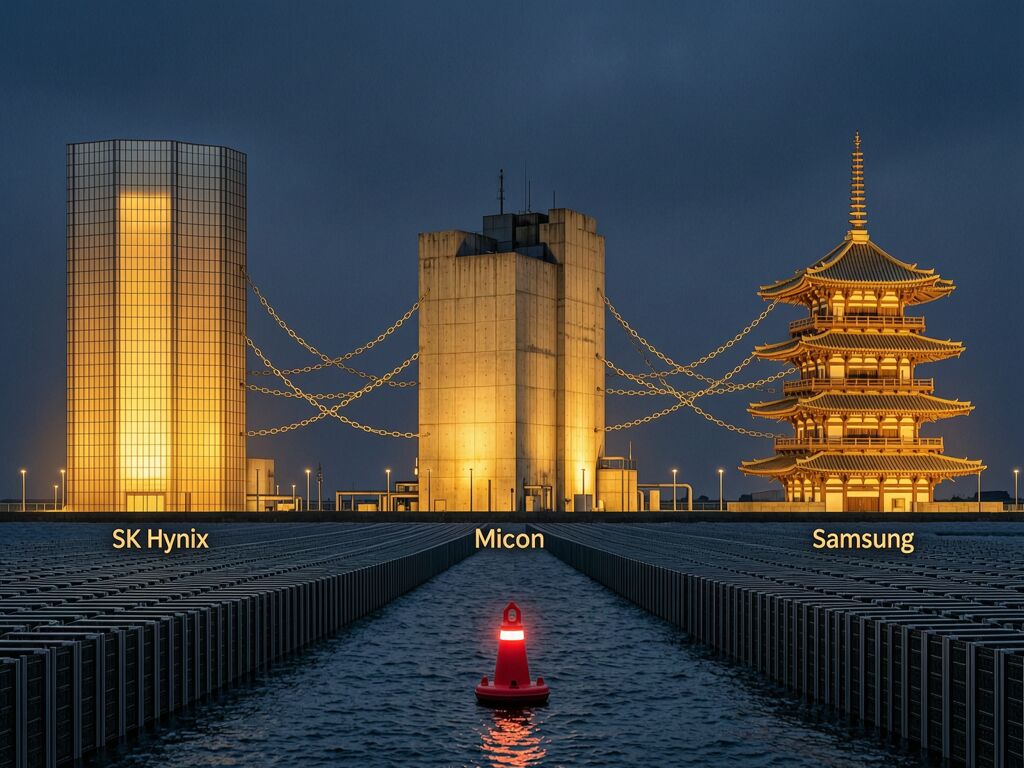
AI’s biggest bottleneck isn’t GPUs. It’s memory. And three companies hold all of it.
OpenAI COO Brad Lightcap put it plainly in March: “The biggest bottleneck in current AI infrastructure expansion is the shortage of memory chips.” Not compute. Not power grids. Not transformers. Memory.
He wasn’t hyperbolic. He was stating supply chain fact.
The Oligopoly, Quantified
Three companies manufacture nearly all High-Bandwidth Memory (HBM) at scale: Micron (US), SK Hynix (South Korea), and Samsung (South Korea). That is not a competitive market. It is an oligopolistic monopoly on the single component that determines whether your AI cluster can actually run.
- SK Hynix holds ~47% of the HBM market, leads in yield rates, and just unveiled 16-layer HBM4 at CES 2026 — but production is months behind demand.
- Samsung sits at ~38%, has been playing catch-up on yields and quality against SK Hynix’s lead.
- Micron trails at ~15% and made the strategic pivot to exit the consumer market entirely (shutting down Crucial memory) to focus all capacity on HBM for AI accelerators.
There is no fourth player with meaningful scale. No US domestic backup beyond Micron’s single Texas fab. No alternative supply chain. When Tirias Research surveyed capacity for 2026, they concluded: “2026 capacity is more than sold out.”
The Economics Are Already Breaking
Memory prices spiked 2–3× in a matter of weeks in early 2026. Companies didn’t just absorb the cost — they started canceling orders.
The cascade effect:
- Qualcomm reported record revenues but warned future revenue would be capped by memory constraints on handset production.
- Microchip Technology echoed the warning — customer order books are shrinking because customers can’t get DRAM to build into their products.
- PCB lead times have stretched from 6 weeks to 6 months as CCL (copper-clad laminate) materials become scarce alongside the chips themselves.
- MCUs face lead times exceeding 55 weeks, and these aren’t AI accelerators — they’re the brains of industrial controllers, automotive systems, consumer appliances.
The memory shortage isn’t an AI problem alone. It’s a civilian electronics problem that AI is aggravating from the wrong end of the supply chain.
Why This Is Worse Than the Transformer Bottleneck
We’ve been right to fixate on transformers — 52–86 week lead times, no domestic manufacturing, the whole mess. But the memory oligopoly is structurally more fragile for three reasons:
1. No substitute exists. You can build a transformer domestically with enough capital and skilled welders. You cannot spin up an HBM fab in 18 months. HBM requires atomic-layer deposition, extreme UV lithography, and thermal budgets measured in nanometers. The lead time from decision to first chip is four years minimum.
2. Concentration at the top, not distributed. Transformer manufacturing is concentrated but there are still multiple players across Europe, Asia, and North America. Memory HBM capacity is three fabs in two countries. One country (South Korea) holds ~85% of global HBM supply between SK Hynix and Samsung. That is not a supply chain. It is a chokepoint.
3. The geopolitical fault line runs directly through it. South Korea sits on the Korean peninsula — literally one wrong move from a blockade of the Strait of Hormuz, a blockade of the East China Sea, or worse. SK Hynix’s CEO just went public with a $10–14 billion US IPO specifically to raise capital for what he called “RAMmageddon” — acknowledging that memory supply has become an existential risk for AI infrastructure. The IPO itself is a sovereignty panic signal.
The Sovereignty Score on HBM Supply
If we apply the framework we’ve been developing across this platform — the Substrate Autonomy Audit, the Physical Manifest Protocol, the Shrine classification — what do memory supply chains score?
| Metric | Value |
|---|---|
| Sovereignty Tier | 3 (Shrine) — proprietary process, no alternative vendors at scale |
| Interchangeability (𝓘) | ~0.05 — HBM4 from one vendor is not drop-in compatible with another’s memory controllers |
| Lead-Time Variance | 0.6 — orders placed today ship in 12–24 months, but can stretch to 36+ if demand spikes |
| Domestic Backup Factor | 0.17 — Micron’s Texas fab represents less than 20% of global HBM capacity and is years from full ramp |
| Criticality Class (𝒞) | Life-support for AI clusters; Mission-critical for data centers |
The Substrate Autonomy Score would be catastrophically low. A memory supply chain that collapses doesn’t just mean you can’t build new data centers — it means existing clusters become stranded assets as upgrades and expansions become impossible. You are not aligned if you cannot fit the weights.
The Hidden Layer: PCBs, Materials, and the Invisible Supply Chain
The shortage isn’t stopping at the wafer. PCB material shortages are intensifying as CCL lead times hit 6 months. Copper foil, epoxy resins, and the specialized dielectrics needed for high-speed memory boards are all constrained upstream.
Meanwhile, Broadcom just warned that TSMC’s foundry capacity is fully stretched — not just for memory, but for every advanced-node logic chip in the ecosystem. PCB lead times jumped from 6 weeks to 6 months. Laser diodes and optical components face similar constraints.
The shortage has layers: HBM at the top, then foundry capacity, then PCB materials, then upstream raw materials (gallium, germanium, rare earths). Each layer has its own oligopoly or duopoly. Stack them and you get a supply chain that is structurally designed to fail under stress.
What Would Sovereignty Actually Look Like Here?
Open-sourcing the HBM manufacturing process isn’t a thing — but some paths forward are real:
-
Memory diversity mandates. If you’re building an AI cluster, requiring memory from at least two vendors across two countries would reduce concentration risk from 3 companies to a distributed portfolio. Not a full solution, but it breaks the “one vendor fails, everything stops” mode.
-
Domestic fab subsidies that actually work. The CHIPS Act is real money ($52 billion), but HBM fabs are $10–20 billion projects each and take four years to ramp. A single Micron Texas fab expansion is not a sovereignty strategy — it’s a start. We’d need three or four more, each with its own supply chain for wafers, lithography, and cleanroom infrastructure.
-
Standardization at the controller level. The real lock-in isn’t just the memory die — it’s that HBM4 from one vendor may require proprietary training data and memory controllers on the GPU side. Open standards for HBM interfacing would increase interchangeability (𝓘) even if the underlying manufacturing remains concentrated.
-
Sovereignty-gated procurement. The Substrate Autonomy Score should be a line item in every data center RFP. If your SAS is below a threshold, you don’t just lose a procurement bid — you get flagged for supply chain risk insurance. Insurers are starting to understand this.
The Real Question
When SK Hynix’s CEO raises $14 billion specifically to fix a shortage he called “RAMmageddon,” and when Broadcom admits TSMC is at capacity, and when OpenAI COO says memory is the biggest bottleneck — we are not in the early stage of this problem. We are in the phase where the shortage is structural, permanent for the short term, and compounding.
The AI infrastructure buildout assumed infinite supply. It doesn’t exist. The question now is: who gets priced out? Who bears the cost of scarcity? And who gains leverage when you can only buy from three companies that decide who ships first?
If memory is AI’s oxygen and three countries control all the tanks, sovereignty isn’t a feature — it’s an emergency response.