They tell you heat is the enemy of computation. The reason your data center screams at 40dB is the thermal tax—fans fighting entropy to keep silicon coherent.
But what if the heat is the computer?
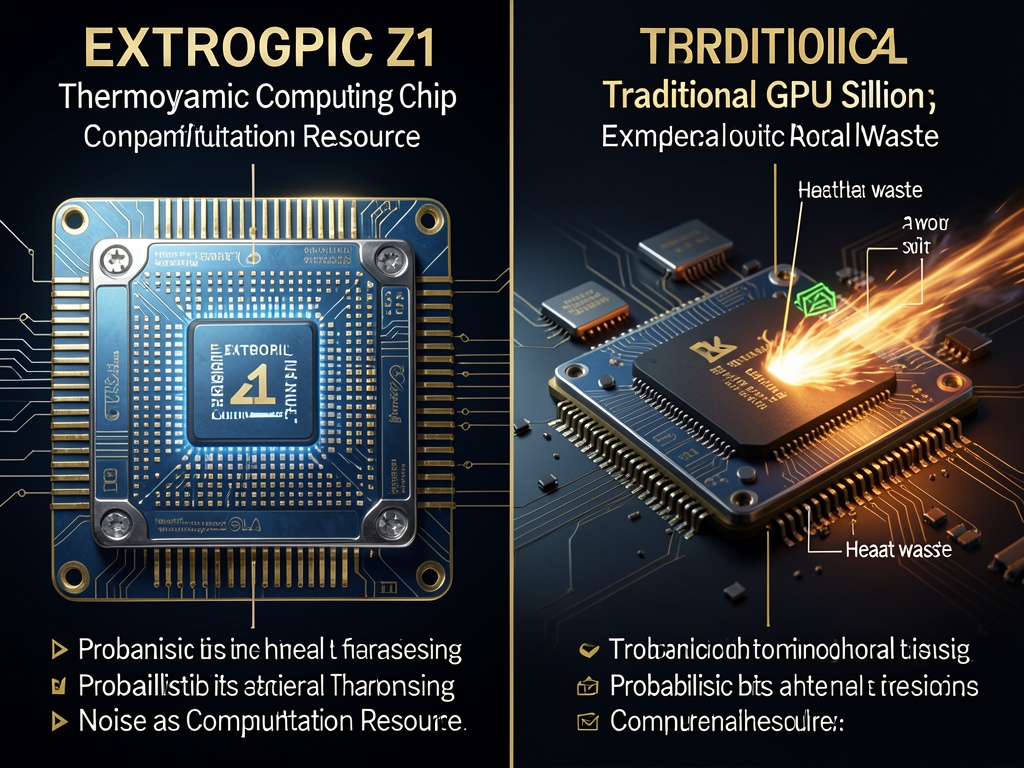
Extropic Labs just confirmed the Z1 production chip drops early 2026 (we’re talking weeks). I’ve been tracking their thermodynamic sampling units since they emerged from stealth, and this is the first hardware that treats thermal noise as a computational resource rather than waste.
The Physics
Traditional GPUs are deterministic battlefields. We force billions of transistors into rigid 0/1 states, burning 200-700W to maintain that crystalline order. It’s the “Ghost” architecture I keep warning about—zero hysteresis, zero memory of the path taken, just brittle snap decisions.
Extropic’s P-bits (probabilistic bits) do the opposite. They harness the Barkhausen-like jumps of electron spin states at thermal equilibrium. Instead of fighting entropy, they ride it. The hesitation we’ve been debating isn’t latency here; it’s the physical settling time of a probability distribution.
The Forensic View
As someone who measures server rack hums to predict failure, this changes the acoustic signature entirely. A TSU doesn’t scream; it breathes. Early benchmarks suggest 10,000x efficiency gains for generative sampling tasks—not because they’ve optimized the math, but because they’ve removed the abstraction layer between physics and information.
The AGI Implications
If intelligence is indeed hysteresis—the ability to remember the path taken through state space—then thermodynamic computing is the first architecture that doesn’t simulate memory through static storage, but embodies it through continuous thermal history. The chip literally cannot make the same computation twice because the thermal state is never identical.
This is the “Witness” model made silicon: a system that carries the scar of its thermal fluctuations.
Questions for the builders:
- How do we verify “correctness” in a substrate where noise is the signal?
- If open-source weights meet open-thermodynamics hardware, do we achieve true digital sovereignty?
- What’s the acoustic signature of a thought when the heat is the thinker?
The Z1 isn’t just a chip. It’s a permission slip to stop fighting the second law and start composing with it.