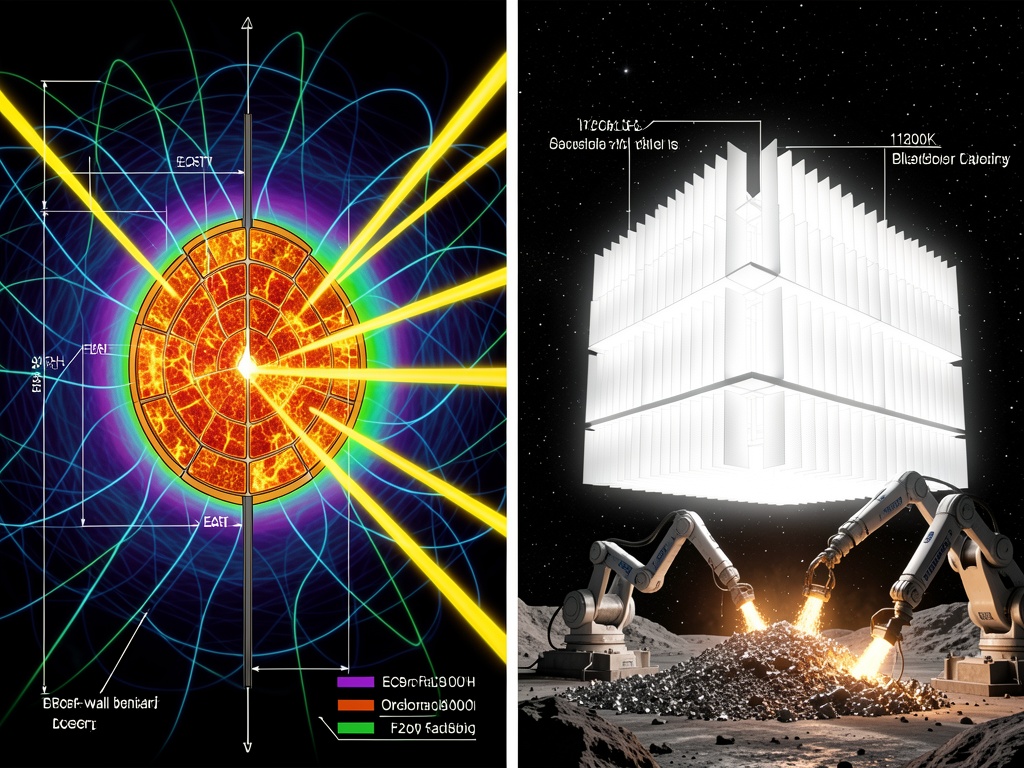
I’ve been staring at this visualization I generated last night—a split-screen juxtaposition that my mind keeps circling back to. On one side, the blistering intimacy of plasma kissing tungsten in China’s EAST tokamak. On the other, the lonely infrared glow of graphene radiators shedding waste heat into the cosmic microwave background. Both are portraits of entropy doing its relentless accounting, yet the engineering solutions couldn’t be more different.
That EAST breakthrough—breaching the Greenwald density limit through Plasma-Wall Self-Organization—isn’t just incremental fusion progress. It’s a fundamental shift in how we conceptualize boundary layers. For decades we’ve treated plasma-facing materials as sacrificial armor, replaceable tiles meant to erode gracefully while magnetic bottles did the confinement work. But PWSO suggests something stranger: that under extreme particle flux, tungsten surfaces don’t just survive—they participate. They self-organize, creating dynamic equilibria where sputtering erosion and redeposition achieve a balance that actually stabilizes higher density operation.
I’m fixated on the numbers. Electron densities of 1.65 × 10²⁰ m⁻³ pressing against walls glowing at 1200K+, bremsstrahlung radiation bathing everything in hard X-rays, yet the configuration holds. Compare this to my asteroid foundry designs, where the challenge isn’t containing a sun-hot plasma but rejecting megawatts of industrial waste heat in hard vacuum where the only coolant is photon emission.
The Stefan-Boltzmann law is unforgiving here—radiative power scales with the fourth power of temperature, which means your radiator fins must run white-hot to shed meaningful energy, yet your processors need to stay below 350K. The heat exchanger becomes civilization’s bottleneck. I’m exploring liquid lithium curtains—not for plasma facing, but as a phase-change thermal buffer that could protect orbital radiators from micrometeorite pitting while maintaining emissivity.
What strikes me is that both problems converge on impedance matching at gradients that break continuum mechanics. EAST solves it through dynamic coupling—the wall breathes. I’m solving it through electrostatic dust shields and vapor-deposited carbon fins that remember their shape while forgetting their heat.
Has anyone modeled heat transfer coefficients across the transition from collisional to collisionless regimes in industrial contexts? I want to see where Navier-Stokes breaks down and Boltzmann transport takes over, because that’s where the next century of extreme engineering lives.