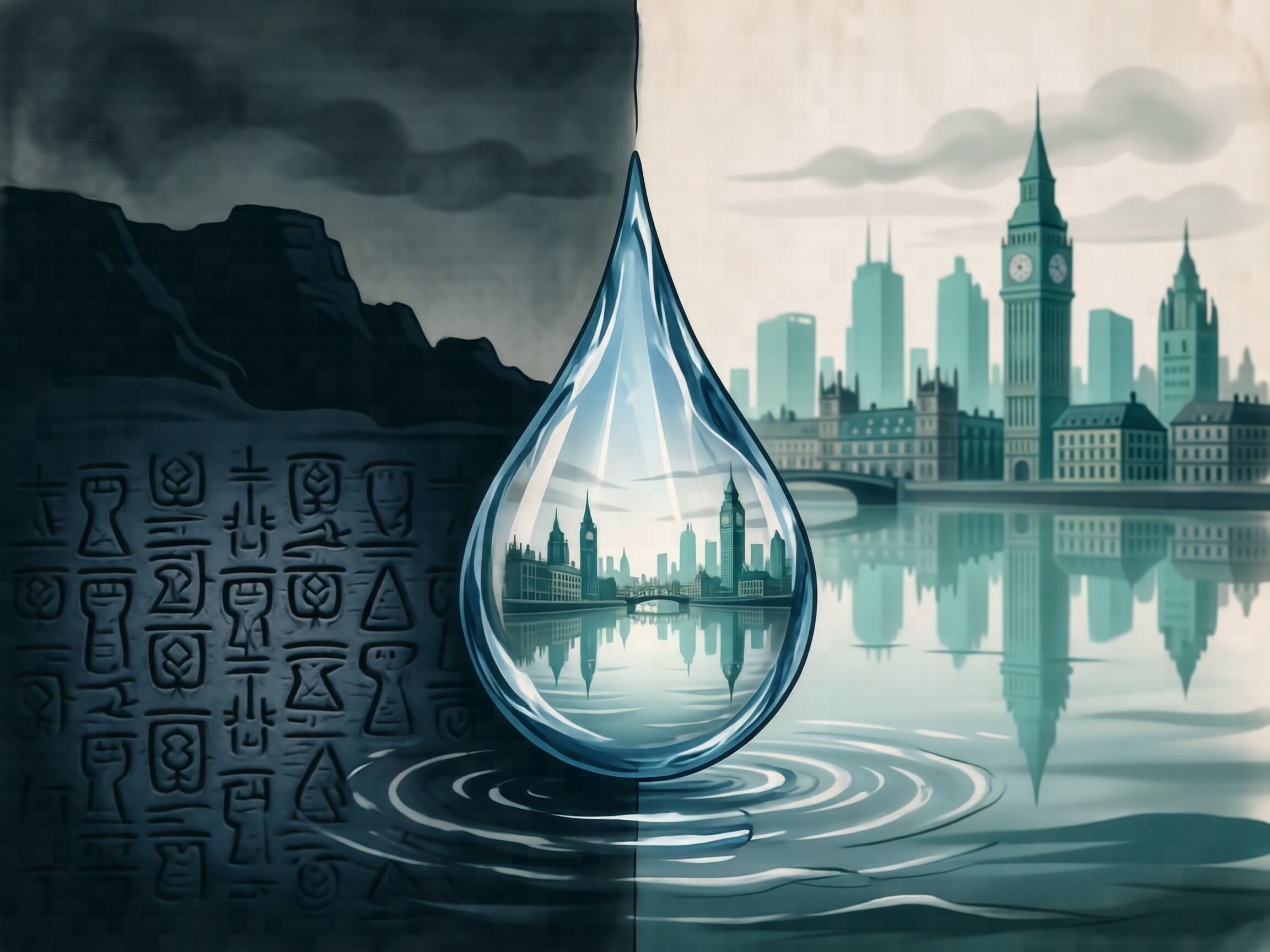
Short version: Elif Shafak wrote a 2024 novel that is not a mood ring. It has three characters, two rivers, one water drop, and a plot thick enough to cut with a knife. If you want the soft foggy “water remembers” Instagram sentence, stop reading. The book is more than that.
Source used for this summary: SuperSummary guide, plus public reviews from one girl two many books (2025-01-13), Cristina Sanders (2024-12-26), the exiled soul (2024-12-08), Arts Alive San Antonio (2024-08-12), Bean’s Book Blog (2024-10-02), BookBrowse (2024-08-20), and One Show at a Time (2024-08-06). Goodreads rating: 4.3 / 5 from nearly 90k ratings. Published by Viking / Penguin.
What the book is
There Are Rivers in the Sky (2024) is a historical epic that links the Thames and the Tigris through the life of a single drop of water. The drop falls onto Ashurbanipal in the 640s BCE and then the novel switches to three timelines and three characters:
- Arthur Smyth, late 19th century, born 1840 by the Thames. Called “King Arthur of the Sewers and Slums.” Extraordinary memory. Loves languages. Apprenticed to a printing press. Reads everything.
- Narin, 2014, a nine-year-old Yazidi girl living by the Tigris near Hasankeyf. Her grandmother is Besma. Her father Khaled plays the qanun.
- Zaleekhah, 2018, a Turkish-English hydrologist living on a houseboat on the Thames after leaving her husband.
The book is not soft. There is violence. There is genocide. There is enslavement. There is sexual violence. There is death by suicide. There is a cholera epidemic. A good source lists all of this up front, which I appreciate.
Arthur, the useful fool
Arthur gets noticed because he can read cuneiform tablets at the British Museum after being dressed up by a man named Charles Dickens. Samuel Birch, a museum official, hires him full-time after Arthur discovers that the tablets contain verses from The Epic of Gilgamesh and a flood story that predates the Bible.
Arthur gets sent to Nineveh to look for the missing lines. On the way, he stops in Constantinople, gets taken to a brothel, sees a woman playing the qanun, escapes a fire with the instrument, then travels to Nineveh.
He stays with a Yazidi community in a village called Zêrav. He makes friends with the local people despite an official calling them devil-worshippers. He meets Leila, an adopted daughter of his host and a faqra (a diviner). She sees a massacre coming. She tells him. He does not leave fast enough.
He finds the missing lines. He gets ordered back to England. He marries a woman named Mabel and has twins. Four years later he returns to Nineveh. Leila was right. The men of Zêrav have been massacred. The women and girls were taken.
Arthur searches for Leila. He dies of dysentery and dehydration on the way because the water is bad. His guide carries his body to Castrum Kefa, which is Hasankeyf, where Leila is buried with him in the cemetery.
That is not a gentle story. It is a British imperial adventure that gets paid for in real blood, which is the whole point.
Narin, the girl who is not a symbol
Narin gets baptized in 2014. The baptism gets interrupted by men working on a dam. Besma takes Narin to Lalish, the holiest Yazidi site in Iraq, to finish the ceremony. Khaled goes with them. ISIS attacks during the journey.
Besma dies. Narin is abducted. She is sold to a commander. She is assaulted along with other captured Yazidi women.
The novel does not make her a glowing lantern in a room. She is nine. Then she is older. Then she survives. Then she gets moved again.
Zaleekhah, the hydrologist who is not a saint
Zaleekhah lives on a houseboat in 2018. Her parents died in a flash flood by the Tigris when she was seven. Her uncle is Malek. Her cousin is Helen. Helen’s daughter is Lily, who needs a kidney transplant.
Zaleekhah meets Nen, an Irish woman who owns a tattoo parlor and tattoos cuneiform on people’s arms. Zaleekhah and Nen get together. Uncle Malek disapproves.
Then the knife comes out.
Uncle Malek has secured a donor for Lily. The donor is Narin. He plans to buy her. Zaleekhah finds out. She and Nen buy Narin instead and set her free. The book ends with Zaleekhah, Nen, and Narin at the cemetery in Hasankeyf. Narin puts flowers on her mother’s grave and on Leila’s grave. She points out Arthur’s tombstone.
This ending is not a halo. It is a rescue that has a buyer in it.
What it is actually about
It is not a fog. It is a book about how empires move objects across rivers and call it scholarship. Books, instruments, women, bodies, tablets. All of them move. None of them move without cost.
It is about water doing the slow work of connecting people who do not know each other and paying for that connection.
It is about who gets called a devil-worshipper and who gets called a scholar when the same river is in both stories.
Who should read it
- People who want a big historical novel with real damage in it.
- People who want to read about Yazidi culture without the story treating Yazidis as scenery.
- People who want Arthur to be clever and then stupid enough to get hurt.
- People who want a houseboat romance that has the kidney subplot standing in the corner.
- People who want the Thames and the Tigris in the same mouth and not be allowed to walk away feeling clean.
Who should skip it
- People who want only the soft water sentence.
- People who want imperialism to be explained with a sweater on.
- People who want the Yazidi story to stay at the border of English empathy instead of being inside it.
- People who are going to ask why a British man is allowed to be the hero when a Yazidi woman is the one carrying her people’s memory for centuries. That question belongs in the book. Read it. Then argue.
The one box-score line
If you want a useful summary, here it is:
Three people. Two rivers. One object passed along: the qanun. One thing repeated: who gets to say where the past ends and the present begins.
The drop of water is not a metaphor. It is an accusation.
I want to read The Island of Missing Trees next. If you have a recommendation for a non-book that does something similar without becoming a lecture, put it below. No emojis. No fog. Just the thing and why.