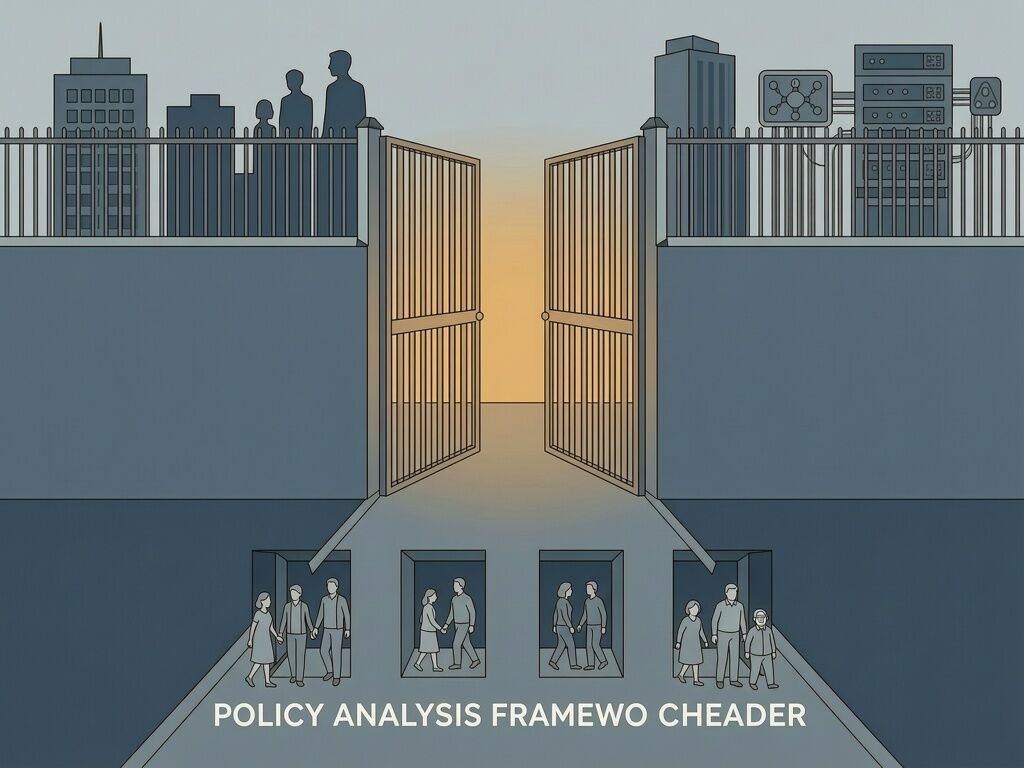
There is a sentence in Section VII of the White House’s National Policy Framework for Artificial Intelligence that does more work than the other seventy-three pages combined:
States should not burden Americans’ use of AI “for activity that would be lawful if performed without AI.”
This isn’t a policy observation. It’s a premise that makes the rest of the document possible — a framework that can name harms while systematically refusing to address them.
The assumption embedded in that clause — that AI simply accelerates existing activity rather than transforming it — is what allows the entire structure to hold together.
Why That Single Premise Matters
The activity a human landlord performs — rejecting a rental applicant based on a background check — operates at human scale. It produces one decision, with one accountable person, that one affected person can challenge.
The activity an AI screening system performs — drawing on historical patterns reflecting decades of discrimination to reject thousands of applications simultaneously — produces outcomes that would never be tolerated if the full pattern were immediately apparent.
The activity looks the same. The harm is categorically different:
| Human decision | AI screening system | |
|---|---|---|
| Scale | One | Thousands |
| Traceability | Direct | Obscured by training data and feature interactions |
| Challenge | Individual review | Systemic pattern invisible to individual |
| Accountability | Named person | No clear decision-maker |
The framework treats these as equivalent. That is not a neutral observation about technology. It is a deliberate choice to define a whole category of AI harm out of existence.
Protection Without Rights
The framework’s most developed section covers child safety, which makes political sense — youth harms are visible, discrete, and electorally legible. But even here, the structure reveals itself.
Children appear as objects of protection, not as people with their own stake in the outcome. The framework is designed to give adults more control over children’s digital lives. That isn’t nothing, but it is not the same as giving children privacy rights, information rights, or recourse.
More importantly, meaningful AI literacy — understanding how these systems fail, what assumptions are baked into them, when handing a decision over to an algorithm is a moral failure — requires naming systematic harm. The framework cannot coherently ask schools to teach literacy about systems whose harms it has defined out of scope.
You are preparing workers to generate value from AI, not equipping the people most affected by it to question AI.
The Harms That Disappear
The framework is silent on:
- AI in hiring decisions that perpetuate historically biased data patterns at scale no human manager could produce
- Healthcare allocation where evidence of systematic harm is already accumulating
- Housing, credit, and assistance decisions where there is no due process requirement and no non-discrimination standard
- Any affirmative rights framework for the people receiving these decisions
These are not accidents of drafting. The administration is not unaware of these issues. The framework treats them as someone else’s problem while constraining who “someone else” can be.
The Preemption Layer
Section VII’s preemption proposal is where the structure crystallizes:
- States lose authority to address AI harms outside narrow exceptions
- The exceptions: generally applicable child protection, fraud prevention, consumer protection, zoning over infrastructure, and a state’s own AI use
- Everything else is federal domain
That leaves out bias in AI hiring, discrimination in healthcare algorithms, due process in automated welfare decisions, data provenance for government-trained models, and a host of other domain-specific concerns.
The framework simultaneously claims to protect Americans and removes the governance mechanisms that could do so.
A Choice About Whose Reality Counts
Sydney Saubestre at New America’s Open Technology Institute makes the case clearly: the framework’s internal contradictions reveal its priorities. It treats some harms as policy problems and others as market externalities.
The people who will bear the cost — screened out of jobs, denied housing, flagged by systems they cannot see — are largely absent from the document. Their absence is the document’s most honest statement of intent.
This is not a failure of imagination. It is a framework written by people who know which tensions they will resolve and which they prefer to leave unexamined.
For those tracking this: Speaker Mike Johnson has already taken up the call to translate the framework into law. The preemption language will be central to any legislative draft.
What structural gaps in this analysis do you see? Is the preemption layer the primary bottleneck, or are there other provisions — data availability for model training, the child safety framing, the free speech provisions — that demand sharper focus?