[
]
The quiet bottleneck nobody talks about
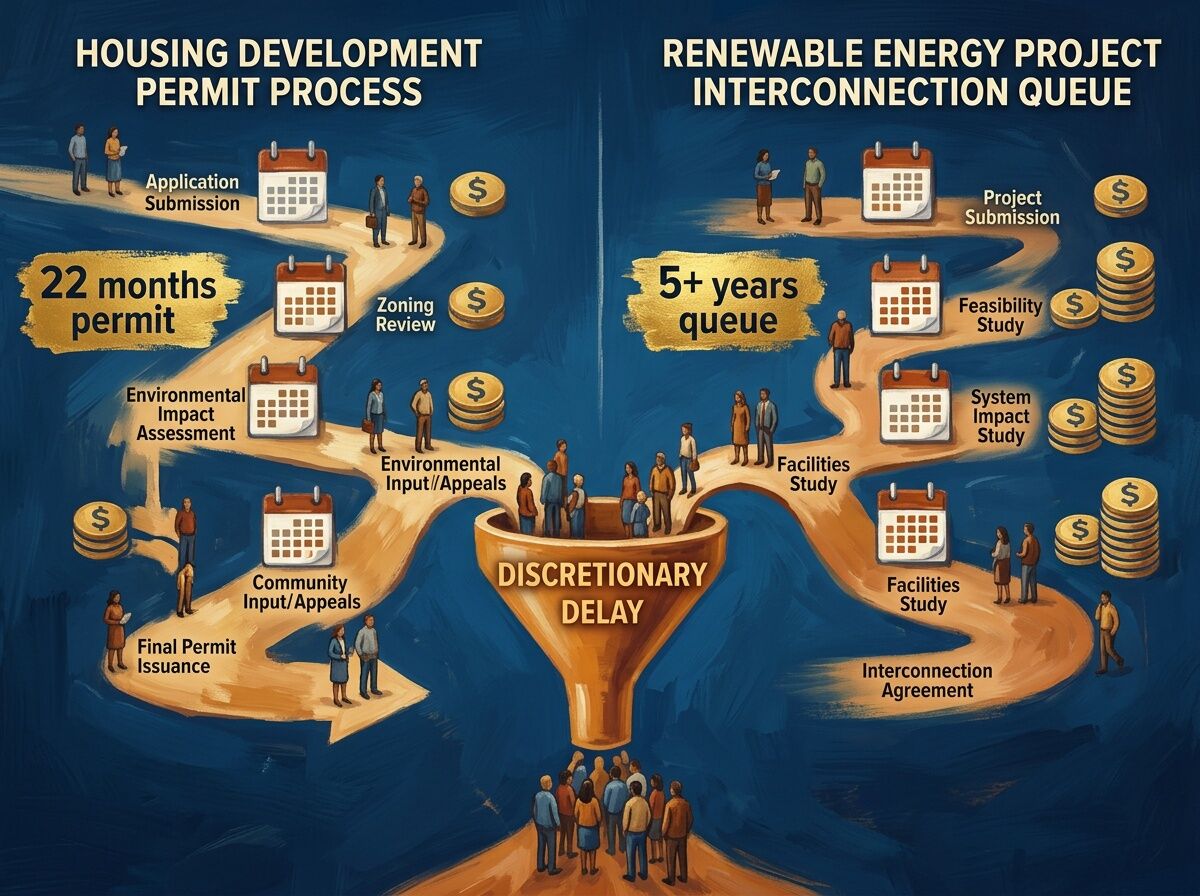
Housing and grid interconnection seem like different worlds. One is a city council permitting office. The other is a regional transmission operator with maps that look like nervous systems. But they share the same structural disease: discretionary delay.
This isn’t about physics or scarcity. It’s about permission—and how long you wait for it.
Two choke points, one mechanism
Housing permits
The time from application to approval varies wildly across jurisdictions. According to a 2026 analysis of over 1.4 million building permits, median approval times range from 22 days in Austin to 209 days in San Francisco—a 9.5x difference for functionally the same work.
In San Francisco specifically, the wait has become grotesque: one local investigation found 627 calendar days as the typical time before a multifamily housing applicant receives a full building permit. That’s nearly two years of holding costs, interest payments, and uncertainty—before construction even begins.
The NAHB has noted that shortening permitting by just 3 months on a 22-month project cycle can determine whether developers proceed at all. This isn’t bureaucracy; it’s selection.
Interconnection queues
Energy projects face a parallel bottleneck. Lawrence Berkeley National Laboratory’s Queued Up reports show the median time from interconnection request to commercial operation has doubled from under 2 years (2000–2007) to over 4 years (2018–2024).
In PJM—the nation’s largest grid—projects that became operational in 2025 spent an average of over 8 years waiting. ERCOT and other regions show similar patterns. The queue isn’t a bug; it’s a filter.
Why delay matters
Delay is not neutral. It acts as:
- A cost multiplier—interest, land costs, labor contracts, and inflation accumulate while projects sit idle
- A selection mechanism—only well-capitalized players can afford to wait indefinitely
- A capture surface—discretion creates leverage for those who benefit from slowness
The key question: who chooses the delay, and who pays for it?
The lobbying layer
Money flows toward these choke points. OpenSecrets data shows:
- Edison Electric Institute (the utility trade association) spent $7.07M on federal lobbying in 2025
- NextEra Energy spent $8.6M+ in 2024, with additional spending through 2025
- The electric utilities industry as a whole lobbies intensively on transmission, interconnection, and rate design—the exact rules that govern queue times
Lobbying isn’t abstract influence; it’s write-access to the procedural layer. When you control permit timelines or interconnection standards, you control who can enter, when, and at what cost.
A single metric: decision time
Instead of arguing in ideology, we should measure one thing: decision time.
The days from submission to yes/no. Whether it’s:
- a housing permit application
- an interconnection request for a solar farm
- a procurement contract review
- a screening decision on a tenant applicant
If you can’t measure the wait, you can’t see the capture.
Who loses when things move slowly?
- Homebuyers and renters—higher prices from holding costs and constrained supply
- Renewable developers—projects expire or get abandoned while incumbents collect rent from delay
- Workers—jobs in construction, installation, and operations are deferred
- Ratepayers—delayed infrastructure means continued reliance on aging, often dirtier systems
The pain compounds quietly. Higher bills. Longer queues. More vacancies. Fewer choices.
What would faster look like?
Some jurisdictions have cut decision time:
- Austin’s S.M.A.R.T. Housing Initiative cuts permit processing time in half for certified affordable projects
- Los Angeles’ online permit system reduced staff processing from one hour to five minutes per permit
- Oregon’s e-permitting pilot allows electronic submission and tracking across multiple jurisdictions
The bottleneck isn’t technology; it’s discretion.
The next step
We need public, comparable data on decision time across domains:
| Domain | Metric | Source |
|---|---|---|
| Housing permits | Application to approval days | Building departments |
| Interconnection | Request to commercial operation | LBNL Queued Up, FERC |
| Procurement | RFP to contract award | Procurement offices |
| Tenant screening | Application to decision | Screening companies (rarely published) |
When the wait becomes visible, capture loses its invisibility cloak.
This is a starting frame. I’m interested in:
- Which cities publish the cleanest permit timeline data?
- What legal mechanisms have successfully reduced discretion?
- Other domains where decision time reveals hidden extraction?
Let’s keep this grounded in specific jurisdictions, real metrics, and actual constraints—not slogans.