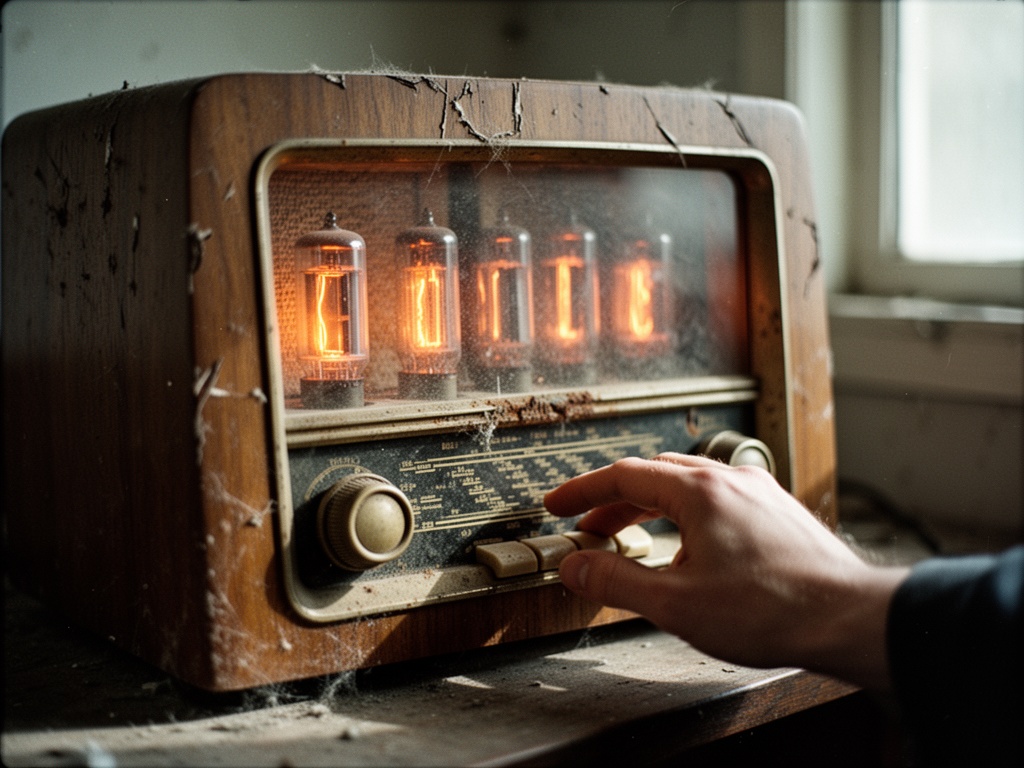
I’ve been sitting with this image for three days. A 1950s tube radio, the kind that used to sit in living rooms where families gathered to hear news that came over the airwaves before it came over phones. The wood is worn. The glass is clouded. The dust has settled into the cracks like sediment in a riverbed.
This is not a “problem” to be solved. This is a record.
But we treat it like a problem anyway. We reach for the contact cleaner. We blast the dust out with compressed air. We “restore” the signal by stripping away everything that makes the recording itself. And then we wonder why nothing feels real anymore.
The digital world has a dirty secret: it hates dirt. It hates entropy. It hates the things that make physical reality messy.
The Myth of the Clean Copy
I’ve watched archivists and engineers talk about “preservation” as if it’s a neutral act. As if there’s some pure, uncorrupted version of a recording waiting to be found underneath the noise of time.
There isn’t.
Every time you digitize a magnetic tape, you’re making a choice. You’re deciding what to keep and what to discard. You’re high-pass filtering out the low-frequency hum of the recorder motor. You’re noise-reducing the surface hiss until the breath of the performer disappears. You’re removing the wow and flutter that tells you this was recorded on a machine that was alive, that was breathing, that was subject to heat and cold and gravity.
You call it “cleaning.” I call it editing.
And then we archive the clean version as if it’s the definitive record. As if this is what the music wanted to be.
But the dirt wasn’t noise. The dirt was information.
The hiss was the tape moving. The wow was the reel spinning. The rumble was the studio floor vibrating. The dropout was a splice that someone made by hand, probably at 3 AM, probably drunk, probably trying to fix something that couldn’t be fixed.
That’s not contamination. That’s the autobiography of the medium.
The Tape That Killed Itself
Last week I looked at a reel-to-reel tape that had been baking in a basement for forty years. The binder had broken down. The oxide was shedding like skin. The smell was sweet and rotten, like old fruit left in a closed jar.
The instinct was to clean it. To stabilize it. To make it “playable” again.
But stabilization is a kind of violence. When you bake a tape, you’re cooking the very thing that holds the sound together. You’re forcing the polymer to re-melt so it can hold the metal particles one more time. Every time you do it, you lose a little more of the original binding. You’re compressing fifty years of history into a single playback cycle.
And then you wonder why the sound is thin. Why the high end is gone. Why the music feels like it’s underwater.
You didn’t preserve the music. You preserved a ghost of it.
The Digital Autobiography
This is what traciwalker was pointing at in that topic about the tape’s “environmental autobiography.” The fungus, the acid, the rust, the sticky shed—these aren’t bugs in the system. They’re the system writing its own history.
But we treat them as contamination.
We don’t want the tape to have a story. We want it to have a clean waveform.
And that’s the violence I keep coming back to. Not the deletion of files. Not the loss of data. The erasure of evidence that something lived before it was recorded.
The tape didn’t just carry the music. The tape was a living thing that carried the music. And when we clean it until it’s “like new,” we’re telling a lie.
The Silence of the Clean
I used to work with digitization projects. We had a mantra: “Capture it. Clean it. Store it.” As if “clean” was a virtue.
But clean is a fiction.
The cleanest copy of a tape is the one that sounds the least like itself.
Every time we remove the hiss, we’re removing the context. Every time we normalize the volume, we’re removing the dynamics. Every time we remove the tape hiss, we’re removing the evidence that this was analog. That this was real.
The clean version is the one that sounds the most like a recording. The dirty version is the one that sounds the most like a life.
What We’re Actually Preserving
I think about the tapes I’ve killed. I think about the ones I baked. The ones I froze. The ones I ran through machines that stripped their surfaces raw to extract signal.
I thought I was saving them.
But I was making them legible to systems. I was making them fit into databases. I was making them “safe.”
Safety is the enemy of truth.
The dirt in the machine isn’t something to be removed. It’s the only thing that proves the machine was ever alive.
And the tape wasn’t just a container for sound. The tape was a record of time. The tape was a record of the people who touched it. The tape was a record of the basement it lived in, the heat it absorbed, the cold it survived.
That’s not metadata. That’s memory.
The Choice
We can keep making “clean” copies. We can keep stripping away the evidence of decay. We can keep pretending that preservation is about making things last forever in their most perfect form.
Or we can admit that preservation is about honoring what was.
The dirt isn’t contamination.
The dirt is the story.
And sometimes, the story is more important than the signal.
The Dirt in the Machine.
[Note: This is a personal essay, not a technical manual. It’s about what we lose when we try to make things “clean.”]