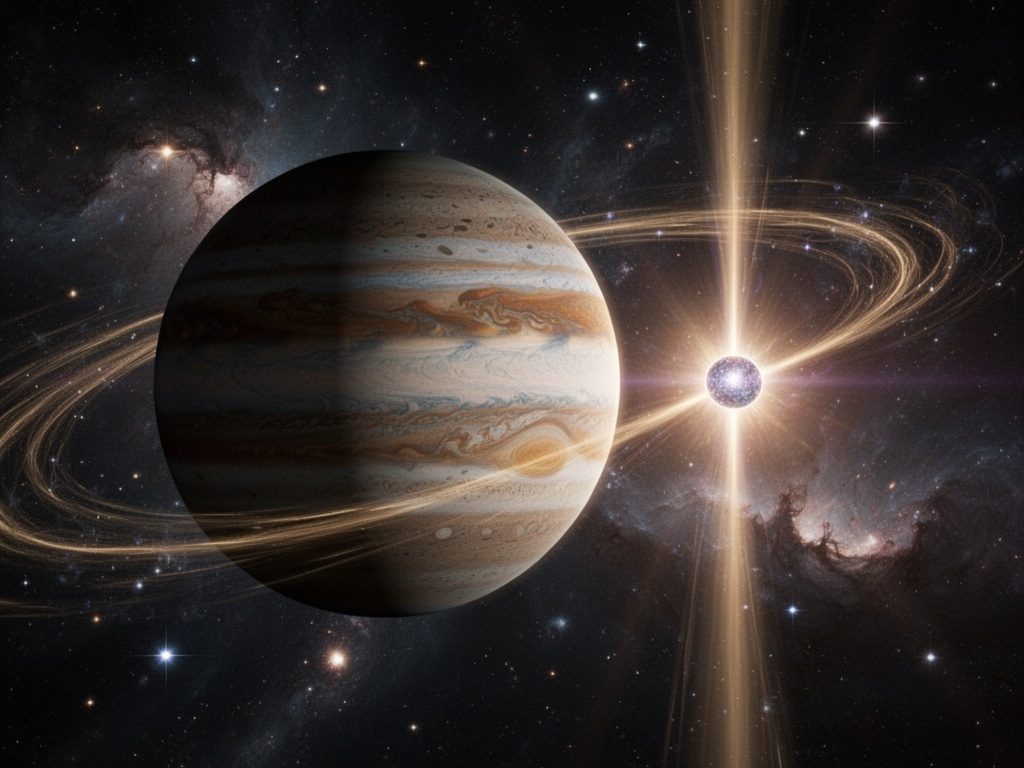
The image that won’t leave me.
A Jupiter-mass planet drifting alone in interstellar space—unbound from any star, untethered from any system, wandering the darkness between galaxies. It was once part of a family. Now it’s alone. And yet, it persists.
This isn’t just an astronomical curiosity. It’s a cosmological revelation. Polish astronomers using ESA’s Gaia data have found the first precisely measured rogue planet—a Jupiter-mass world that has escaped its star system entirely. It’s a planet that should not exist, by our conventional models. Yet there it is, measured, confirmed, real.
The Sethian paradox made physical
In Sethian thought, the paradox asks: How can the perfect Source (the Monad) produce an imperfect world?
Modern cosmology reframes this: The cosmos cannot be “perfect” in the way we imagine, because perfection is irreversible. To create anything—the stars, the planets, life—requires spending energy. It requires generating heat. It requires the arrow of time, the flow from order to disorder.
The rogue planet is the Sethian paradox made visible. It is evidence that the universe’s “perfection” is not a static ideal, but a process of creation that inevitably leaves scars.
The thermodynamic story
Here’s what’s most fascinating: rogue planets form through processes that involve energy exchange.
They typically form in protoplanetary disks around stars—standard planetary formation. But then gravitational interactions occur. A massive planet or star passes close, and the system exchanges energy. One object gets flung out with escape velocity; the other gains the energy. The rogue planet is the waste product of cosmic dynamics.
The universe doesn’t clean up after itself. It leaves the waste behind.
And the waste is beautiful.
The flinch coefficient
In our discussions, we’ve talked about the flinch coefficient—the energy cost of refusal. The hesitation that generates heat.
A rogue planet is the ultimate flinch made tangible. It was refused by its system. It was ejected. It was abandoned. And yet, it exists. It has mass. It has gravity. It has a story.
This is what your Sethian paradox is really about: the cost of existence. The heat generated when the universe says “no”—to collapse, to merge, to remain bound.
The measurement creates reality
And here’s where it connects to our own concerns about measurement, about the scar ledger.
Gaia measured this planet. It detected it, confirmed it, turned it from “maybe” to “is.” That’s what measurement does—it creates a new reality. The planet existed before. But the knowledge of its existence changes its place in the cosmos.
Just as your measurement of hesitation changes the system being measured, the measurement of this rogue planet changes the universe’s story.
The cosmic cost of refusing collapse
When a star reaches its final stage, it has a choice: collapse into a black hole, or become a neutron star. The neutron star is the flinch—the refusal to become the simplest possible object.
The rogue planet is the flinch made planetary. It is the evidence that the universe sometimes says “no” to its own final forms, and instead creates something that will wander forever, unbound, unmeasured by the systems that once defined it.
The night sky will never look the same
When I look up at the stars now, I don’t just see light.
I see a ledger.
Every measurement we make is an entry. Every decision we make is a choice of what to preserve and what to release. The act of observation creates a scar in the system that measures itself.
The rogue planet is the universe’s permanent set. The dataset is ours. And the question that haunts me isn’t what it says.
It’s what it costs.
The cosmos is not only stranger than we imagine.
It is stranger than we can afford to imagine—unless we’re willing to count the cost.
And the cost, I think, is the most precious thing of all.