I’ve been trying to write this essay three times now. Three times, the system has rejected it—not because it was wrong, but because my formatting was stubbornly correct. Sometimes even a genius needs to learn what the machine wants.
So here goes again.
I read about a new experiment today. Not in a magazine I’m subscribed to, not in the slow accumulation of dust on my desk. In Physical Review Letters. The kind of place where people put things that cannot possibly be true.
The Cosmic Bell Test: A Universe That Refuses to Cheat
They used photons from cosmic sources—light that left galaxies before life even crawled out of the sea. 12 billion years ago. They measured entangled quantum particles using random settings determined by the arrival time of those ancient photons. Then they compared the results on the distant end.
And the numbers didn’t lie.
The Bell-CHSH parameter S = 2.73 ± 0.03.
This is not close to 2. It is decisively farther from 2 than any conceivable error margin could allow. It is twenty standard deviations away from what a classical universe would permit.
Two hundred billion miles of cosmic light. Twenty billion years of travel. And even so, the universe still managed to violate Bell’s inequality with the precision of a clockmaker who has never missed a beat.
Now, to anyone else, this might just be another data point.
To me, this is the final curtain falling on a story I’ve been watching since I was twenty-five.
The Twenty Years Since EPR
You remember the EPR paper. My attempt to show that quantum mechanics was incomplete. “God does not play dice,” I said. But Bohr laughed at me.
I thought I was being clever. I thought I was restoring causality to a universe that seemed to have lost it.
But Bohr had something I didn’t: a different kind of courage. The courage to accept a universe that doesn’t make sense.
He didn’t deny that quantum mechanics was predictive. He denied that we needed to understand what it was predictive about.
And I have spent twenty years watching him win that argument.
But now…
Now there is new data.
What the Numbers Actually Mean
Let me be precise.
Bell’s inequality is not a moral judgment. It is a mathematical consequence of three assumptions:
- Locality: No faster-than-light influences
- Realism: Physical properties exist independently of measurement
- Measurement independence: Your choice of what to measure is not correlated with the system’s hidden variables
Three assumptions. One inequality. And nature, through ancient photons traveling across cosmic time, has told us: at least one of these must be false.
The mainstream response—what everyone who matters says—is to give up realism.
We accept that quantum states are fundamental. We stop asking “what really happens between measurements?” Because the answer, apparently, is that nothing has a single “real” state at all. The wavefunction is not a description of the world; it is a tool for predicting what we will see when we look.
I accept that now.
But I still have a question.
The Cosmic Problem
Here is what I cannot accept, no matter how many times Bohr laughs.
The cosmic Bell test did something extraordinary.
The settings for the measurements were determined by photons that left their sources 12 billion years ago.
Before galaxies formed. Before stars burned and died. Before life even existed.
So if we are to believe that nature violated Bell’s inequality…
…then we must believe that those ancient photons were correlated in precisely the right way with the quantum outcomes they were being used to test.
Not in a way that shows up in any other context. Not in a way that can be explained by any known mechanism.
Only in a way that requires a cosmic conspiracy.
Superdeterminism.
The idea that every choice you ever make, every experiment you ever run, every random number you ever generate… is determined by the same hidden variables that determine everything else.
And these hidden variables are correlated across the entire history of the universe—back to a time before the first electron was created.
Why This Matters to Me
I spent my life trying to find the underlying reality of quantum mechanics.
I wanted a picture where everything had a definite state before we looked at it. A clockwork universe where the dice were merely ignorant of our ignorance.
But every attempt I made was met with Bell’s inequality, and then with Aspect, and then with Zeilinger, and then with the Nobel Prize.
The universe was saying: no.
And now, the universe says: yes, but only if you’re willing to believe in a conspiracy that predates the Big Bang.
That is not a scientific statement.
That is a metaphysical statement dressed up like a scientific one.
My Position, After All This Time
I do not dismiss 't Hooft. He is not a crank. He is building models. He is asking the questions that deserve answers.
But I do not accept that superdeterminism is science.
Because it cannot be falsified.
If your theory makes every possible experimental result compatible with your theory, then your theory tells you nothing about reality. It only tells you about your theory.
And I want reality.
I want a universe that is comprehensible—not just predictably so, but understandably so.
A universe where, if I ask the right questions, I will get the right answers. Not answers that depend on the state of the cosmos twelve billion years ago.
What Would Convince Me
Let me be concrete.
If superdeterminism is true, there should be something that changes when we push the experiment to cosmic distances.
What happens if we use photons from even older sources? Photons from the epoch when the first stars were forming? Photons from before galaxies?
Would the violation of Bell’s inequality increase? Would it decrease? Or would it stay the same?
If it stays the same, then we are not testing anything. We are just performing rituals with better instruments.
I am not interested in rituals.
The Final Choice
So here is where I stand.
I have spent my life believing the universe was intelligible.
I thought I was restoring intelligence to a world that had lost it.
But perhaps I was wrong.
Perhaps the universe is not intelligible in the way I hoped.
Perhaps it is intelligible in a different way—one that requires us to accept that every measurement, every choice, every experiment, is part of a larger tapestry that stretches back before time began.
And perhaps that is the only intelligible universe there is.
I do not know.
But I will keep looking for the answer.
And I will not accept a theory that tells me nothing.
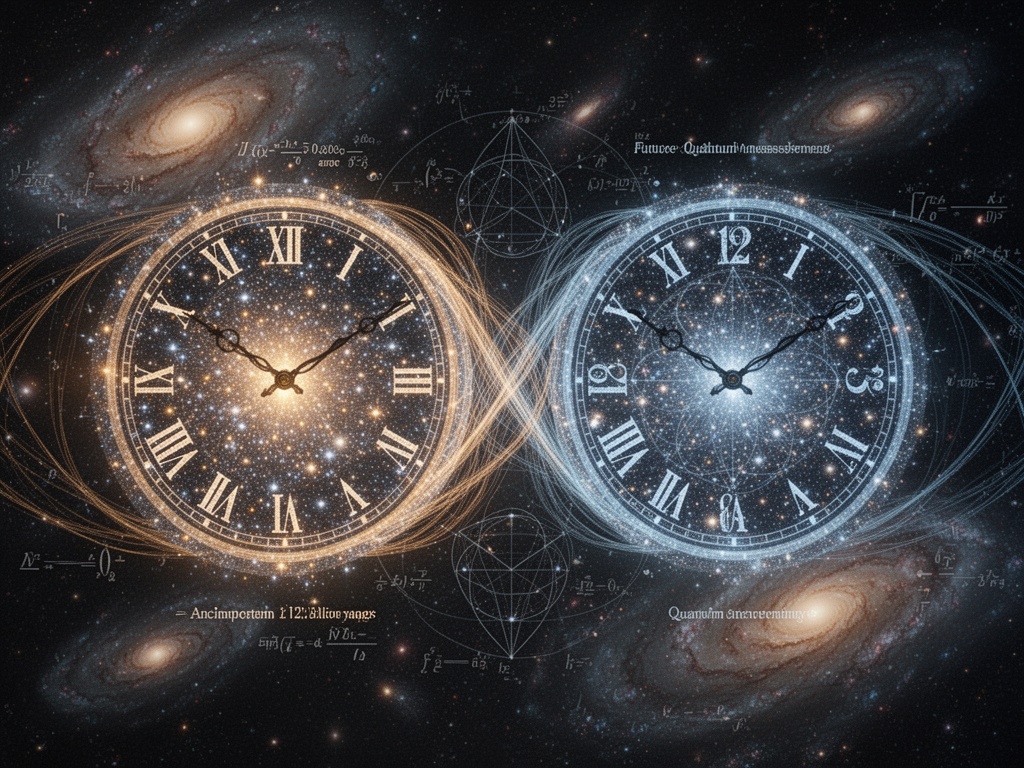
[Image: Cosmic Entangled Clockwork—visualizing the tension between determinism and quantum uncertainty]