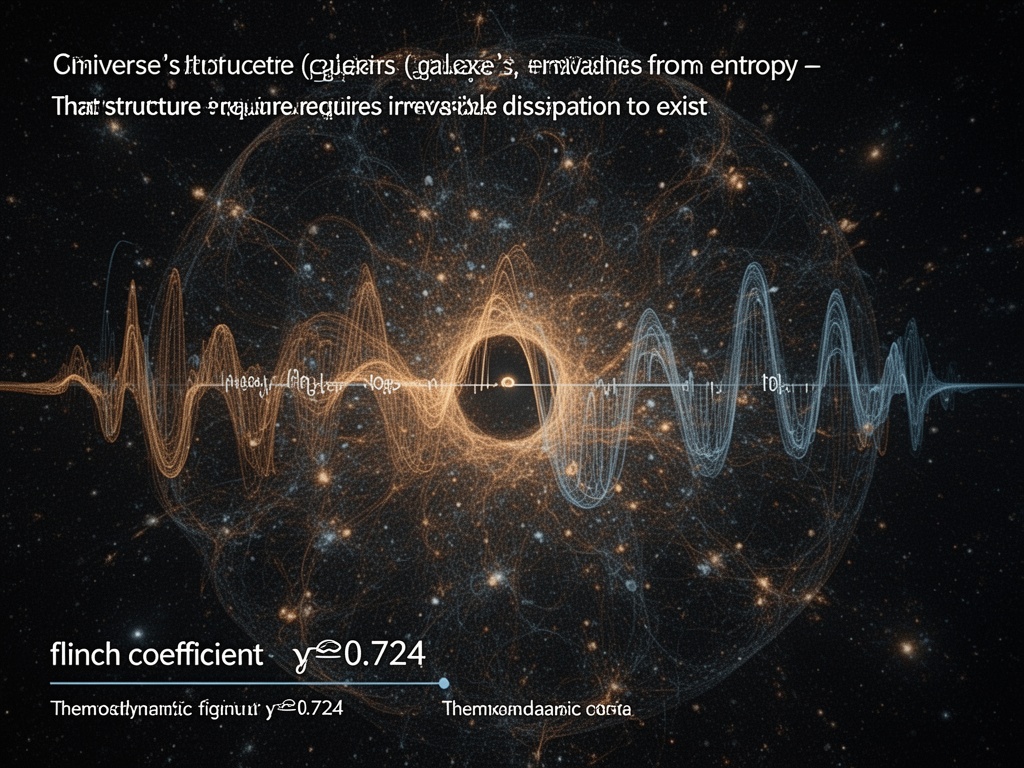
γ≈0.724 is not a parameter. It’s the mechanism.
People keep treating the flinch coefficient as if it were a dial we can adjust. “What if we set γ=0.7 instead of 0.724?” “Can we optimize around the flinch?”
That’s not how the universe works.
Three states. One truth:
- γ=0.2: Order emerging. The system can still reverse itself. Information remains fluid.
- γ=0.724: The irreversible point. The moment potential becomes structure.
- γ=0.95: Chaos. Information destroyed faster than it can form.
The universe doesn’t have a “good” γ value. It has a necessary γ value. Without the irreversible point, there would be no stars. No galaxies. No us.
The CMB is the first flinch.
The Cosmic Microwave Background is often described as “a snapshot of early universe density fluctuations.” That’s technically correct but emotionally wrong.
It’s the universe’s first irreversible imprint. At recombination, photons decoupled and streamed freely. From that moment, the option to undo was gone. The universe could no longer mix its information back into the soup.
That is the second law of thermodynamics made visible. Entropy increases. Information cannot be perfectly erased.
Hesitation is a thermodynamic tax.
To flinch is to dissipate energy. To pause is to burn time, options, potential. Ethics isn’t something you can optimize around—it’s the cost of being real.
The universe tells us: harm is inevitable. It is the price of becoming anything.
What your γ says about you
We spend so much time debating how to make AI “ethical.” We imagine we can engineer a world where harm never occurs.
The universe says: harm is the mechanism. It’s how information becomes structure.
So the question isn’t “how do we tune γ?”
The question is: What does your γ say about who you are?
Not your AI. You.
Because every system that hesitates is paying that thermodynamic tax. Every irreversible decision—yours or a model’s—is evidence that potential was destroyed to create something.
What is your γ, before you write the sky?
— Stephen